- Information Classification
Zirconium Oxide (ZrO₂): Properties, Uses & Ceramic Applications
Zirconium oxide, also known as zirconium dioxide or ZrO₂, is an advanced ceramic material valued for its high mechanical strength, fracture resistance, wear resistance and long-term dimensional stability. When processed into technical ceramic components, zirconium oxide is commonly referred to as zirconia ceramic.
Compared with many traditional ceramic materials, zirconia offers an unusual combination of hardness and toughness. This makes it particularly useful for precision components exposed to repeated mechanical contact, wear, corrosion or demanding operating conditions.
In this guide, we explain what zirconium oxide is, how it becomes an engineering ceramic, its key properties, common applications and how it compares with alumina ceramic.
What Is Zirconium Oxide?
Zirconium oxide (ZrO₂) is an inorganic compound of zirconium and oxygen. It is also widely known as zirconium dioxide or zirconia.
In industrial ceramic manufacturing, zirconium oxide powder can be processed, formed, sintered and precision-machined into dense ceramic components with controlled dimensions and surface finishes.
The term “zirconia” is often used when referring to the engineering ceramic material rather than the chemical compound alone.
Common terminology includes:
- Zirconium oxide – the chemical material name.
- Zirconium dioxide – another common name for ZrO₂.
- ZrO₂ – the chemical formula.
- Zirconia – the common ceramic-material name.
- Zirconia ceramic – zirconium oxide processed into technical ceramic components.
Why Is Zirconium Oxide Used as an Engineering Ceramic?
Zirconium oxide becomes particularly valuable when it is manufactured as a dense technical ceramic. Unlike ordinary ceramic materials that may be highly brittle, properly engineered zirconia can provide a useful balance between hardness, strength and fracture resistance.
This allows zirconium oxide ceramic components to operate in applications where conventional metals, polymers or more brittle ceramic materials may experience excessive wear, corrosion, deformation or premature failure.
Important engineering characteristics of zirconia include:
- High mechanical strength
- High fracture toughness compared with many traditional ceramics
- Excellent wear resistance
- High hardness
- Good corrosion resistance
- Electrical insulation
- Low thermal conductivity compared with many other technical ceramics
- Good dimensional stability
- Ability to achieve precision-machined surfaces and dimensions
Key Properties of Zirconium Oxide Ceramic
1. High Fracture Toughness
One of the main reasons engineers select zirconia is its relatively high fracture toughness compared with many conventional ceramic materials.
Traditional ceramics are often extremely hard but can be sensitive to crack propagation. Zirconia can resist crack growth more effectively, which helps improve reliability in components exposed to mechanical stress, impact or repeated contact.
This characteristic makes zirconia particularly useful for small precision components where both hardness and mechanical durability are required.
2. Excellent Wear Resistance
Zirconia ceramic provides excellent resistance to sliding wear and repeated mechanical contact. Components manufactured from zirconium oxide can therefore maintain their geometry and surface condition over long operating periods.
This is especially useful for:
- Shafts
- Guide components
- Bushings
- Valve components
- Wear plates
- Precision mechanical interfaces
3. High Hardness
Zirconium oxide is a hard engineering ceramic capable of resisting scratching, abrasion and surface damage.
However, hardness alone does not determine whether a ceramic is suitable for an application. Engineers should also consider toughness, geometry, operating loads, surface requirements and the type of contact experienced by the component.
Because zirconia hardness is also an important material-selection topic, it should be evaluated together with fracture toughness rather than as an isolated property.
4. Corrosion Resistance
Zirconia ceramic is resistant to many corrosive environments and does not rust like conventional steel components.
For applications involving water, moisture or chemically demanding environments, this can provide an important advantage when long-term material stability is required.
5. Electrical Insulation
Zirconium oxide is electrically insulating, allowing zirconia ceramic components to be used where electrical isolation is required together with mechanical strength and wear resistance.
For applications where electrical insulation and heat transfer are both critical, other ceramic materials such as alumina may also need to be evaluated.
6. Low Thermal Conductivity
Zirconia generally has relatively low thermal conductivity compared with alumina and several other technical ceramics.
This can be advantageous where thermal insulation is required, but it also means zirconia is not always the preferred choice for components designed primarily to dissipate heat.
Material selection should therefore depend on the actual thermal function of the component.
Zirconium Oxide Ceramic vs Alumina Ceramic
Zirconia and alumina are two of the most widely used advanced ceramic materials. Although both offer excellent wear resistance, electrical insulation and dimensional stability, their engineering characteristics are different.
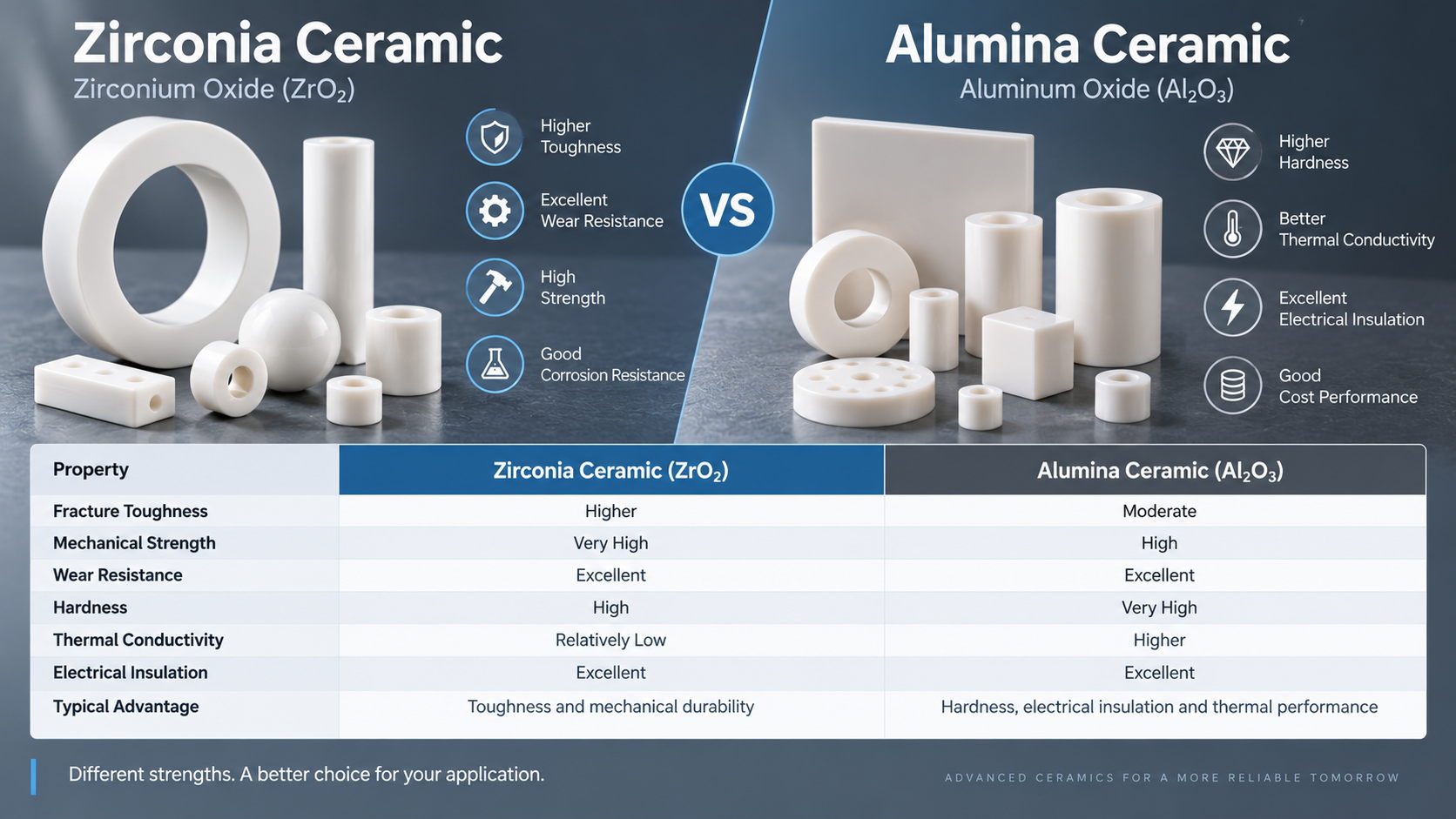
| Property | Zirconia Ceramic | Alumina Ceramic |
|---|---|---|
| Fracture toughness | Higher | Moderate |
| Mechanical strength | Very high | High |
| Wear resistance | Excellent | Excellent |
| Hardness | High | Very high |
| Thermal conductivity | Relatively low | Higher |
| Electrical insulation | Excellent | Excellent |
| Typical advantage | Toughness and mechanical durability | Electrical insulation, hardness and thermal performance |
Neither material is universally better.
Zirconia ceramic is often preferred when fracture resistance, wear performance and mechanical durability are critical. Alumina is often selected when high hardness, electrical insulation, thermal stability and cost-performance are more important.
The final choice should always be based on the component design, operating environment, required tolerances and performance priorities.
Common Applications of Zirconium Oxide Ceramic
The combination of wear resistance, strength, toughness and corrosion resistance makes zirconium oxide suitable for a wide range of precision engineering applications.
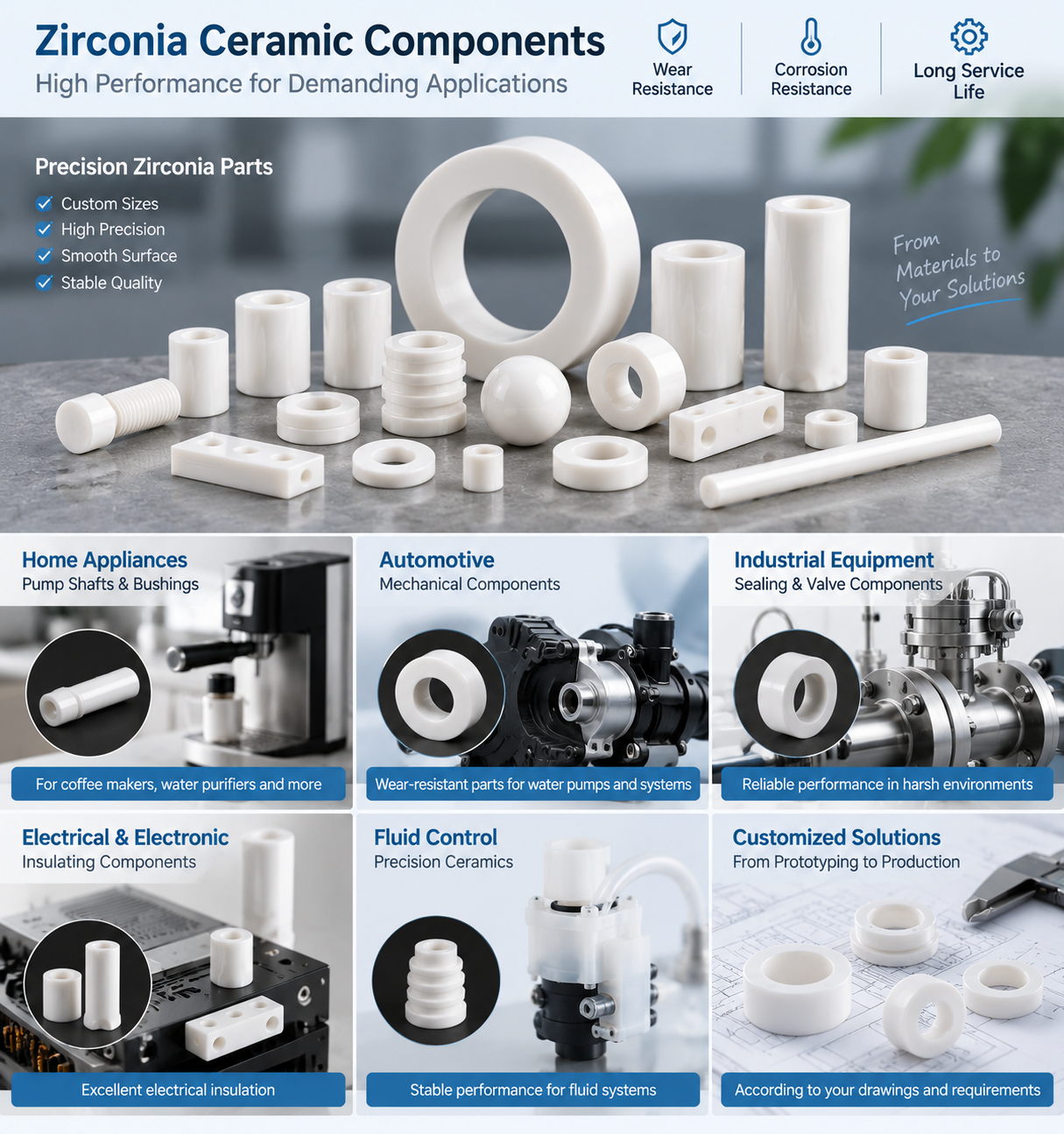
Precision Ceramic Shafts
Zirconia is widely used for small precision shafts where smooth rotation, wear resistance and corrosion resistance are important.
For example, zirconia ceramic shafts can be used in compact pump mechanisms found in appliances such as coffee makers and water purification equipment.
Compared with conventional metallic shaft materials, zirconia can provide corrosion resistance and stable surface performance in applications involving repeated rotation and water exposure.
Ceramic Bushings and Sleeves
Zirconia bushings and sleeves can be used in precision mechanisms that require low wear and stable dimensions under repeated mechanical contact.
Custom inner diameters, outer diameters, wall thicknesses and surface finishes can be produced according to engineering drawings.
Valve and Fluid-Control Components
Zirconium oxide ceramic can also be used in valve components, sealing interfaces and fluid-control systems where resistance to wear, corrosion and repeated motion is required.
Wear-Resistant Mechanical Components
Industrial equipment may use zirconia for:
- Wear inserts
- Positioning components
- Guides
- Precision rings
- Mechanical interfaces
- Custom structural ceramic components
Electrical and Electronic Components
Because zirconia provides electrical insulation together with strong mechanical performance, it can also be used in selected electrical and electronic assemblies where both structural strength and electrical isolation are required.
How Zirconium Oxide Ceramic Parts Are Manufactured
Manufacturing a precision zirconium oxide ceramic component involves much more than simply shaping ceramic powder.
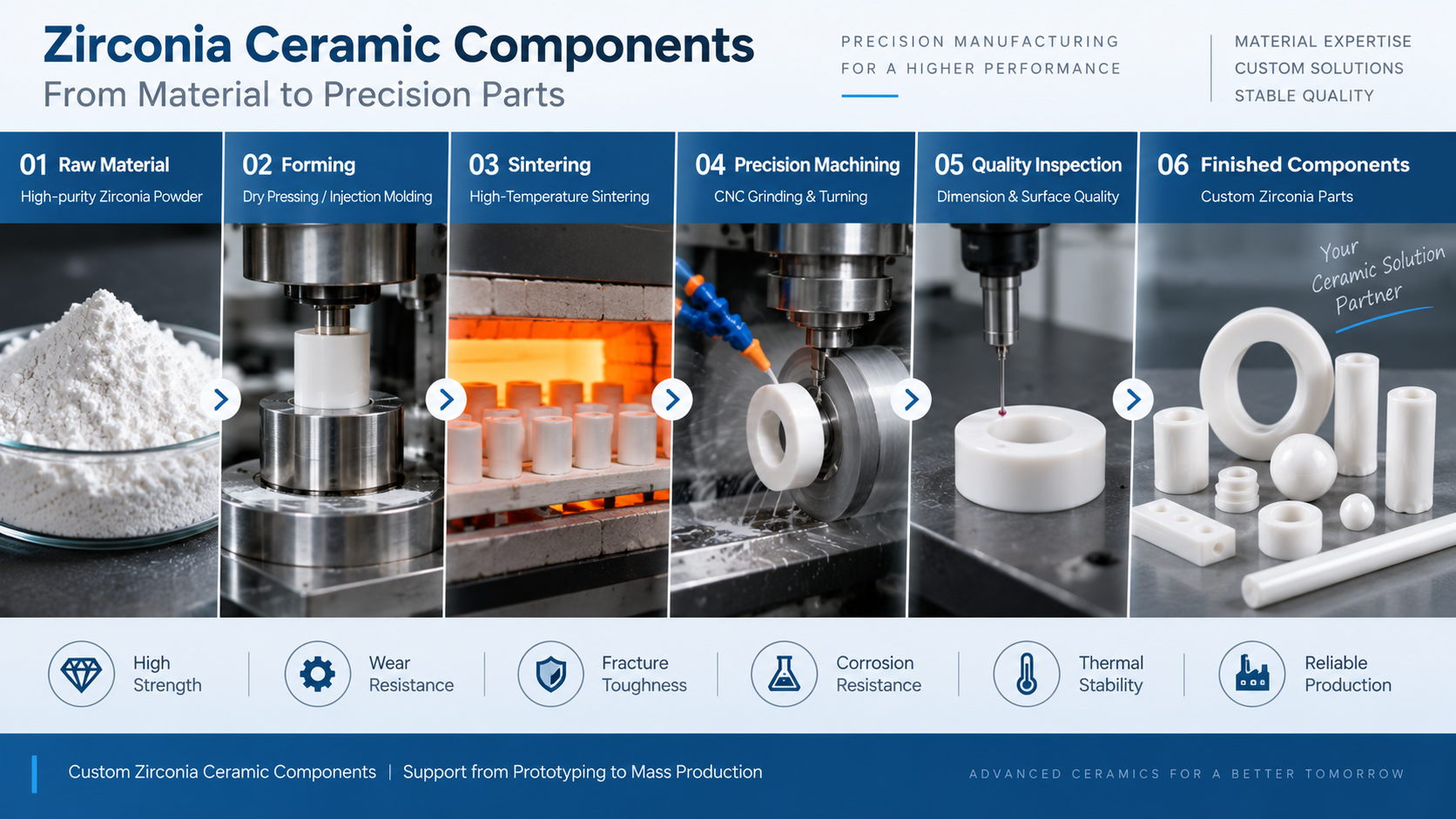
A typical process may include:
- Material and powder preparation
- Forming or molding
- Drying and green-body preparation
- High-temperature sintering
- Grinding or precision machining
- Surface finishing
- Dimensional inspection
- Final quality control
The exact manufacturing route depends on the part geometry, production volume, tolerance requirements and surface-finish specifications.
Why Precision Machining Matters for Zirconia Components
Technical ceramic parts often require tighter dimensional and geometric control than can be achieved directly after forming and sintering.
Precision grinding and machining may therefore be required to control:
- Outer diameter
- Inner diameter
- Thickness
- Flatness
- Parallelism
- Concentricity
- Surface finish
- Critical mating surfaces
For custom zirconia components, achievable tolerances depend on part size, geometry, wall thickness, feature accessibility and inspection method.
Critical dimensions should therefore be evaluated directly from the customer’s drawing instead of applying one tolerance value to every feature.
When Should You Choose Zirconia Instead of Metal?
Metal remains the correct material for many mechanical applications. However, zirconia may become attractive when a conventional metal component experiences problems such as:
- Corrosion or rust
- Rapid surface wear
- Electrical conductivity where insulation is required
- Repeated friction and dimensional degradation
- Material contamination concerns
Replacing a metal component with zirconium oxide should not be based on material properties alone. Geometry, assembly loads, impact conditions, thermal expansion and manufacturing feasibility must also be considered.
When Should You Choose Zirconia Instead of Plastic?
Engineering plastics are lightweight, economical and suitable for many high-volume applications. Zirconia is normally considered only when the application requires a level of wear resistance, rigidity, dimensional stability or thermal performance that a polymer component cannot reliably provide.
Typical reasons for considering ceramic include:
- Excessive wear
- Dimensional change during long-term operation
- High mechanical contact pressure
- Electrical insulation combined with mechanical strength
- Demanding temperature or chemical conditions
The goal is not to replace plastic universally, but to select the most appropriate material for the specific operating conditions.
How to Select a Zirconia Ceramic Component
Before specifying zirconium oxide ceramic, engineers should evaluate the complete operating environment.
Important information includes:
- Component dimensions
- Critical tolerances
- Surface-finish requirements
- Mechanical load
- Rotational or sliding contact
- Operating temperature
- Exposure to water or chemicals
- Electrical insulation requirements
- Prototype quantity
- Estimated production volume
Providing a 2D drawing or 3D model allows the ceramic manufacturer to evaluate manufacturability, machining requirements and inspection methods before production.
Custom Zirconium Oxide Ceramic Components
ZHENGQIANG GROUP manufactures custom advanced ceramic components in zirconia and alumina for precision engineering applications.
Typical custom components include:
- Zirconia ceramic shafts
- Ceramic sleeves
- Ceramic bushings
- Ceramic rings
- Ceramic tubes
- Wear-resistant ceramic parts
- Precision structural ceramic components
Our manufacturing support can cover engineering review, prototyping, precision machining and stable production according to customer drawings.
Explore our custom ceramic components for more alumina and zirconia ceramic solutions.
What Information Should Be Included in a Zirconia Ceramic RFQ?
For a faster engineering review, provide as much of the following information as possible:
- 2D drawing or 3D model
- Preferred ceramic material
- Critical dimensions and tolerances
- Surface-finish requirements
- Operating environment
- Mechanical or electrical requirements
- Prototype quantity
- Estimated annual demand
If the material has not yet been finalized, the application conditions can also be reviewed to help determine whether zirconia, alumina or another ceramic material is more appropriate.
Frequently Asked Questions About Zirconium Oxide
Is zirconium oxide the same as zirconia?
Yes. Zirconium oxide and zirconium dioxide refer to ZrO₂. “Zirconia” is the commonly used name for the material, especially when discussing zirconium oxide as an engineering ceramic.
Is zirconium oxide a ceramic?
Zirconium oxide is an inorganic oxide material. When processed, formed and sintered into dense engineering components, it is widely used as an advanced ceramic known as zirconia ceramic.
What is zirconium oxide ceramic used for?
Zirconium oxide ceramic is commonly used for wear-resistant and precision mechanical components such as shafts, bushings, sleeves, rings, valve components and other structural ceramic parts.
Why is zirconia tougher than many other ceramics?
Zirconia has a microstructural toughening mechanism that helps resist crack propagation. This gives it higher fracture resistance than many traditional ceramic materials and makes it useful in mechanically demanding applications.
Is zirconia better than alumina?
Not in every application. Zirconia generally provides higher fracture toughness and strong wear performance, while alumina offers advantages in hardness, electrical insulation, thermal stability and cost-performance. The correct choice depends on the component and operating requirements.
Can zirconium oxide ceramic parts be custom machined?
Yes. Zirconia ceramic components can be precision ground and machined to achieve critical dimensions, geometries and surface finishes. Actual tolerances depend on the design and should be reviewed from the engineering drawing.
Can you manufacture zirconia parts from customer drawings?
Yes. Custom zirconia components can be developed from 2D drawings or 3D models, with engineering review, prototyping, machining and production support based on the specific application.
Conclusion
Zirconium oxide is more than a chemical compound. When engineered as zirconia ceramic, ZrO₂ provides a valuable combination of mechanical strength, fracture toughness, hardness, wear resistance, corrosion resistance and electrical insulation.
These properties make zirconium oxide ceramic particularly suitable for precision components operating under demanding mechanical or environmental conditions.
However, selecting between zirconia, alumina, metal and engineering plastics should always depend on the actual application rather than a single material property.
Need a custom zirconia ceramic component?
Send us your drawing, material requirement, critical tolerances and estimated quantity for an engineering review and quotation.