- Information Classification
Ceramic Shaft vs Stainless Steel Shaft for Small Pumps
Ceramic Shaft vs Stainless Steel Shaft: Which Is Better for Small Pumps?
Choosing the right shaft material can directly affect the wear resistance, corrosion performance,
rotational stability and service consistency of a small pump.
For coffee makers, water purifiers, compact appliance pumps and other small fluid-handling systems,
two common options are ceramic shafts and stainless steel shafts.
Neither material is automatically better in every application. The right choice depends on the
operating environment, load, mating components, dimensional requirements and cost target.
This guide compares ceramic shaft vs stainless steel shaft from an engineering
and procurement perspective, with a focus on small pump applications.
Ceramic Shaft vs Stainless Steel Shaft: Quick Comparison
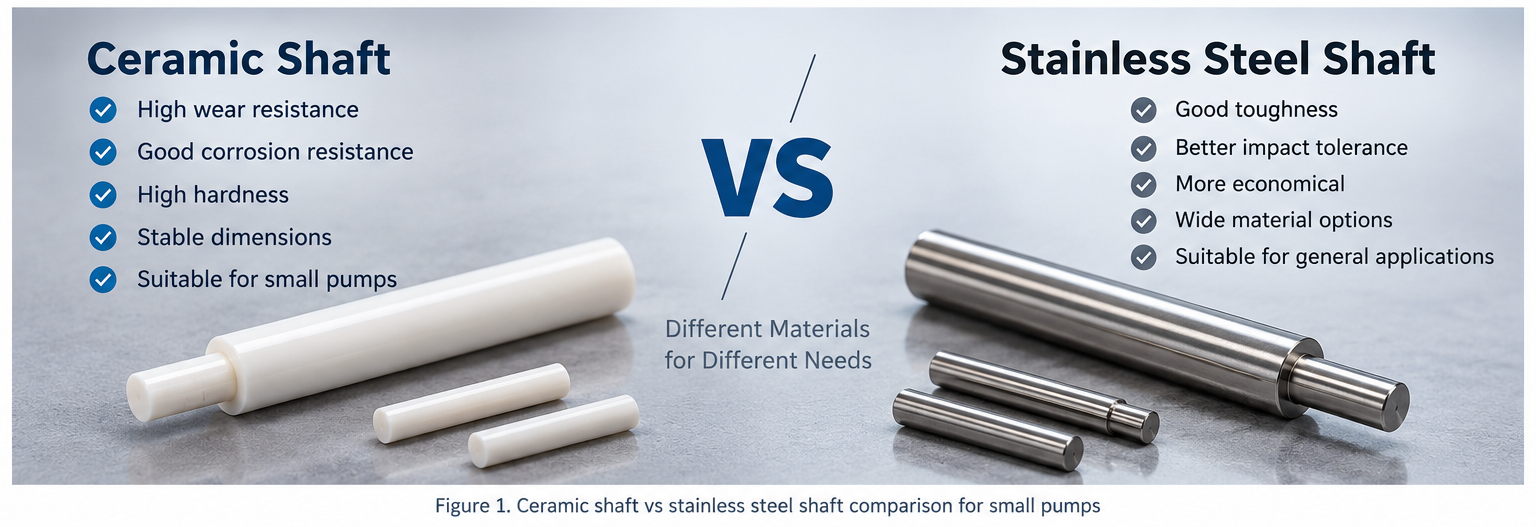
| Factor | Ceramic Shaft | Stainless Steel Shaft |
|---|---|---|
| Wear Resistance | Excellent for repeated sliding and rotating contact | Good, but surface wear may become important in long-term operation |
| Corrosion Resistance | Very good in many water and moisture-related environments | Good, depending on stainless steel grade and fluid conditions |
| Hardness | High | Lower than technical ceramics |
| Impact Tolerance | Requires careful design and assembly due to ceramic brittleness | Generally better for shock and impact loading |
| Dimensional Stability | Suitable for precision rotating components | Good, depending on load and operating conditions |
| Cost | Usually higher processing cost | Usually more economical for conventional applications |
1. Wear Resistance
Wear is one of the most important considerations for a small pump shaft because the shaft may operate
continuously against bearings, bushings, seals or other mating components.
Technical ceramics such as zirconia have high hardness and good wear resistance. This can make a
ceramic pump shaft attractive in applications where repeated friction gradually changes
the surface condition of a metallic shaft.
Stainless steel also performs well in many pump systems, but its long-term wear behavior depends on
the steel grade, surface finish, lubrication, load and mating material.
For high-cycle small pumps where wear consistency is a priority, zirconia ceramic may provide an advantage.
2. Corrosion and Water Exposure
Coffee makers, water purifiers and compact water pumps operate in environments where shafts may be
repeatedly exposed to water, moisture and cleaning conditions.
Stainless steel is widely used because of its corrosion resistance, but performance still depends on
the selected grade and the actual fluid environment.
Zirconia ceramic does not rely on a metallic corrosion-resistant surface in the same way.
This makes a zirconia ceramic shaft useful for many water-contact and moisture-related applications.
However, material selection should still consider the complete system rather than only the shaft.
Seals, bearings, bushings and fluid chemistry may all affect long-term reliability.
3. Hardness and Surface Stability
High hardness is one of the main reasons engineers consider ceramic shafts for compact rotating systems.
A hard shaft surface can help reduce wear during repeated rotation and sliding contact.
For small pumps with tight clearances, maintaining the shaft surface condition can help support
consistent rotational performance.
Zirconia also combines high hardness with comparatively high fracture toughness among technical ceramics,
which is one reason it is often considered for precision ceramic shaft applications.
4. Impact and Brittleness: Where Stainless Steel Has an Advantage
Ceramic is not automatically the better material.
One important limitation is brittleness. A ceramic shaft can be sensitive to improper assembly,
impact loading, excessive bending stress or poor mating-part alignment.
Stainless steel is generally more forgiving in systems where:
- Impact or shock loading may occur
- Assembly alignment is difficult to control
- The shaft may experience significant bending load
- Cost is the main priority
- Wear and corrosion requirements are moderate
This is why replacing a stainless steel shaft with ceramic should not be treated as a simple
one-to-one material substitution.
5. Shaft, Bearing and Bushing Matching Matters
A shaft does not work independently. Its performance depends heavily on the components around it.
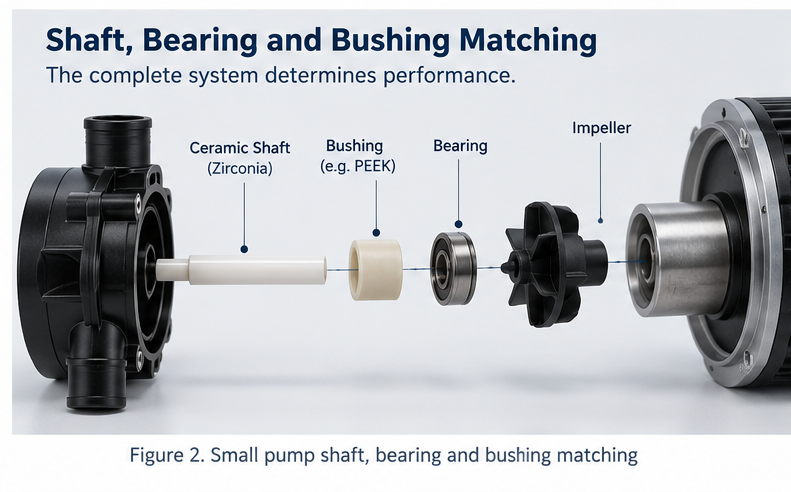
When evaluating a pump shaft material, engineers should also consider:
- Bearing or bushing material
- Surface finish
- Running clearance
- Radial load
- Rotational speed
- Fluid environment
- Temperature
- Assembly method
A high-performance ceramic shaft can still fail if the mating system is poorly designed.
For this reason, drawing review should include both the ceramic shaft geometry and the critical
mating interfaces whenever possible.
6. When Should You Choose a Zirconia Ceramic Shaft?
A zirconia shaft may be worth evaluating when the application requires several of the following:
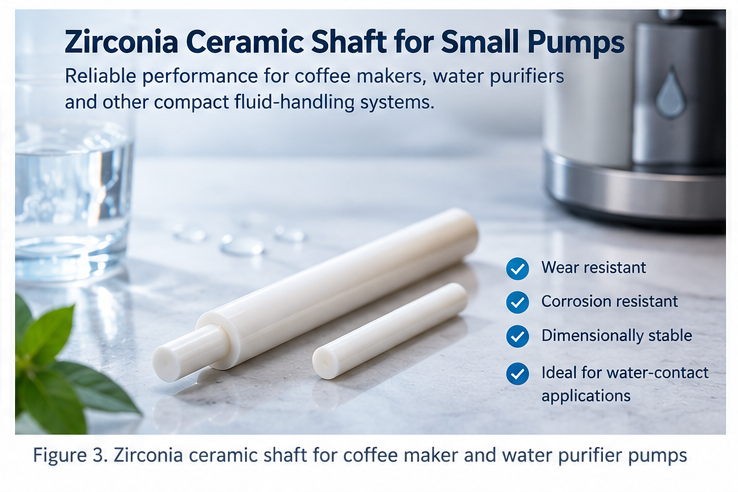
- High wear resistance
- Repeated rotating or sliding contact
- Water or moisture exposure
- Corrosion resistance
- Stable shaft dimensions
- Long-term rotational consistency
- Small precision shaft geometry
Typical applications can include:
- Coffee maker pumps
- Water purifier pumps
- Small appliance pumps
- Compact fluid-handling systems
- Other precision rotating components
7. When Is Stainless Steel Still the Better Choice?
Stainless steel remains a practical choice when the application has moderate wear requirements
and prioritizes cost, impact tolerance or manufacturing simplicity.
It may also be preferable when:
- The shaft experiences frequent shock loading
- Assembly tolerances are difficult to control
- The operating environment is not highly corrosive
- The expected operating cycle is relatively low
- The project is highly cost-sensitive
In these situations, switching to ceramic may add cost without delivering a meaningful system-level benefit.
8. Prototype Testing Before Material Conversion
If an existing pump uses a stainless steel shaft and you are considering a ceramic replacement,
prototype validation is important.
The evaluation should consider:
- Shaft dimensions and geometry
- Bearing and bushing compatibility
- Surface requirements
- Assembly method
- Rotational stability
- Wear after repeated operation
- Fluid and temperature conditions
The goal is not simply to determine whether ceramic is stronger or harder.
The goal is to confirm whether the complete pump system performs better with the new shaft material.
Ceramic Shaft vs Stainless Steel Shaft: Which Should You Choose?
For conventional applications where cost, toughness and easy manufacturing are the main priorities,
stainless steel remains a strong option.
For small pumps requiring high wear resistance, corrosion resistance and stable precision rotation,
a zirconia ceramic shaft can be worth evaluating.
The final decision should be based on the complete operating system, including shaft geometry,
mating components, fluid conditions and expected service requirements.
Need Help Evaluating a Custom Ceramic Shaft?
Zhengqiang provides drawing-based ODM development for custom zirconia ceramic shafts used in coffee makers,
water purifiers, small pumps and other precision rotating applications.
Our engineering team can review your drawing, material requirements, critical dimensions
and estimated quantity before prototype evaluation.
Related Product:
Zirconia Ceramic Shaft for Coffee Makers & Water Purifiers