- Information Classification
Ceramic Part Drawing Checklist: 10 RFQ Details
“`html
A clear ceramic part drawing checklist helps engineers and purchasing teams prepare a more complete request for quotation (RFQ). For custom alumina (Al₂O₃) and zirconia (ZrO₂) ceramic components, the drawing should communicate not only the part’s shape and dimensions but also the functional requirements that affect material selection, assembly and manufacturing feasibility.
Before requesting an ODM quotation, review the following ceramic part drawing checklist to reduce missing information, avoid unnecessary clarification and give the supplier a better understanding of the application.
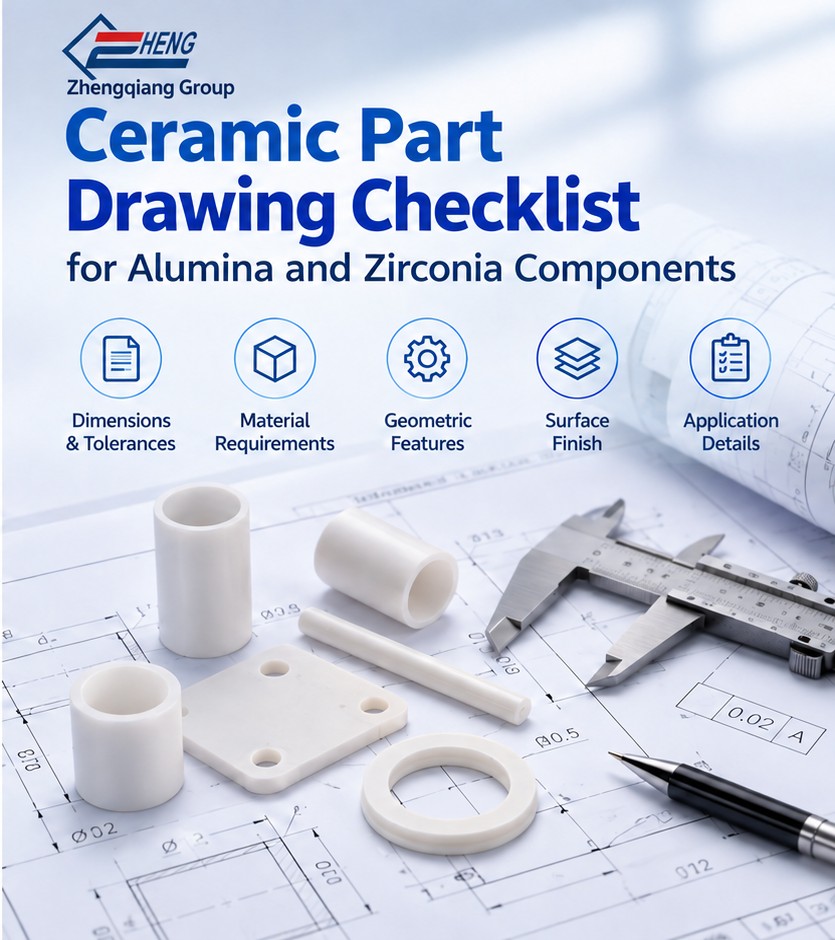
Why Is a Ceramic Part Drawing Checklist Important?
Technical ceramic components are often designed for a specific assembly and working environment. The same material can be used in very different products, so a drawing should communicate more than the basic shape of the part.
For example, an alumina ceramic plate used in an EV water pump may depend on thickness, flatness, electrical insulation and contact conditions. A zirconia ceramic shaft used in a coffee maker, water purifier or small appliance pump may depend more heavily on diameter, alignment, mating components and operating loads.
A complete drawing therefore gives the supplier a better basis for reviewing material suitability, dimensional requirements, powder-pressing feasibility and quality expectations.
1. Confirm the Component Application
Start by explaining where the ceramic component will be installed and what function it needs to perform.
Useful application information includes:
- Equipment or assembly using the ceramic component
- Primary function of the part
- Electrical insulation requirements, where applicable
- Wear or friction conditions
- Whether the component rotates, slides or remains stationary
- Contact with metal, plastic or other ceramic components
- Exposure to water, coolant or other fluids
Application information helps identify which dimensions and material characteristics are most important to the finished component.
2. Specify Alumina or Zirconia Ceramic
Zhengqiang focuses on two technical ceramic material families:
- Alumina Ceramic (Al₂O₃)
- Zirconia Ceramic (ZrO₂)
If the material has already been specified by your engineering team, include it clearly in the drawing or RFQ.
If the exact material has not yet been selected, provide the required operating conditions and performance expectations instead of choosing a material based only on a general property.
Information that can support material evaluation includes:
- Electrical insulation requirements
- Wear conditions
- Mechanical loading
- Operating temperature
- Exposure to water or other fluids
- Customer-specific material requirements
Explore our custom alumina and zirconia ceramic components for additional application examples.
3. Provide a Complete 2D Engineering Drawing
A dimensioned 2D engineering drawing is one of the most important documents for a custom ceramic RFQ.
If a 3D model is available, it can be provided as supplementary information to clarify component geometry, but the 2D drawing should still identify the critical dimensions and requirements used for inspection.
Check that the drawing includes:
- Overall length, width and height
- Outer and inner diameters where applicable
- Wall thickness
- Hole and slot dimensions
- Grooves, steps, chamfers and radi