- Information Classification
Alumina Ceramic Plate for EV Water Pumps | Design Guide
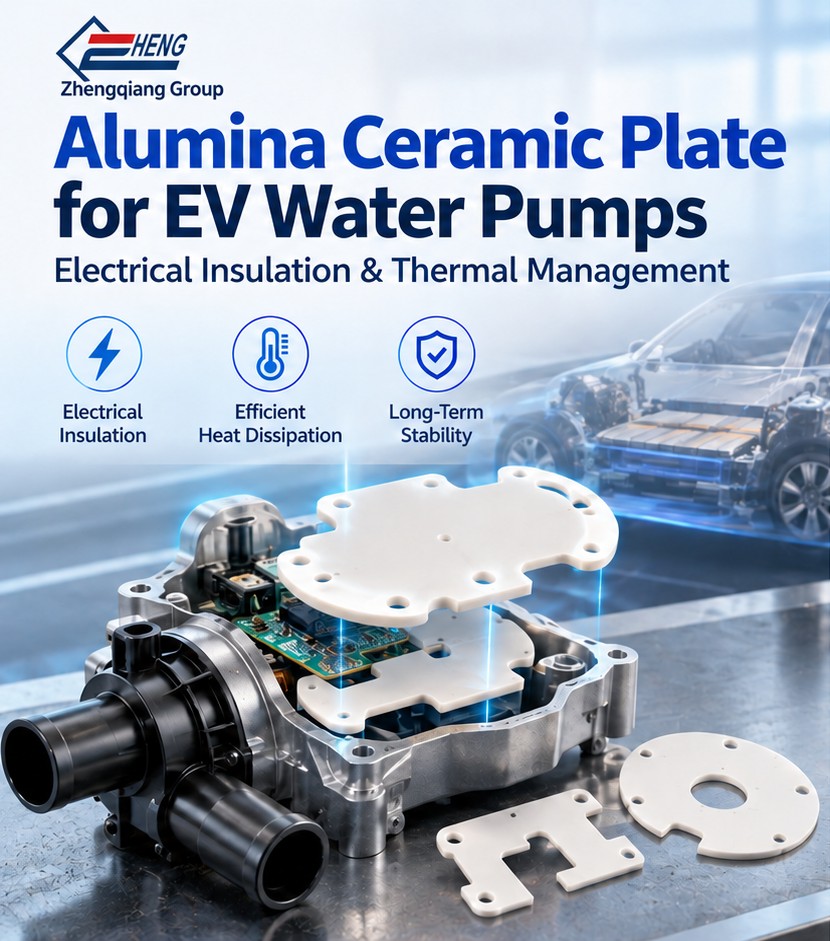
An alumina ceramic plate can help address two important requirements in electronic water pump assemblies: electrical insulation and heat transfer. In electric vehicle (EV) water pumps, the plate’s performance depends not only on the ceramic material itself, but also on thickness, contact surfaces, mounting conditions and its position within the overall thermal path.
For engineers developing an EV water pump, selecting an alumina ceramic plate should therefore begin with the actual application, assembly structure and operating requirements rather than material properties alone.
Why Use an Alumina Ceramic Plate in EV Water Pumps?
Electronic water pumps are part of the thermal management systems used in electric vehicles. Their electronic components must operate within the electrical and temperature limits defined by the complete pump and vehicle system.
Depending on the pump architecture, an alumina ceramic plate may be installed between an aluminum housing and the PCB or electronic assembly. In this position, the ceramic component can provide electrical insulation while also allowing heat to pass through the material toward the surrounding structure.
Alumina ceramic (Al₂O₃) is commonly considered for applications that require electrical insulation, wear resistance, dimensional stability and useful thermal performance.
Explore our custom alumina ceramic heat-dissipation plate for EV water pumps.
How Does an Alumina Ceramic Plate Support Thermal Management?
An alumina ceramic plate does not remove heat by itself. Instead, it forms part of the thermal path through which heat travels from electronic components toward the housing or cooling structure.
The actual thermal performance depends on several factors:
- Material grade: Different alumina grades can have different thermal and electrical properties.
- Plate thickness: Thickness influences the distance heat must travel through the ceramic.
- Contact area: The available contact surface affects heat transfer between the ceramic and adjacent parts.
- Interface condition: Gaps, uneven contact or interface materials can increase thermal resistance.
- Mounting conditions: The assembly should maintain suitable contact without introducing unnecessary local stress.
For this reason, thermal conductivity alone is not enough to predict the operating temperature of the complete EV water pump assembly.
Industry research on electric water pump electronics also evaluates ceramic PCBs, thermal paths, PCB temperature and cooling structures as part of the complete system design.
Reference: Analytical Study on Cooling Characteristics of Ceramic PCB in Electric Water Pump.
Electrical Insulation in EV Water Pump Electronics
Electrical insulation is another important reason for using ceramic components around electronic assemblies. An alumina ceramic plate can form an electrically insulating layer between conductive structures while still contributing to the thermal path.
When reviewing an EV water pump ceramic plate, engineers should consider:
- Required operating voltage and insulation performance
- Plate thickness and geometry
- Position relative to conductive components
- Contact with the aluminum housing and PCB
- Operating temperature and environmental conditions
- Application-specific electrical testing requirements
The appropriate ceramic grade and dimensions should always be evaluated against the actual application specification. Not every alumina ceramic plate provides identical electrical performance under all operating conditions.
5 Design Factors for an Alumina Ceramic Plate
1. Thickness and Flatness
Thickness affects both the thermal path and available installation space. Flatness can influence contact between the ceramic plate, PCB and housing.
Critical thickness and flatness requirements should be identified clearly on the engineering drawing so that the component can be evaluated for the intended assembly.
2. Overall Geometry
EV water pump ceramic plates may require irregular outlines, holes, slots or locating features according to the electronic assembly.
Zhengqiang’s confirmed ceramic forming process is powder pressing. Therefore, custom geometry must be reviewed for compatibility with the forming process before the design is finalized.
Very thin sections, abrupt changes in thickness or highly complex features may require additional engineering review.
3. Contact and Mounting Conditions
Ceramic materials do not deform in the same way as many metals or engineering plastics. Poor alignment, uneven contact or excessive localized clamping force may introduce stress into the component.
The mounting method should therefore be reviewed together with the aluminum housing, PCB and surrounding assembly.
4. Operating Environment
Provide the expected operating conditions when requesting a custom alumina ceramic plate, including:
- Operating temperature
- Exposure to coolant, moisture or other fluids
- Electrical requirements
- Mechanical loads
- Thermal cycling conditions, if applicable
These details help evaluate whether the selected material and component design are appropriate for the intended application.
5. Inspection Requirements
Critical inspection requirements should be defined before production. Depending on the application, these may include:
- Thickness
- Flatness
- Critical dimensions
- Hole and slot positions
- Edge condition
- Visual appearance
- Application-specific electrical or functional testing
Alumina Ceramic Plate vs. General Ceramic Substrate
The terms ceramic plate and ceramic substrate can overlap, but they are not always used in exactly the same way.
A ceramic plate often describes the physical form of the component. A ceramic substrate usually emphasizes its role within an electrical or thermal assembly, where thickness, flatness, surface condition and insulation performance may be particularly important.
For an EV water pump, the correct specification depends on the actual function of the component in the assembly.
For broader material selection information, read our alumina ceramic substrate selection guide.
What Information Should Be Included in an RFQ?
To evaluate a custom alumina ceramic plate for an EV water pump, provide as much of the following information as possible:
- 2D engineering drawing
- Available 3D model
- Required alumina material grade, if specified
- Overall dimensions and thickness
- Critical tolerances
- Flatness requirements
- Hole, slot and locating-feature dimensions
- Assembly position and mating materials
- Electrical requirements
- Thermal operating conditions
- Inspection requirements
- Estimated order quantity and annual demand
Providing complete engineering information helps determine whether the proposed alumina ceramic plate is suitable for the intended EV water pump application and whether the geometry is compatible with the powder-pressing process.
Common Design Mistakes to Avoid
- Looking only at thermal conductivity: The complete thermal path also depends on thickness, contact area and interfaces.
- Ignoring mounting stress: Uneven contact or excessive local force can affect ceramic reliability.
- Using unnecessarily tight tolerances: Critical tolerances should be linked to actual functional requirements.
- Finalizing complex geometry before manufacturing review: Powder-pressing feasibility should be checked early.
- Omitting application details: Electrical, thermal and assembly conditions are important for material and design evaluation.
Frequently Asked Questions
What is an alumina ceramic plate used for in an EV water pump?
Depending on the pump design, the ceramic plate can provide electrical insulation and form part of the thermal path between electronic components and the surrounding housing.
Does an alumina ceramic plate automatically solve overheating?
No. Thermal performance depends on the entire assembly, including the heat source, ceramic thickness, interface conditions, contact area and surrounding cooling structure.
Why is electrical insulation important in an EV water pump?
Electrical insulation can help separate conductive electronic components from surrounding structures. The required insulation level depends on the actual system voltage, geometry and operating conditions.
Can irregular alumina ceramic plates be customized?
Custom geometry may be possible, but feasibility depends on the drawing, dimensions and powder-pressing requirements. The design should be reviewed before tooling or production begins.
What should I send for an alumina ceramic plate quotation?
Provide the drawing, material requirements, critical dimensions, operating conditions, assembly information, inspection requirements and expected quantity.
Request an ODM Review for Your EV Water Pump Ceramic Plate
Zhengqiang supports drawing-based ODM development of alumina ceramic components for EV water pumps and other industrial applications.
Send your drawing, application requirements, critical dimensions and expected quantity for an initial engineering review.
View our EV water pump ceramic heat-dissipation plate or explore more custom alumina and zirconia ceramic components.