- Information Classification
Alumina Density: 5 Factors Affecting Al2O3 Ceramic Performance
Alumina Density: What It Means for Al2O3 Ceramic Properties, Grades and Performance
Alumina density is an important property when selecting aluminum oxide (Al2O3) ceramic materials for precision components. It is closely related to the ceramic’s composition, porosity, processing conditions and final microstructure.
For engineers and purchasers, understanding alumina density can help when comparing ceramic grades and evaluating requirements for strength, hardness, wear resistance, dimensional stability and other performance characteristics.
For custom alumina ceramic components, density should not be considered by itself. Material purity, forming process, sintering, machining and the final application all need to be evaluated together.
What Is Alumina Density?
Alumina density describes the mass of an alumina ceramic material per unit volume.
The basic relationship is:
Density = Mass / Volume
For Al2O3 ceramic, measured density depends on several factors, including alumina purity, porosity, microstructure and manufacturing process.
A higher measured density generally indicates a more densely sintered ceramic structure with fewer internal pores. However, density alone does not determine the complete performance of a ceramic component.
When selecting an alumina ceramic material, engineers should consider density together with hardness, strength, thermal properties, electrical insulation and application requirements.
What Is the Density of Alumina?
The density of alumina ceramic varies according to its grade and manufacturing process.
For high-density alumina, the practical density is commonly close to the theoretical density of fully dense Al2O3.
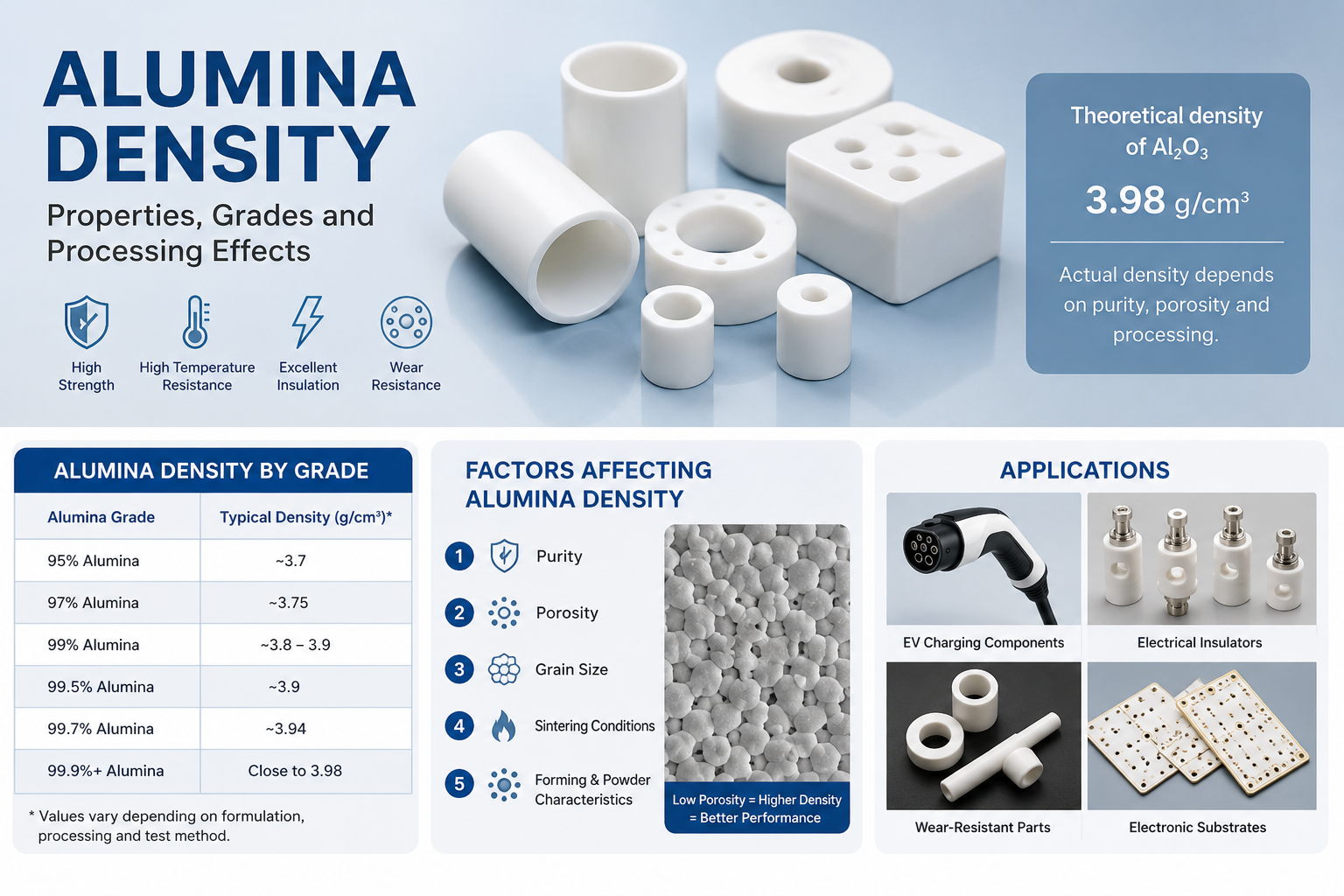
Theoretical alumina density is approximately 3.98 g/cm³.
Actual ceramic components may have lower measured density because of residual porosity, composition and processing conditions.
For this reason, alumina density should always be specified together with the material grade and required properties.
Alumina Density by Ceramic Grade
Different alumina grades can provide different combinations of density, hardness, mechanical strength, electrical insulation and processing characteristics.
Typical examples include:
| Alumina Grade | Typical Density Range* | Typical Characteristics |
|---|---|---|
| 95% Alumina | ~3.7 g/cm³ | Good hardness, wear resistance and cost efficiency |
| 97% Alumina | ~3.75 g/cm³ | Balanced mechanical and electrical performance |
| 99% Alumina | ~3.8–3.9 g/cm³ | Higher purity and improved performance |
| 99.5% Alumina | ~3.9 g/cm³ | High density and strong overall properties |
| 99.7% Alumina | ~3.94 g/cm³ | Very high density and low porosity |
| 99.9%+ Alumina | Close to theoretical density | High-purity applications and precision components |
*Typical values can vary depending on formulation, processing and test method. Material specifications should be confirmed for the selected grade.
The higher-purity alumina grades are generally selected when greater density, lower porosity and more demanding performance are required.
Lower-purity grades can be attractive where a balanced combination of performance and cost is more important.
5 Factors That Affect Alumina Density
1. Alumina Purity
Alumina purity has a strong influence on the final material properties.
Higher-purity alumina generally allows a higher theoretical and practical density, while impurities and secondary phases can affect the final microstructure.
Material purity should therefore be considered when selecting an alumina ceramic grade for precision applications.
2. Porosity
Porosity refers to internal voids within the ceramic structure.
Lower porosity generally means a denser ceramic structure.
Reducing porosity can contribute to:
- Higher mechanical strength
- Better wear resistance
- More uniform performance
- Improved dimensional stability
For precision alumina ceramic components, controlling porosity is an important part of the manufacturing process.
3. Grain Size
The microstructure and grain size of alumina can influence density and mechanical performance.
Controlled grain growth during sintering can help manufacturers achieve a more uniform ceramic structure.
The appropriate grain structure depends on the required properties and final component design.
4. Sintering Conditions
Sintering is one of the most important processing stages affecting alumina density.
Temperature, holding time and atmosphere can influence densification and the final microstructure of the ceramic.
Insufficient sintering can leave excessive porosity, while properly controlled sintering helps the material approach its target density.
5. Forming and Powder Characteristics
The condition of the ceramic powder and the forming process also affect the final density.
Uniform powder distribution, suitable particle size and controlled forming pressure can help reduce density variation within the green body before sintering.
For complex ceramic components, consistent forming is especially important for maintaining uniform dimensions and reliable final performance.
Why Is Alumina Density Important?
The importance of alumina density depends on the application.
Higher-density alumina generally has a more compact structure and lower porosity. This can contribute to improved mechanical and wear performance.
For example, dense alumina is often considered for components requiring:
- High hardness
- Wear resistance
- Mechanical strength
- Dimensional stability
- Long service life
However, the highest possible density is not automatically the best choice for every application.
A material grade should be selected according to the actual component requirements rather than density alone.
Alumina Density and Mechanical Performance
Density and porosity are closely related to the mechanical structure of alumina ceramic.
As porosity decreases, the ceramic structure generally becomes more compact and uniform.
This can support improved:
- Hardness
- Compressive strength
- Wear resistance
- Dimensional stability
For wear-resistant components and precision parts, controlling density and microstructure is therefore an important part of material engineering.
At the same time, fracture toughness and overall mechanical reliability depend on more than density. Composition, grain structure, geometry and applied stress should also be considered.
Alumina Density and Electrical Insulation
Alumina is widely used as an electrical insulating ceramic.
High-purity alumina can provide excellent electrical insulation together with high thermal and chemical stability.
For applications such as:
- Electrical insulators
- Electronic substrates
- Connector insulation components
- High-voltage ceramic parts
the selected alumina grade should be matched to the electrical requirements of the finished component.
Density is one part of this evaluation, but electrical properties should be verified according to the material specification.
Dense Alumina vs. Standard Alumina
Dense alumina refers to ceramic material with relatively low porosity and a high degree of densification.
Compared with lower-density alumina, dense alumina can provide advantages such as:
- Higher hardness
- Better wear resistance
- Greater mechanical stability
- More consistent dimensions
- Improved durability
Dense alumina is often selected for demanding precision components.
Standard or lower-purity alumina may be more suitable when cost efficiency, electrical insulation or general mechanical performance is the main consideration.
The correct selection depends on the specific application.
Alumina Density and Ceramic Component Design
For custom alumina ceramic components, material density is only one part of the engineering equation.
A component may also require control of:
- Dimensional tolerance
- Surface finish
- Geometry
- Mechanical strength
- Thermal conductivity
- Electrical insulation
- Chemical resistance
- Operating temperature
For example, a ceramic component for an electrical connector may prioritize insulation and dimensional stability, while a ceramic shaft or wear-resistant component may require high hardness and stable surface performance.
This is why the ceramic grade should be selected together with the component design.
Applications of High-Density Alumina Ceramic
Different alumina grades and density levels can be used in many technical ceramic applications.
Electrical and Electronic Components
Alumina is widely used for insulating components, substrates and other electrical parts because of its electrical insulation and thermal stability.
EV Charging Components
Alumina ceramic can be used in selected EV charging connector housings, insulating structures and other high-voltage components where electrical insulation and dimensional stability are important.
Wear-Resistant Components
Dense alumina is suitable for components exposed to repeated friction and mechanical wear.
Examples include:
- Ceramic bushings
- Wear plates
- Ceramic guides
- Precision mechanical components
Precision Ceramic Components
High-purity alumina can be used for precision components requiring stable dimensions and reliable mechanical and electrical performance.
How to Choose the Right Alumina Density
When selecting an alumina ceramic material, do not choose based only on the highest density value.
Instead, evaluate:
Application Requirements
What will the component do, and what environment will it operate in?
Mechanical Requirements
Consider hardness, strength, wear resistance and expected load.
Electrical Requirements
Determine whether electrical insulation or dielectric performance is required.
Thermal Requirements
Consider operating temperature and heat transfer requirements.
Dimensional Requirements
Check required tolerances, geometry and surface finish.
Cost Requirements
Higher-purity alumina generally involves higher material and processing costs, so the selected grade should be appropriate for the actual performance requirements.
Custom Alumina Ceramic Components
We manufacture customized alumina ceramic components according to customer drawings, samples and application requirements.
Our alumina ceramic solutions include:
- Alumina ceramic housings
- Ceramic sleeves
- Ceramic shafts
- Ceramic rings
- Ceramic plates
- Electrical insulation components
- Precision alumina ceramic parts
Material selection can be matched to the required density, purity, mechanical performance, electrical insulation and dimensional accuracy.
Our manufacturing process includes ceramic forming, sintering, precision grinding and dimensional inspection according to component requirements.
For OEM and ODM projects, customers can provide 2D drawings, 3D files, samples or technical specifications for engineering evaluation.
Alumina Density: Key Takeaways
The key points to remember about alumina density are:
- Alumina density depends on purity, porosity, grain structure and processing.
- Theoretical density of Al2O3 is approximately 3.98 g/cm³.
- Higher density generally corresponds to a more compact and lower-porosity structure.
- Dense alumina can provide excellent hardness, wear resistance and dimensional stability.
- Different alumina grades are suitable for different applications.
- Material selection should consider density together with electrical, mechanical, thermal and chemical requirements.
For custom ceramic components, the right alumina grade is the one that meets the actual application requirements—not necessarily the one with the highest density.
Need Custom Alumina Ceramic Components?
If you are selecting an alumina ceramic material for a new component, send us your drawing, sample or technical requirements.
Our engineering team can help evaluate the suitable alumina grade and develop a customized ceramic component based on your application.
Contact us for an alumina ceramic solution tailored to your project.