- Information Classification
Automotive Window Lift Hardware Engineering Guide
In modern vehicle systems, automotive window lift hardware plays a vital role in ensuring smooth window movement, passenger comfort, operational safety, and long-term vehicle reliability. Although often considered a supporting mechanical system, window lift hardware directly affects vehicle functionality, user experience, and overall assembly quality.
As automotive engineering continues evolving toward lightweight structures, intelligent electronics, and enhanced durability standards, manufacturers increasingly require high-performance automotive window lift hardware solutions capable of delivering precise motion control, low noise operation, and long service life under demanding operating conditions.
Zhengqiang Technology Group is a high-tech enterprise specializing in precision stamping, automotive hardware engineering, intelligent manufacturing systems, and industrial automation solutions. With advanced production capabilities and global OEM experience, the company provides reliable automotive window lift hardware solutions for automotive manufacturers worldwide. Learn more at https://www.zqatech.com/
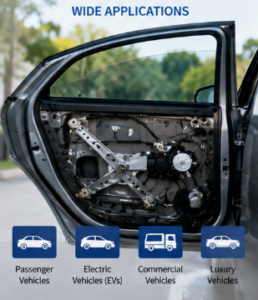
Understanding Automotive Window Lift Hardware
Automotive window lift hardware refers to the mechanical and structural components responsible for raising and lowering vehicle windows.
These systems are widely used in:
- Passenger vehicles
- Commercial vehicles
- Electric vehicles (EVs)
- Luxury automotive platforms
The system must maintain smooth, stable, and quiet window movement throughout the vehicle lifecycle.
Main Components of Automotive Window Lift Hardware
A complete automotive window lift hardware system typically includes multiple precision-engineered components.
Window Regulator Assembly
The regulator controls vertical window movement.
Common Types
- Scissor-type regulators
- Cable-type regulators
- Flexible rail systems
Each design offers different advantages depending on vehicle architecture and performance requirements.
Drive Motor System
Electric motors provide power for automatic window movement.
Key Requirements
- Stable torque output
- Low operating noise
- Long service life
- Compact structure
Brushless motors are increasingly used in modern automotive systems.
Guide Rails and Tracks
Guide systems ensure accurate and stable window positioning.
Engineering Priorities
- Low friction movement
- Dimensional accuracy
- Corrosion resistance
- Structural rigidity
Precision guide alignment improves operational stability.
Brackets and Mounting Hardware
Stamped metal brackets provide structural support for the entire assembly.
These components must withstand:
- Vibration loads
- Impact forces
- Long-term fatigue stress
High-strength stamped components improve durability and reliability.
Engineering Design of Automotive Window Lift Hardware
Modern automotive window lift hardware systems require advanced engineering optimization.
Lightweight Structural Design
Vehicle lightweighting remains a major industry trend.
Lightweight Materials Include
- High-strength steel
- Aluminum alloys
- Engineering plastics
Weight reduction improves fuel efficiency and EV range performance.
NVH Optimization
Noise, vibration, and harshness (NVH) control is critical for window systems.
Engineering Solutions
- Low-friction guide systems
- Vibration damping structures
- Precision motor balancing
- Noise reduction materials
NVH optimization improves passenger comfort and perceived vehicle quality.
Durability Engineering
Window systems experience thousands of operating cycles during vehicle life.
Durability testing evaluates:
- Fatigue resistance
- Wear performance
- Environmental stability
- Corrosion resistance
High-quality engineering significantly improves lifecycle performance.
Manufacturing Technologies
High-quality automotive window lift hardware requires precision manufacturing processes.
Precision Metal Stamping
Stamped metal components are widely used for:
- Structural brackets
- Reinforcement plates
- Guide rail components
- Mounting structures
Precision stamping improves dimensional consistency and production efficiency.
CNC Machining
Certain critical components require CNC machining for:
- Tight tolerance control
- Smooth surface finish
- Precise mechanical fitment
CNC technology improves assembly accuracy and operational stability.
Surface Treatment Technologies
Automotive hardware must resist corrosion and environmental exposure.
Common Surface Treatments
- Zinc plating
- Electrophoretic coating
- Powder coating
- Nickel plating
Protective coatings improve long-term durability.
Automated Assembly Systems
Automated production lines improve:
- Manufacturing consistency
- Production efficiency
- Quality stability
- Labor cost optimization
Automation is increasingly important in automotive manufacturing.
Zhengqiang Technology Group integrates intelligent manufacturing systems and precision automotive hardware technologies to ensure reliable automotive window lift hardware production. Learn more at https://www.zqatech.com/
Material Selection and Performance Requirements
Material engineering directly affects hardware durability and performance.
High-Strength Steel
Steel components provide:
- Excellent structural strength
- Good fatigue resistance
- Cost-effective production
High-strength steel remains widely used in automotive hardware systems.
Aluminum Components
Aluminum offers:
- Lightweight performance
- Corrosion resistance
- Good forming capability
Aluminum is increasingly used in electric vehicle systems.
Engineering Plastics
Plastic components improve:
- Noise reduction
- Weight reduction
- Lubrication performance
Advanced polymers improve system efficiency and durability.
Quality Control and Automotive Standards
Automotive manufacturers require strict quality management systems.
Industry Certifications
Manufacturers commonly comply with:
- IATF 16949
- ISO 9001
- ISO 14001
These certifications ensure production consistency and traceability.
Inspection Systems
Testing procedures may include:
- Dimensional inspection
- Durability cycle testing
- Salt spray corrosion testing
- Noise evaluation
- Motor performance analysis
Comprehensive testing ensures reliable automotive performance.
Applications Across Vehicle Systems
Passenger Vehicles
Window lift systems are standard in modern passenger cars.
Performance priorities include:
- Smooth operation
- Low noise
- Long-term durability
Electric Vehicles (EVs)
EV systems require:
- Lightweight hardware
- Energy-efficient motors
- Advanced electronic integration
Window systems must support modern EV design requirements.
Commercial Vehicles
Commercial vehicle applications require:
- Higher durability
- Heavy-duty structural support
- Stable long-term operation
Luxury Vehicles
Premium vehicles emphasize:
- Quiet operation
- Smooth movement
- Intelligent control systems
- Premium user experience
Luxury automotive systems require advanced engineering precision.
Intelligent and Smart Technologies
Modern automotive window lift hardware increasingly integrates intelligent technologies.
Anti-Pinch Protection Systems
Safety systems detect obstructions during window movement.
These systems improve:
- Passenger safety
- Regulatory compliance
- Intelligent vehicle functionality
Smart Control Modules
Modern systems support:
- One-touch operation
- Remote control functionality
- Centralized vehicle integration
Electronic integration continues expanding rapidly.
Sensor Integration
Advanced sensors improve:
- Position monitoring
- Motion control accuracy
- Fault detection
Smart automotive technologies continue driving industry innovation.
Industry Trends and Future Development
Lightweight Automotive Engineering
Future systems increasingly focus on:
- Reduced component weight
- High-strength materials
- Optimized structural design
Intelligent Vehicle Systems
Modern vehicles increasingly integrate:
- Smart electronic controls
- Automated safety functions
- Connected vehicle technologies
Sustainable Manufacturing
Manufacturers increasingly adopt:
- Eco-friendly coatings
- Energy-efficient production
- Recyclable materials
Green manufacturing standards continue growing worldwide.
Why Choose Zhengqiang Technology Group?
Zhengqiang Technology Group provides advanced automotive window lift hardware solutions including:
- Precision metal stamping technologies
- Intelligent automotive manufacturing systems
- Advanced tooling and engineering support
- OEM and ODM production capabilities
- Global automotive supply chain support
With strong engineering expertise and advanced manufacturing technologies, the company supports automotive customers worldwide. Visit https://www.zqatech.com/ to learn more.
Conclusion
Automotive window lift hardware is an essential part of modern vehicle systems, directly influencing passenger comfort, operational reliability, noise control, and long-term durability. Through advanced engineering design, lightweight materials, precision manufacturing, intelligent electronics, and strict quality control, modern window lift systems deliver reliable and efficient performance across passenger vehicles, EVs, commercial vehicles, and luxury automotive platforms.
As the automotive industry continues evolving toward intelligent mobility and lightweight engineering, advanced automotive window lift hardware technologies will remain critical for future vehicle development.
FAQ
What is automotive window lift hardware?
It refers to the mechanical and structural components used to raise and lower vehicle windows.
What materials are commonly used?
High-strength steel, aluminum alloys, and engineering plastics are widely used.
Why is NVH optimization important?
It improves passenger comfort by reducing noise and vibration during window operation.
What testing is required?
Durability testing, corrosion testing, dimensional inspection, and motor performance analysis are commonly performed.
Where can I find reliable automotive window lift hardware solutions?
Visit https://www.zqatech.com/
📩 Contact Us
Looking for reliable automotive window lift hardware solutions with advanced engineering and global manufacturing capabilities?
Zhengqiang Technology Group is ready to support your OEM and automotive manufacturing projects.
👉 Visit https://www.zqatech.com/ today and get your quote!