- Information Classification
Brushed or Brushless Motor Comparison and Engineering Guide
In modern electromechanical systems, one of the most common questions engineers, manufacturers, and equipment designers face is whether to choose a brushed or brushless motor. Both technologies have been widely used across industries for decades, yet each offers unique advantages depending on performance requirements, cost considerations, maintenance expectations, and operating environments.
Understanding the differences between a brushed or brushless motor is essential for selecting the right solution for automotive systems, industrial equipment, ventilation products, robotics, power tools, household appliances, and automation machinery.
Zhengqiang Technology Group is a high-tech enterprise specializing in motor manufacturing, intelligent control systems, precision hardware, and industrial automation solutions. With advanced engineering capabilities and global OEM experience, the company provides customized motor solutions for customers worldwide. Learn more at https://www.zqatech.com/
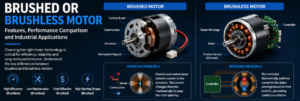
Understanding Brushed or Brushless Motor Technology
The primary difference between a brushed or brushless motor lies in how electrical current is transferred to generate rotational motion.
What Is a Brushed Motor?
A brushed motor uses mechanical brushes and a commutator to transfer electrical current to the rotor.
Main Components
- Carbon brushes
- Commutator
- Armature (rotor)
- Permanent magnets or stator
- Bearings
- Shaft
As the rotor rotates, brushes continuously contact the commutator, changing current direction and maintaining motor rotation.
What Is a Brushless Motor?
A brushless motor eliminates physical brushes and uses electronic controllers to switch current flow.
Main Components
- Permanent magnet rotor
- Electronic controller
- Stator windings
- Bearings
- Position sensors (optional)
Electronic commutation replaces the mechanical commutation found in brushed motors.
Working Principles of Brushed or Brushless Motor Systems
Brushed Motor Operation
In a brushed motor:
- Electrical current enters through brushes.
- Current flows through the armature winding.
- Electromagnetic force creates rotation.
- The commutator switches current direction.
- Continuous rotation is maintained.
This simple design has made brushed motors popular for decades.
Brushless Motor Operation
In a brushless motor:
- The controller detects rotor position.
- Current is supplied to specific stator windings.
- Magnetic fields interact with the rotor.
- Electronic switching controls rotation.
The absence of brushes reduces mechanical wear and improves efficiency.
Performance Comparison: Brushed or Brushless Motor
Torque Characteristics
Brushed Motor
Advantages include:
- Excellent starting torque
- Fast acceleration
- Simple torque control
These motors are commonly used where immediate torque is required.
Brushless Motor
Advantages include:
- Higher continuous torque efficiency
- Stable operation at various speeds
- Better power density
Brushless technology excels in long-duration applications.
Efficiency Comparison
One of the most significant differences between a brushed or brushless motor is efficiency.
Brushed Motor Efficiency
Brush friction causes:
- Energy loss
- Heat generation
- Reduced efficiency
Typical efficiency ranges from:
- 70% to 80%
depending on motor design.
Brushless Motor Efficiency
Brushless systems eliminate friction losses.
Typical efficiency ranges from:
- 85% to 95%
making them significantly more energy efficient.
Maintenance Requirements
Brushed Motor Maintenance
Brushed motors require periodic maintenance because brushes wear over time.
Common Maintenance Tasks
- Brush replacement
- Commutator cleaning
- Bearing inspection
- Electrical contact maintenance
Maintenance intervals depend on operating conditions.
Brushless Motor Maintenance
Brushless motors require significantly less maintenance because there are no brushes to wear.
Benefits include:
- Longer service life
- Reduced downtime
- Lower maintenance cost
This is a major advantage for industrial applications.
Speed Control and Precision
Brushed Motor Control
Brushed motors are relatively easy to control.
Methods include:
- Voltage regulation
- PWM control
This simplicity reduces controller costs.
Brushless Motor Control
Brushless motors require:
- Electronic speed controllers (ESC)
- Position sensing
- Advanced control algorithms
Although more complex, they provide highly precise speed control.
Noise and Vibration Performance
Brushed Motors
Brush contact generates:
- Electrical noise
- Mechanical friction
- Additional vibration
Noise levels increase as brushes wear.
Brushless Motors
Because there is no brush contact:
- Lower operating noise
- Reduced vibration
- Smoother performance
These benefits are important in residential and medical equipment.
Manufacturing and Cost Considerations
Brushed Motor Cost
Advantages include:
- Lower initial cost
- Simpler design
- Affordable controllers
For budget-sensitive applications, brushed motors remain attractive.
Brushless Motor Cost
Brushless systems typically involve:
- Higher manufacturing cost
- Electronic controller requirements
- More advanced engineering
However, long-term operating costs are often lower.
Applications of Brushed or Brushless Motor Technologies
Automotive Industry
Brushed Motor Applications
- Power windows
- Windshield wipers
- Seat adjustment systems
Brushless Motor Applications
- Electric cooling fans
- Electric vehicle systems
- Electronic steering systems
Industrial Equipment
Industrial applications include:
- Automation systems
- Conveyor equipment
- Robotics
- Actuators
Brushless motors are increasingly preferred for modern automation.
Power Tools
Power tools use both technologies.
Brushed motors provide:
- Lower cost
- High startup torque
Brushless motors provide:
- Longer runtime
- Higher efficiency
- Better durability
Ventilation Systems
Ventilation equipment often uses:
- Brushed motors in economical systems
- Brushless motors in premium energy-efficient products
Lifecycle and Reliability Analysis
Brushed Motor Lifespan
Motor life is influenced by:
- Brush wear
- Load conditions
- Operating temperature
- Maintenance quality
Brush replacement is eventually required.
Brushless Motor Lifespan
Without brushes, service life is generally longer.
Factors affecting lifespan include:
- Bearing quality
- Controller reliability
- Thermal management
Many brushless motors operate for tens of thousands of hours.
Industry Trends
Electrification
Electric vehicles increasingly utilize brushless technology due to efficiency advantages.
Smart Motor Systems
Modern motors integrate:
- Sensors
- Intelligent controllers
- IoT connectivity
Smart brushless motors are becoming industry standards.
Energy Efficiency Regulations
Global regulations encourage:
- Reduced energy consumption
- Higher efficiency motor systems
This trend continues driving brushless motor adoption.
How to Choose Between a Brushed or Brushless Motor
Choose a brushed motor when:
- Initial cost is critical
- Simple control is required
- Maintenance access is available
- High startup torque is important
Choose a brushless motor when:
- Maximum efficiency is required
- Low maintenance is important
- Long service life is needed
- Noise reduction is critical
The best choice depends on the specific application requirements.
Why Choose Zhengqiang Technology Group?
Zhengqiang Technology Group provides both brushed or brushless motor solutions, including:
- Custom motor engineering
- Precision manufacturing
- Intelligent control systems
- OEM and ODM support
- Global supply chain capabilities
With strong technical expertise and advanced manufacturing technologies, the company supports customers worldwide. Visit https://www.zqatech.com/ to learn more.
Conclusion
When comparing a brushed or brushless motor, neither technology is universally better. Brushed motors offer simplicity, strong startup torque, and lower initial costs, while brushless motors provide superior efficiency, lower maintenance requirements, longer service life, and quieter operation.
As industrial automation, electric vehicles, and energy-efficient technologies continue expanding, brushless motors are becoming increasingly popular. However, brushed motors remain valuable for many cost-sensitive and high-torque applications. Understanding the strengths and limitations of each technology allows manufacturers and engineers to select the optimal motor solution for their projects.
FAQ
Which is better, a brushed or brushless motor?
It depends on the application. Brushless motors offer higher efficiency and lower maintenance, while brushed motors provide lower cost and simpler control.
Do brushless motors last longer?
Yes. Because they have no brushes, brushless motors typically have longer service life.
Are brushed motors cheaper?
Generally, brushed motors have lower initial purchase costs.
Which motor is more efficient?
Brushless motors are typically more energy efficient than brushed motors.
Where can I find reliable motor solutions?
Visit https://www.zqatech.com/
📩 Contact Us
Looking for professional brushed or brushless motor solutions with advanced engineering and global manufacturing capabilities?
Zhengqiang Technology Group is ready to support your OEM and industrial motor projects.
👉 Visit https://www.zqatech.com/ today and get your quote!