
- Information Classification
Brushless vs Brushed Motor: Full Comparison Guide
Introduction to Brushless vs Brushed Motor
In modern engineering and manufacturing, motor selection is no longer a simple component choice—it is a strategic decision that directly affects product performance, energy efficiency, operational reliability, and long-term cost. The comparison of brushless vs brushed motor is therefore one of the most critical topics for engineers, product designers, and procurement professionals.
Both technologies are widely used across industries such as automotive systems, industrial automation, consumer electronics, medical devices, and smart equipment. However, their differences in structure, control methods, efficiency, durability, and maintenance create very different value propositions.
Zhengqiang Technology Group, a high-tech enterprise specializing in motor manufacturing, cooling systems, precision components, intelligent equipment, and advanced materials, provides integrated solutions to global customers. This in-depth guide explores every aspect of brushless vs brushed motor technologies to help you make informed and optimized decisions.
What Is a Brushed Motor?
A brushed motor is one of the most established and widely used electric motor types. In the comparison of brushless vs brushed motor, brushed motors represent a traditional, mechanically simple, and cost-effective solution.
This type of motor uses carbon brushes and a commutator to transfer electrical current to the rotating armature. As the rotor turns, the commutator reverses the current direction, ensuring continuous motion. This process is known as mechanical commutation.
The simplicity of this design makes brushed motors easy to control and integrate into systems without requiring complex electronics. They are especially suitable for applications where cost sensitivity and straightforward functionality are key priorities.
However, the physical contact between brushes and the commutator leads to friction, wear, and eventual maintenance requirements, which must be considered in long-term applications.
What Is a Brushless Motor?
A brushless motor, also referred to as a BLDC motor, represents a more advanced solution in the comparison of brushless vs brushed motor technologies.
Unlike brushed motors, brushless motors eliminate mechanical commutation and instead rely on electronic commutation. The rotor is typically equipped with permanent magnets, while the stator contains the windings. An electronic speed controller (ESC) regulates current flow based on rotor position.
This design removes friction caused by brushes, significantly improving efficiency, reducing heat generation, and extending motor lifespan. As a result, brushless motors are widely used in high-performance, energy-efficient, and precision-critical applications.
Although the control system is more complex, the long-term operational benefits often outweigh the initial cost.
Structural Differences: Brushless vs Brushed Motor
The structural design is the foundation of the differences between brushless vs brushed motor technologies.
Brushed Motor Structure:
- Carbon brushes and commutator
- Rotor-based windings (armature)
- Mechanical commutation system
- Direct contact between moving electrical components
Brushless Motor Structure:
- Electronic speed controller (ESC)
- Permanent magnets on the rotor
- Stator-based windings
- Contactless commutation system
These differences lead to variations in efficiency, durability, noise levels, and maintenance requirements.
Working Principles Explained
Understanding how each motor operates is essential when comparing brushless vs brushed motor.
Brushed Motor Operation
Electrical current flows through the brushes into the commutator, energizing the rotor windings. The interaction between the rotor and stator magnetic fields generates torque. The commutator continuously switches current direction to maintain rotation.
Brushless Motor Operation
The electronic controller alternates current in the stator windings, creating a rotating magnetic field. This magnetic field drives the rotor without physical contact, resulting in smoother and more efficient operation.
The absence of mechanical switching is a key advantage of brushless motors.
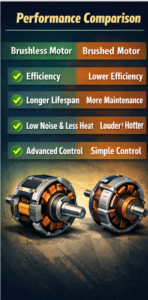
Detailed Performance Comparison of Brushless vs Brushed Motor
Efficiency and Energy Consumption
In the comparison of brushless vs brushed motor, brushless motors are significantly more efficient due to reduced friction and optimized current control. This makes them ideal for energy-sensitive and battery-powered applications.
Lifespan and Reliability
Brushless motors have a longer lifespan because they eliminate brush wear. Brushed motors, on the other hand, require periodic maintenance and component replacement.
Torque and Speed Performance
Brushed motors provide strong starting torque, making them suitable for load-heavy startup conditions. Brushless motors deliver smoother torque output and perform better at high speeds.
Noise and Heat Generation
Brushless motors operate more quietly and produce less heat, making them suitable for precision and noise-sensitive environments such as medical equipment.
Control Complexity
Brushed motors are easier to control using basic voltage adjustments. Brushless motors require electronic controllers but provide superior precision and programmability.
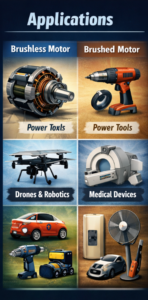
Industrial Applications of Brushless vs Brushed Motor
The choice between brushless vs brushed motor depends on the specific requirements of each application.
Brushed Motor Applications
Brushed motors are widely used in:
- Household appliances such as mixers, fans, and vacuum cleaners
- Automotive systems including window regulators and seat adjusters
- Basic industrial machinery
- Toys and portable devices
Brushless Motor Applications
Brushless motors are commonly used in:
- Electric vehicles and e-mobility solutions
- Drones, robotics, and automation systems
- Medical devices requiring high precision and reliability
- High-end industrial equipment and CNC machinery
Zhengqiang Technology Group integrates advanced manufacturing capabilities including motor production, cooling systems, precision stamping, mold manufacturing, and surface treatment. Learn more at https://www.zqatech.com/
Manufacturing Capabilities and Quality Control
In the context of brushless vs brushed motor, manufacturing quality is a decisive factor in performance and durability.
Key technologies include:
- Precision Stamping: Ensures dimensional accuracy and consistency
- Mold Manufacturing: Improves structural integrity and repeatability
- Surface Treatment: Enhances corrosion resistance and lifespan
- Advanced Ceramic Materials: Provide superior insulation and heat resistance
- Automated Production Systems: Enable efficient and scalable manufacturing
These capabilities ensure that motors meet global standards and perform reliably in demanding environments.
Cost Analysis: Brushless vs Brushed Motor
Cost plays a crucial role in selecting between brushless vs brushed motor technologies.
Initial Investment
Brushed motors have lower upfront costs due to simpler design and production processes.
Maintenance Cost
Brushless motors reduce maintenance costs due to their contactless design, while brushed motors require periodic servicing.
Energy Efficiency
Brushless motors consume less energy, resulting in lower operational costs over time.
Total Cost of Ownership
Although brushless motors require a higher initial investment, they often deliver better long-term value due to efficiency and durability.
Maintenance and Operational Considerations
Maintenance is a key differentiator in brushless vs brushed motor technologies.
Brushed motors require regular maintenance, including brush replacement and commutator cleaning. This can lead to downtime and increased operational costs.
Brushless motors offer minimal maintenance requirements and higher reliability, making them suitable for continuous operation and mission-critical applications.
Environmental Impact and Sustainability
The comparison of brushless vs brushed motor increasingly includes environmental considerations.
Brushless motors are more energy-efficient and generate less heat, reducing energy consumption and carbon emissions. Their longer lifespan also contributes to sustainability.
Brushed motors remain relevant in cost-driven applications but may result in higher energy consumption over time.
Future Trends in Motor Technology
The evolution of brushless vs brushed motor technologies is driven by innovation in materials, electronics, and manufacturing.
Brushless motors are gaining popularity due to their compatibility with smart systems, IoT integration, and energy efficiency requirements. Meanwhile, advancements in materials and production techniques are improving the performance of brushed motors.
Both technologies will continue to coexist, serving different market needs based on cost and performance priorities.
How to Choose Between Brushless vs Brushed Motor
Selecting the right motor requires a comprehensive evaluation of your needs:
- Choose brushed motors for low-cost, simple applications
- Choose brushless motors for high efficiency, durability, and precision
- Consider operating conditions such as temperature, load, and duty cycle
- Evaluate long-term maintenance and energy costs
Working with an experienced manufacturer ensures optimal motor selection and performance.
Conclusion
The comparison of brushless vs brushed motor highlights a clear trade-off between simplicity and advanced performance. Brushed motors offer affordability and ease of use, while brushless motors provide superior efficiency, longer lifespan, and reduced maintenance.
With strong expertise in motor systems, precision components, and intelligent manufacturing, Zhengqiang Technology Group delivers customized solutions for global industries. Choosing the right motor technology is essential for achieving performance, efficiency, and long-term success.
Partner With a Trusted Manufacturer
Looking for a reliable partner for your motor and precision component needs? Visit https://www.zqatech.com/ to explore our full range of solutions. Our expert team is ready to provide customized support and high-quality manufacturing services.
Contact us today and power your next innovation with the right motor solution.

Guangdong Zhengqiang Technology Group
Address: Building 2, No.5 Jinli Road, Sanjiao Town, Zhongshan City, Guangdong Province, China.
HOT CATALOG
PRODUCTS
CONTACT US
- Building 2, No.5 Jinli Road, Sanjiao Town, Zhongshan City,Guangdong Province, China.
- Tel: +86 180 2838 4452
- Whatsapp:+44-7871-124085
- Email:info@zqatech.com