- Information Classification
Ceramic Connector Block & Alumina Ceramic Insulators - Guangdong Zhengqiang Technology Group
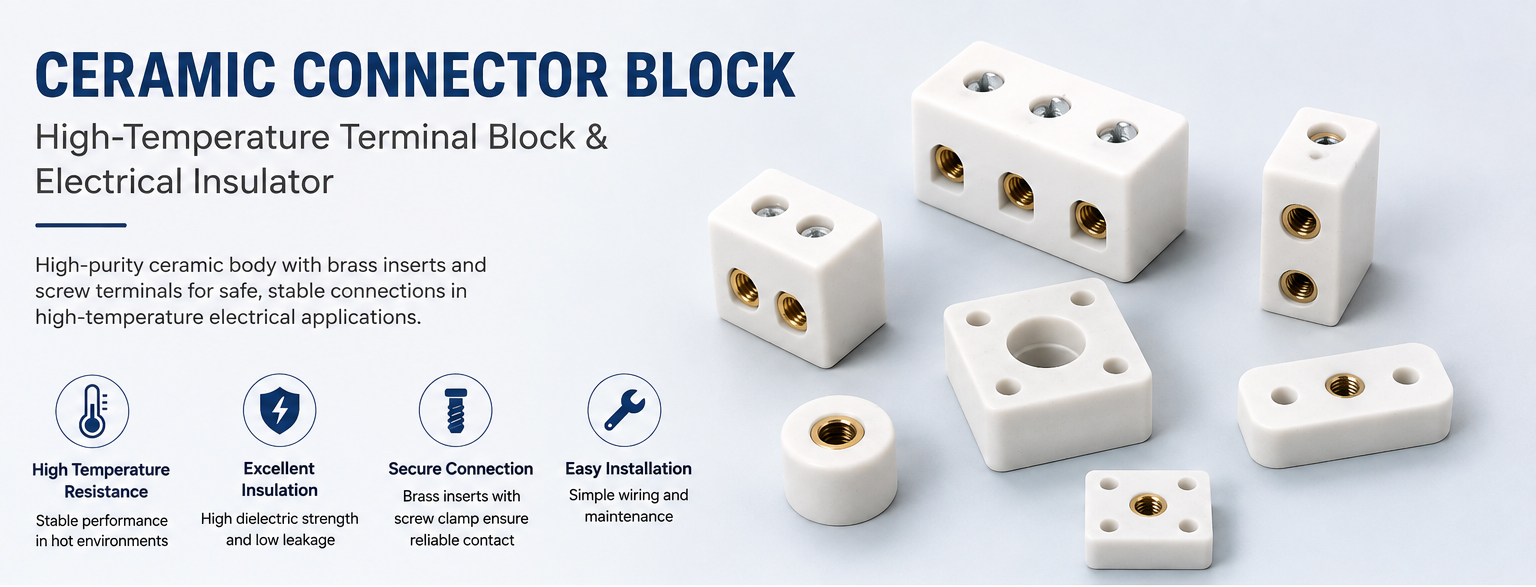
Ceramic Connector Block: High-Temperature Terminal Block and Alumina Ceramic Insulators
When electrical connections operate in high-temperature or high-voltage environments, the insulating material can be just as important as the conductor itself. A ceramic connector block uses a heat-resistant ceramic body to provide electrical insulation and mechanical stability where conventional plastic connectors may not be suitable.
Ceramic connector blocks are commonly used in lighting equipment, heating appliances, ovens, industrial equipment, and other applications exposed to elevated temperatures. For more demanding electrical systems, alumina ceramic connector insulators can also be customized to separate conductive components, provide high-voltage insulation, and maintain dimensional stability.
This article explains what a ceramic connector block is, how ceramic terminal blocks work, what materials are commonly used, and how custom alumina ceramic components can be applied to electrical connectors and high-temperature electrical systems.
What Is a Ceramic Connector Block?
A ceramic connector block, also called a ceramic terminal block or high-temperature ceramic terminal block, is an electrical connection component designed to join or terminate wires while providing electrical insulation.
Unlike conventional plastic terminal blocks, a ceramic connector block uses a ceramic insulating body. The ceramic body surrounds or separates the conductive terminals, helping maintain electrical insulation when the surrounding temperature increases.
A typical ceramic connector block may include:
- A high-temperature ceramic insulating body
- Brass or plated metal conductor inserts
- Screw terminals for securing wires
- Separate connection channels to reduce the possibility of accidental electrical contact
- Mounting features depending on the application
The exact voltage, current, temperature and wire-size ratings depend on the specific design, ceramic material, metal terminal structure and applicable safety requirements.
Ceramic Connector Block vs. Plastic Terminal Block
The main reason to use a ceramic connector block is temperature resistance and insulation stability.
Plastic is widely used for conventional electrical connectors because it is lightweight, economical and easy to mold. However, some high-temperature applications require an insulating material with greater thermal stability.
| Feature | Ceramic Connector Block | Plastic Terminal Block |
|---|---|---|
| High-temperature resistance | Excellent, depending on ceramic grade | Depends strongly on plastic material |
| Electrical insulation | Excellent | Good to excellent |
| Dimensional stability | Excellent at elevated temperatures | Can decrease as temperature increases |
| Resistance to aging | Excellent in demanding environments | Material dependent |
| Mechanical rigidity | High | Material dependent |
| Typical use | High-temperature and demanding electrical applications | General electrical wiring |
For applications where heat is a major concern, ceramic can provide a more stable insulating structure than many conventional polymer materials.
What Materials Are Used in Ceramic Connector Blocks?
The ceramic material used in a connector block depends on the required temperature resistance, electrical insulation, mechanical strength and cost.
Porcelain and Steatite Ceramic
Porcelain and steatite ceramics are commonly used in traditional high-temperature terminal blocks and electrical connection components. They offer good electrical insulation and thermal stability for many heating and lighting applications.
Alumina Ceramic
Alumina ceramic, or aluminum oxide (Al2O3), is an advanced ceramic material widely used for electrical insulation and precision ceramic components.
Compared with conventional electrical ceramics, alumina can provide a combination of:
- Excellent electrical insulation
- High-temperature stability
- High hardness
- Good wear resistance
- Good chemical resistance
- Low deformation
- Stable dimensions for precision components
Different alumina purity grades can be selected depending on the application. Common grades include 95% alumina, 96% alumina, 99% alumina and higher-purity alumina.
Why Is Alumina Ceramic Suitable for Electrical Connectors?
In electrical connector applications, the ceramic component is often required to perform several functions simultaneously. It may need to electrically isolate conductive parts, maintain a precise position between terminals, withstand heat generated during operation and maintain its shape during repeated thermal cycles.
This is where alumina ceramic becomes useful.
1. Excellent Electrical Insulation
Alumina ceramic provides strong electrical insulation and can be used to separate conductive pins, terminals and metal components.
For high-voltage electrical assemblies, the geometry and purity of the ceramic material can be selected according to the required insulation performance and application conditions.
2. High-Temperature Stability
Electrical connectors can experience significant temperature increases due to current flow, ambient heat or nearby heating components.
Alumina ceramic maintains its physical structure at elevated temperatures and does not soften in the same way as many polymer materials. This makes alumina ceramic useful for connector components operating in demanding thermal environments.
3. Dimensional Stability
Precision electrical connectors often require controlled dimensions and accurate positioning of pins, terminals and conductive components.
A ceramic insulator with stable dimensions can help maintain the designed clearance and positioning between conductive elements.
4. Mechanical Strength and Wear Resistance
Connector components may experience assembly pressure, vibration, friction or repeated insertion and removal. Alumina ceramic offers high hardness and good wear resistance, making it suitable for precision insulating components.
What Is a Ceramic Connector Insulator?
A ceramic connector insulator is a ceramic component used inside or around an electrical connector to electrically isolate conductive components.
Unlike a complete ceramic connector block, a ceramic connector insulator may be a small custom component such as a sleeve, housing, tube, ring, spacer, plate or precision-shaped ceramic part.
These components can be designed according to:
- Customer drawings
- 3D models
- Existing samples
- Pin diameter and position
- Required insulation distance
- Assembly dimensions
- Operating temperature
- Electrical requirements
This type of custom ceramic component is particularly useful when a standard ceramic terminal block cannot meet the dimensional or performance requirements of a specific connector.
Custom Alumina Ceramic Components for Electrical Connectors
For advanced electrical applications, the ceramic component does not always look like a traditional rectangular terminal block.
It may instead be a precision-machined or sintered ceramic sleeve, housing, tube, plate, ring or other custom geometry.
For example, custom alumina ceramic components can be designed for:
- High-voltage electrical connectors
- EV charging connectors
- High-power DC charging systems
- Electrical feedthroughs
- Power electronics
- High-temperature electrical assemblies
- Industrial electrical equipment
- Electronic insulation components
For high-power EV charging applications, ceramic insulating components can be used to separate conductive elements and provide electrical insulation within the connector assembly.
Our alumina ceramic housings and sleeves for EV charging connectors are designed as custom ceramic components rather than generic off-the-shelf terminal blocks. This approach allows the ceramic geometry, dimensions and material grade to be developed according to the customer’s connector design.
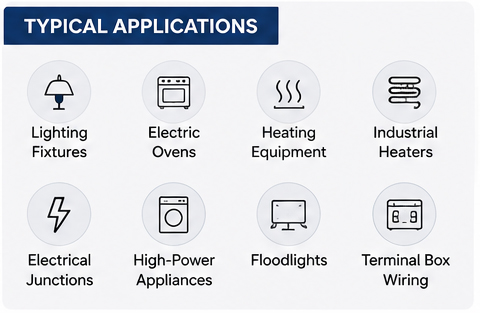
Ceramic Connector Block Applications
Ceramic connector blocks and ceramic electrical insulators can be found in a wide range of applications where electrical insulation must be maintained under heat or demanding operating conditions.
Lighting Equipment
High-temperature ceramic terminal blocks are commonly used in lighting equipment where heat is generated around the electrical connection.
Electric Ovens and Heating Appliances
Ovens, heaters and other heating appliances can expose electrical connection points to elevated temperatures. Ceramic insulating components can provide a stable electrical insulation structure in these environments.
Industrial Heating Equipment
Industrial heaters, furnaces and thermal processing equipment may require electrical components that can operate reliably in elevated-temperature environments.
EV Charging Connectors
As EV charging power increases, connector components face higher electrical loads and increasingly demanding thermal and insulation requirements.
Custom alumina ceramic connector insulators can be used in high-power charging connectors to provide electrical isolation, dimensional stability and thermal resistance.
Power Electronics and Electrical Equipment
Custom ceramic insulating components can also be used around terminals, pins and conductive elements in power electronics and industrial electrical assemblies.
What Are the Typical Ratings of a Ceramic Connector Block?
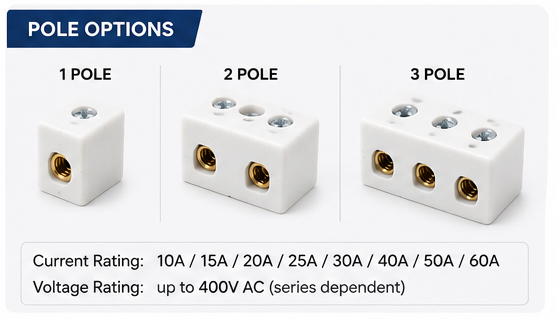
Commercial ceramic connector blocks are available in different configurations. Depending on the product series, typical specifications may include different current ratings, voltage ratings and numbers of poles.
For example, ceramic terminal blocks on the market may be available in configurations such as:
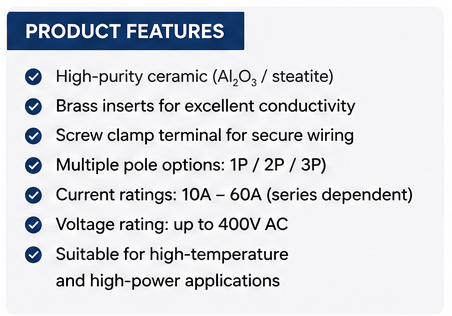
- 1-pole, 2-pole and 3-pole versions
- Different current ratings from low-current to higher-current applications
- Rated voltages around 400V AC or higher depending on the design
- Different wire cross-section ranges
- Different mounting and screw-terminal configurations
Important: these values are product- and manufacturer-dependent. The exact voltage, current, temperature and wire-size ratings must always be confirmed from the applicable product datasheet and certification before use.
How to Choose the Right Ceramic Connector or Insulator
Selecting a ceramic electrical component requires more than simply choosing a ceramic material. The complete application should be considered.
1. Determine the Operating Temperature
First identify the normal operating temperature, peak temperature and possible thermal cycling conditions.
The ceramic grade and complete connector construction should be selected according to the actual temperature requirements.
2. Define the Electrical Requirements
Consider the working voltage, current, insulation distance, dielectric requirements and electrical environment.
For high-voltage applications, the ceramic geometry is particularly important because the distance between conductive components directly affects the insulation design.
3. Select the Appropriate Alumina Grade
Different alumina purity grades provide different combinations of performance and cost.
95% alumina can be a practical choice for many general industrial insulation components, while higher-purity alumina can be considered when greater performance, precision or demanding electrical characteristics are required.
4. Check Dimensional Tolerances
Connector insulators are often small precision components. Hole diameter, wall thickness, length, concentricity and other dimensions may affect the final assembly.
For custom ceramic components, dimensional tolerances should therefore be defined before production.
5. Consider the Manufacturing Process
Depending on the shape and quantity, ceramic components can be manufactured using processes such as dry pressing, injection molding, tape casting and subsequent sintering and precision finishing.
The appropriate process depends on the geometry, material, dimensional requirements and production volume.
From Ceramic Powder to Precision Connector Components
Manufacturing a reliable alumina ceramic connector component requires control throughout the production process.
A typical ceramic manufacturing workflow may include:
- Material preparation: Alumina powder and additives are prepared according to the required ceramic formulation.
- Forming: The ceramic material is shaped using an appropriate forming process.
- Green machining: Where required, additional features are produced before sintering.
- Sintering: The formed ceramic is fired at controlled temperatures to achieve the required density and mechanical properties.
- Precision finishing: Grinding, polishing or other finishing operations can be applied when tighter tolerances are required.
- Inspection: Dimensions and appearance are checked according to the customer’s specifications.
- Final testing: Appropriate inspection and testing are performed according to the application and customer requirements.
Process control is especially important for small ceramic connector components because dimensional variation can affect the final electrical assembly.

Why Choose Custom Ceramic Components Instead of a Standard Connector Block?
A standard ceramic connector block can be an effective solution for common wiring applications. However, standard products may not fit every electrical connector design.
Custom ceramic components become valuable when you need:
- A special shape or geometry
- Non-standard dimensions
- Precise holes or slots
- Custom pin positioning
- Specific wall thickness
- Higher dimensional accuracy
- A particular alumina purity grade
- Integration into an existing connector assembly
Instead of modifying the entire electrical connector around an off-the-shelf ceramic block, engineers can develop the ceramic insulating component around the existing connector architecture.
Our Custom Alumina Ceramic Connector Solutions
We focus on custom alumina and zirconia ceramic components for industrial and electrical applications.
For connector applications, our ceramic components can be developed according to customer drawings, samples and technical requirements. Typical forms include ceramic housings, sleeves, tubes, rods, rings, plates and other precision ceramic geometries.
Our ceramic components can be customized for applications including:
- EV charging connectors
- High-power DC charging systems
- Electrical insulation components
- Electronic assemblies
- Appliance components
- Industrial equipment
For EV charging connector applications, alumina ceramic can provide a combination of electrical insulation, thermal stability, mechanical strength and dimensional stability.
For other electrical applications, the ceramic geometry can be customized to match the customer’s conductor arrangement and assembly requirements.
Frequently Asked Questions About Ceramic Connector Blocks
What is a ceramic connector block?
A ceramic connector block is an electrical terminal component that uses a ceramic insulating body to connect and isolate wires or conductive terminals, especially in applications exposed to elevated temperatures.
Are ceramic terminal blocks better than plastic terminal blocks?
Not necessarily for every application. Plastic terminal blocks are suitable for many general electrical applications, while ceramic terminal blocks are particularly useful when high-temperature resistance, electrical insulation stability and dimensional stability are important.
What is the difference between a ceramic connector block and a ceramic connector insulator?
A ceramic connector block is generally a complete terminal connection component, often including metal terminals and screws. A ceramic connector insulator is usually the ceramic insulating component inside or around an electrical connector and can be customized to a specific connector design.
Can alumina ceramic be used in EV charging connectors?
Yes. Alumina ceramic can be used as an insulating material in electrical connector assemblies. Custom alumina ceramic housings, sleeves and other insulating components can help provide electrical isolation and thermal stability in demanding charging applications.
Can ceramic connector components be customized?
Yes. Ceramic components can be customized according to drawings, samples, dimensions, hole positions, tolerances, material grades and application requirements. The suitable manufacturing process depends on the component geometry and production requirements.
Conclusion
A ceramic connector block is a practical solution for electrical connections exposed to heat, while custom alumina ceramic connector insulators provide a more flexible solution for demanding electrical and high-voltage applications.
When selecting a ceramic electrical component, engineers should consider operating temperature, voltage, current, insulation requirements, dimensional tolerances, ceramic purity and manufacturing process.
For applications such as EV charging connectors, high-power electrical systems and precision electrical assemblies, custom alumina ceramic components can be designed to match the exact requirements of the connector rather than relying only on standard terminal block designs.
Looking for a custom ceramic connector insulator? Send us your drawing, 3D model or sample. We can evaluate the ceramic material, manufacturing process and dimensions for your application.