- Information Classification
Different Grades of Alumina: 95%, 96%, 99% & Higher Purity Compared - Guangdong Zhengqiang Technology Group
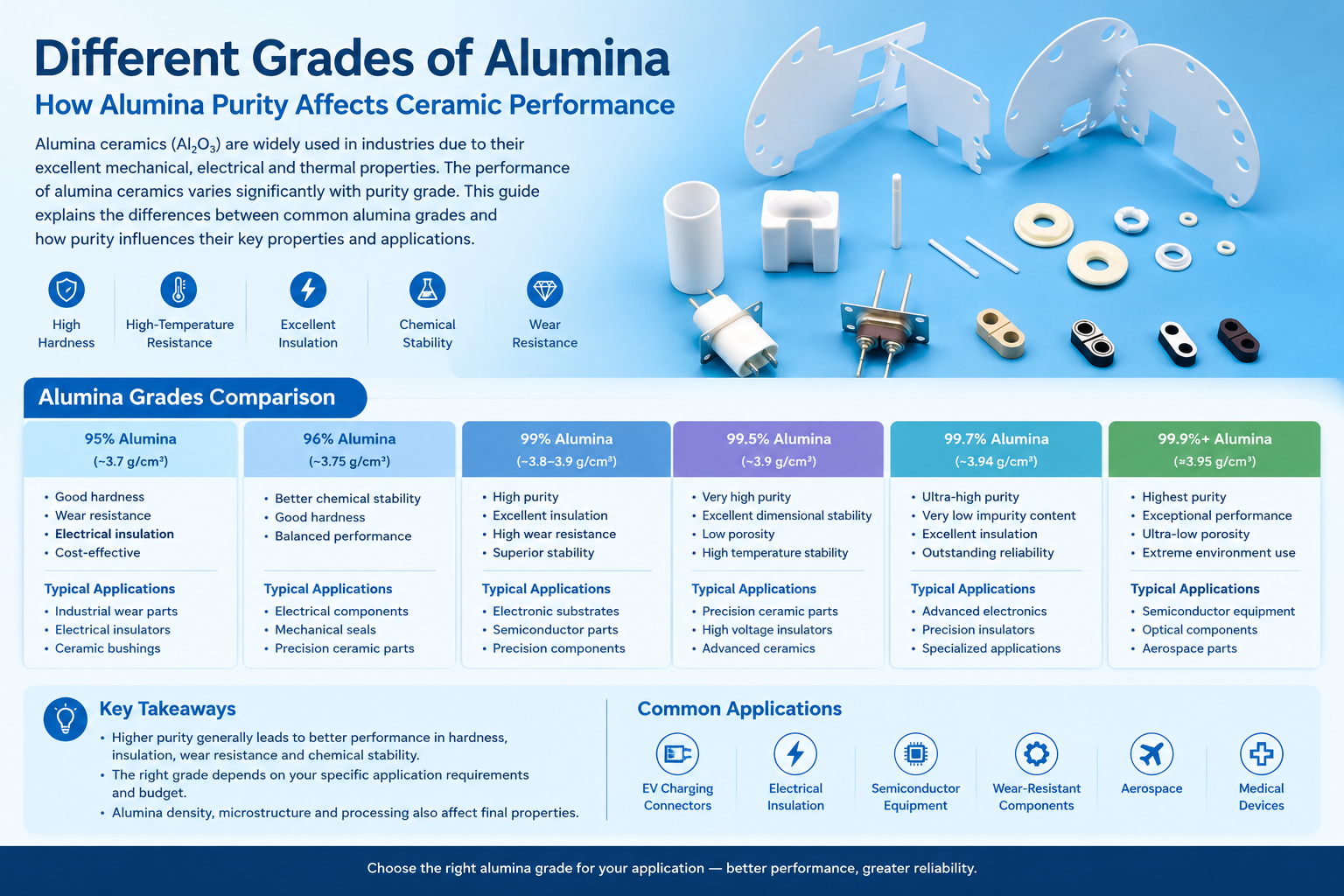
Different Grades of Alumina: 95%, 96%, 99% & Higher Purity Compared
Different grades of alumina are developed to provide different combinations of mechanical, electrical, thermal and chemical performance.
Alumina ceramic, also known as aluminum oxide ceramic or Al₂O₃ ceramic, is one of the most widely used advanced ceramic materials. Its performance can vary significantly depending on alumina purity, formulation, processing conditions and final microstructure.
For engineers and purchasers, understanding the differences between alumina grades can help when selecting ceramic materials for electrical insulation, wear-resistant parts, precision components and other demanding applications.
This guide explains common alumina purity grades, their characteristics and how to choose the right alumina ceramic for a specific application.
What Are the Different Grades of Alumina?
The term different grades of alumina generally refers to alumina ceramics with different Al₂O₃ contents and material formulations.
Common industrial grades include:
- 95% alumina
- 96% alumina
- 99% alumina
- 99.5% alumina
- 99.7% alumina
- 99.9% or higher-purity alumina
As alumina purity increases, the material can provide different combinations of density, electrical insulation, chemical stability, thermal performance and mechanical properties.
However, higher purity does not automatically mean that a ceramic component is better for every application.
The best grade depends on the required performance, component design, manufacturing process and target cost.
How Does Alumina Purity Affect Ceramic Performance?
Alumina purity is one of the important factors affecting ceramic performance.
Higher-purity alumina generally contains fewer secondary phases and can achieve a denser, more stable ceramic structure when properly processed.
This can contribute to improvements in areas such as:
- Electrical insulation
- Chemical stability
- Hardness
- Wear resistance
- Dimensional stability
- Thermal performance
At the same time, higher-purity alumina can require more demanding processing and may have a higher material and manufacturing cost.
For this reason, material selection should balance performance requirements and cost rather than simply choosing the highest alumina percentage.
95% Alumina Ceramic
95% alumina is one of the most commonly used grades for general industrial ceramic applications.
It provides a balanced combination of mechanical performance, electrical insulation, wear resistance and chemical stability.
Key Characteristics of 95% Alumina
Typical advantages include:
- High hardness
- Good wear resistance
- Good electrical insulation
- Good corrosion resistance
- Stable dimensional performance
- Cost-effective material selection
95% alumina is suitable when a combination of performance and cost efficiency is important.
Typical applications may include:
- Electrical insulators
- Wear-resistant components
- Ceramic sleeves
- Ceramic bushings
- Industrial ceramic parts
- General precision ceramic components
For many applications, 95% alumina provides sufficient performance without the additional material cost of very high-purity grades.
96% Alumina Ceramic
96% alumina provides a slightly higher alumina content and can offer a useful balance between general-purpose and higher-performance ceramic requirements.
Depending on the formulation and manufacturing process, 96% alumina can provide:
- Good electrical insulation
- High hardness
- Wear resistance
- Chemical stability
- Good dimensional stability
It can be considered for electrical and mechanical components where stable performance is required.
The exact properties should always be confirmed using the manufacturer’s material specification because alumina percentage alone does not define every characteristic of a ceramic grade.
99% Alumina Ceramic
99% alumina is generally selected for more demanding applications where higher purity and stable material properties are required.
Compared with lower-purity alumina, 99% alumina can provide a more highly refined ceramic structure and excellent electrical, mechanical and chemical performance.
Typical characteristics include:
- High hardness
- Excellent wear resistance
- High electrical insulation
- Strong chemical stability
- High-temperature stability
- Good dimensional stability
Potential applications include:
- Precision ceramic components
- Electrical insulation parts
- Electronic components
- Semiconductor equipment
- High-performance industrial ceramics
When an application requires high purity together with precise dimensions and stable performance, 99% alumina can be an appropriate option.
99.5% and 99.7% Alumina
Higher-purity grades such as 99.5% and 99.7% alumina are used when the application requires a highly refined ceramic material with very low levels of impurities.
These grades can provide excellent:
- Hardness
- Electrical insulation
- Chemical stability
- Wear resistance
- Thermal stability
- Dimensional consistency
They may be considered for precision components and applications where material purity and stable performance are especially important.
However, the final properties still depend on powder preparation, forming, sintering, machining and quality control.
99.9% and Higher-Purity Alumina
Ultra-high-purity alumina is used for applications with particularly demanding material requirements.
Higher-purity alumina can be selected where very high electrical insulation, purity, chemical stability or other specialized characteristics are required.
Applications may include:
- Advanced electronic components
- Semiconductor equipment
- Specialized insulating parts
- High-purity technical ceramic components
These grades typically come with higher material and processing costs, so they are most appropriate when the application justifies the additional performance requirements.
Alumina Ceramic Grades Comparison
The following table provides a general comparison of common alumina purity grades.
| Alumina Grade | Typical Position | Main Characteristics | Suitable Applications |
|---|---|---|---|
| 95% Alumina | General purpose | Balanced performance and cost | Industrial parts, insulators, wear parts |
| 96% Alumina | General to intermediate | Good insulation and mechanical performance | Electrical and precision components |
| 99% Alumina | High performance | Higher purity, hardness and stability | Precision and demanding applications |
| 99.5% Alumina | High purity | Excellent stability and insulation | Precision ceramic components |
| 99.7% Alumina | Very high purity | High density and low impurity level | Advanced technical applications |
| 99.9%+ Alumina | Ultra-high purity | Specialized high-purity performance | Advanced electronics and specialized ceramics |
Actual properties vary by formulation, processing route and manufacturer specification.
What Is the Difference Between Alumina Grades?
The main differences between types of alumina are related to purity, microstructure and processing.
Higher-purity alumina generally offers:
Higher Material Purity
There are fewer impurities and secondary phases within the ceramic structure.
Lower Porosity
Properly processed high-purity alumina can achieve a denser structure with lower residual porosity.
Better Electrical Insulation
Higher-purity alumina can be suitable for applications where reliable electrical insulation is important.
Better Chemical Stability
Higher-purity alumina can provide excellent resistance to many chemical environments.
Higher Processing Requirements
High-purity alumina may require stricter control during forming, sintering and machining.
Higher Cost
Higher material purity and tighter processing control can increase manufacturing costs.
This is why the highest alumina percentage is not always the most economical or appropriate choice.
How to Choose the Right Alumina Grade
Choosing among different grades of alumina should start with the actual application.
Electrical Insulation
For electrical components, consider the required insulation performance, dielectric behavior and operating temperature.
Wear Resistance
For ceramic shafts, bushings, sleeves and other moving components, hardness, wear resistance and surface finish are important.
Chemical Resistance
For applications involving water, humidity or chemicals, material stability and chemical compatibility should be evaluated.
Mechanical Strength
If the component experiences mechanical load, impact or stress, the selected alumina grade should provide the required strength and reliability.
Dimensional Accuracy
Precision ceramic components require suitable control of forming shrinkage, sintering and machining tolerances.
Cost
A higher alumina percentage may increase material and processing costs. The correct grade should therefore meet the application’s requirements without unnecessary over-specification.
Different Grades of Alumina for Ceramic Components
For custom ceramic components, the choice of alumina grade should be connected to the function of the part.
Electrical Insulation Components
Alumina is widely used when reliable electrical insulation is required.
Applications can include:
- Insulating sleeves
- Ceramic housings
- Connector insulation components
- Electronic ceramic parts
For high-voltage applications such as EV charging connectors, the ceramic grade should be selected according to the required electrical, thermal and mechanical performance.
Wear-Resistant Components
Alumina is also used for components that experience repeated friction and mechanical contact.
Examples include:
- Ceramic bushings
- Ceramic guides
- Wear-resistant parts
- Precision rotating components
The selected grade should be matched to the load, speed, mating material and operating environment.
Ceramic Shafts
Alumina ceramic can also be used for customized ceramic shafts where hardness, wear resistance and dimensional stability are important.
For water pump applications, the design of the shaft, surface finish, tolerance and ceramic grade should be evaluated together.
Does Higher Alumina Purity Always Mean Better Performance?
Not necessarily.
A common mistake is to assume that a 99.9% alumina component must always outperform a 95% alumina component.
In practice, performance depends on more than alumina percentage.
Other factors include:
- Powder characteristics
- Forming method
- Sintering conditions
- Grain structure
- Porosity
- Component geometry
- Machining accuracy
- Surface finish
A well-designed 95% alumina component can be a better choice than a much higher-purity grade when the application does not require ultra-high purity.
The best material is the one that provides the required performance at the appropriate cost.
How Manufacturing Affects Alumina Ceramic Performance
The final properties of an alumina component depend on the complete manufacturing process.
A typical process may include:
Material Preparation → Forming → Sintering → Grinding → Precision Machining → Inspection
Forming
The ceramic powder is shaped according to the required component geometry.
Sintering
Controlled heating densifies the ceramic and develops its final microstructure.
Precision Machining
Grinding and machining can be used to achieve the required dimensional tolerances and surface finish.
Inspection
Final components can be inspected according to dimensional and quality requirements.
Therefore, choosing the correct alumina grade is only one part of producing a reliable ceramic component.
Custom Alumina Ceramic Components
We manufacture customized alumina ceramic components according to customer drawings, samples and application requirements.
Our alumina ceramic products include:
- Alumina ceramic housings
- Ceramic sleeves
- Ceramic shafts
- Ceramic rings
- Ceramic plates
- Electrical insulation components
- Precision ceramic parts
Different alumina grades can be considered according to the required electrical, mechanical, thermal and chemical performance.
For EV charging connector components, electronic insulation parts, water pump components and other precision applications, our engineering team can evaluate the material grade together with component geometry and manufacturing requirements.
Alumina Grade Selection for ODM Projects
For ODM ceramic projects, material selection should take place together with component design.
Customers can provide:
- 2D drawings
- 3D drawings
- Existing samples
- Application requirements
- Dimensional tolerances
- Operating temperature
- Electrical requirements
- Mechanical requirements
Our team can then evaluate the appropriate alumina grade and manufacturing process for the component.
This approach helps avoid selecting an unnecessarily expensive material while ensuring that the finished ceramic component meets the required performance.
Conclusion
The main difference between the different grades of alumina is not simply the alumina percentage. Purity, microstructure, porosity, processing conditions and final machining all influence the performance of the ceramic component.
95% and 96% alumina can provide a practical balance of performance and cost for many industrial applications, while 99% and higher-purity alumina can be selected for more demanding electrical, precision and high-performance applications.
The right alumina ceramic grade should always be selected according to the actual requirements of the component.
For customized alumina ceramic components, provide your drawing, sample or application requirements so the appropriate material grade and manufacturing process can be evaluated.
Contact us for a customized alumina ceramic solution.
Frequently Asked Questions
What are the different grades of alumina?
Common industrial alumina grades include 95%, 96%, 99%, 99.5%, 99.7% and 99.9% or higher-purity alumina. The appropriate grade depends on the required electrical, mechanical, thermal and chemical performance.
What is the difference between 95% and 99% alumina?
The main difference is alumina purity and the resulting material characteristics. 99% alumina is generally selected for applications requiring higher purity and more demanding performance, while 95% alumina is often used when balanced performance and cost efficiency are important.
Is higher-purity alumina always better?
No. Higher purity can provide advantages for specific applications, but it may also increase material and processing costs. The correct alumina grade should be selected according to the actual application requirements.
Which alumina grade is best for ceramic components?
There is no single best grade for every component. 95% or 96% alumina can be suitable for many general-purpose applications, while 99% and higher grades may be preferred for precision, electrical or high-performance applications.
Can alumina ceramic grades be customized?
Yes. Custom alumina ceramic components can be developed according to customer drawings, samples, material requirements, dimensions and application conditions.