- Information Classification
EV Water Pump Components: Where Technical Ceramics Work Best
Ceramic is harder and more wear-resistant than many metals—but that does not mean
every part inside an EV water pump should be ceramic.
For engineers evaluating water pump components, the real question is
where technical ceramics provide a meaningful advantage in wear resistance,
electrical insulation, corrosion resistance or dimensional stability—and where
metal or polymer may still be the better choice.
This guide looks at potential EV water pump components such as shafts,
rings, plates and custom structural parts, and explains how alumina and zirconia
can be evaluated according to the actual operating conditions of the pump.
Why Material Selection Matters in an EV Water Pump
Electronic and EV water pumps operate under several conditions at the same time.
A component may be exposed to coolant, continuous rotation, sliding contact,
temperature changes and tight dimensional requirements.
This means material selection should not be based on one property such as hardness alone.
The component’s function, geometry, mating material and assembly method all matter.
Typical engineering factors include:
- Coolant or fluid exposure
- Continuous or intermittent rotation
- Sliding contact and wear
- Corrosion resistance
- Temperature and thermal cycling
- Electrical insulation requirements
- Component geometry
- Mating materials
- Assembly load and fit
Technical ceramics can be useful in demanding locations, but the entire pump system
should be considered before converting a metal or polymer component to ceramic.
Where Technical Ceramics Can Be Used in Water Pump Components
Different pump designs use different architectures, so not every EV water pump
contains the same ceramic parts.
However, several types of ceramic water pump components can be evaluated
where wear, insulation, corrosion resistance or dimensional stability are important.
1. Ceramic Shafts and Rotating Components
A precision shaft operates continuously against bearings, bushings or other mating
components. Surface condition, straightness, wear resistance and corrosion behavior
can directly affect rotational stability.
Zirconia is often evaluated for small precision shafts where mechanical toughness,
wear resistance and corrosion resistance are important.
The shaft should not be selected independently. Engineers should also review:
- Bearing or bushing material
- Clearance
- Surface finish
- Alignment
- Radial and axial loading
- Rotational speed
Related product:
Zirconia Ceramic Shaft for Water Pump Applications
2. Ceramic Rings and Wear Components
Ceramic rings can be considered in locations involving sliding contact,
wear, fluid exposure or dimensional requirements.
Depending on the pump structure, an alumina ceramic ring may provide a hard,
wear-resistant and corrosion-resistant interface.
Important design checks include:
- Contact pressure
- Sliding conditions
- Mating surface material
- Edge geometry
- Fluid or coolant chemistry
- Assembly method
Ceramic hardness alone does not guarantee long service life.
Poor alignment or excessive local stress can still damage the component.
3. Ceramic Plates and Heat-Dissipation Components
Flat ceramic components may be used where electrical insulation, dimensional stability
and heat transfer need to be considered together.
In an electronic water pump assembly, the exact function of a ceramic plate depends
on the design. It should therefore be evaluated according to the thermal path,
electrical requirements and mounting structure rather than treated as a universal
solution for every pump.
Related product:
Ceramic Heat Dissipation Plate for NEV Electric Water Pump
4. Custom Structural or Insulating Ceramic Parts
Some pump designs may require custom ceramic sleeves, bushings, rings, plates
or other structural components.
These parts should be developed according to the actual drawing and application.
Geometry, wall thickness, mounting features and surrounding materials may be as
important as the ceramic material itself.
Quick Guide to Ceramic Water Pump Components
| Component | Why Ceramic May Be Considered | Key Design Check |
|---|---|---|
| Shaft | Wear resistance, corrosion resistance and dimensional stability | Bearing fit, alignment, surface finish and mechanical load |
| Ring / Wear Ring | Hardness, wear resistance and fluid resistance | Contact pressure, edge design and mating material |
| Ceramic Plate | Electrical insulation, dimensional stability and thermal-function integration | Mounting stress, flatness and thermal path |
| Custom Structural Part | Application-specific insulation, wear or corrosion requirements | Geometry, wall thickness, assembly and manufacturability |
Alumina or Zirconia: Which Fits Which Water Pump Component?
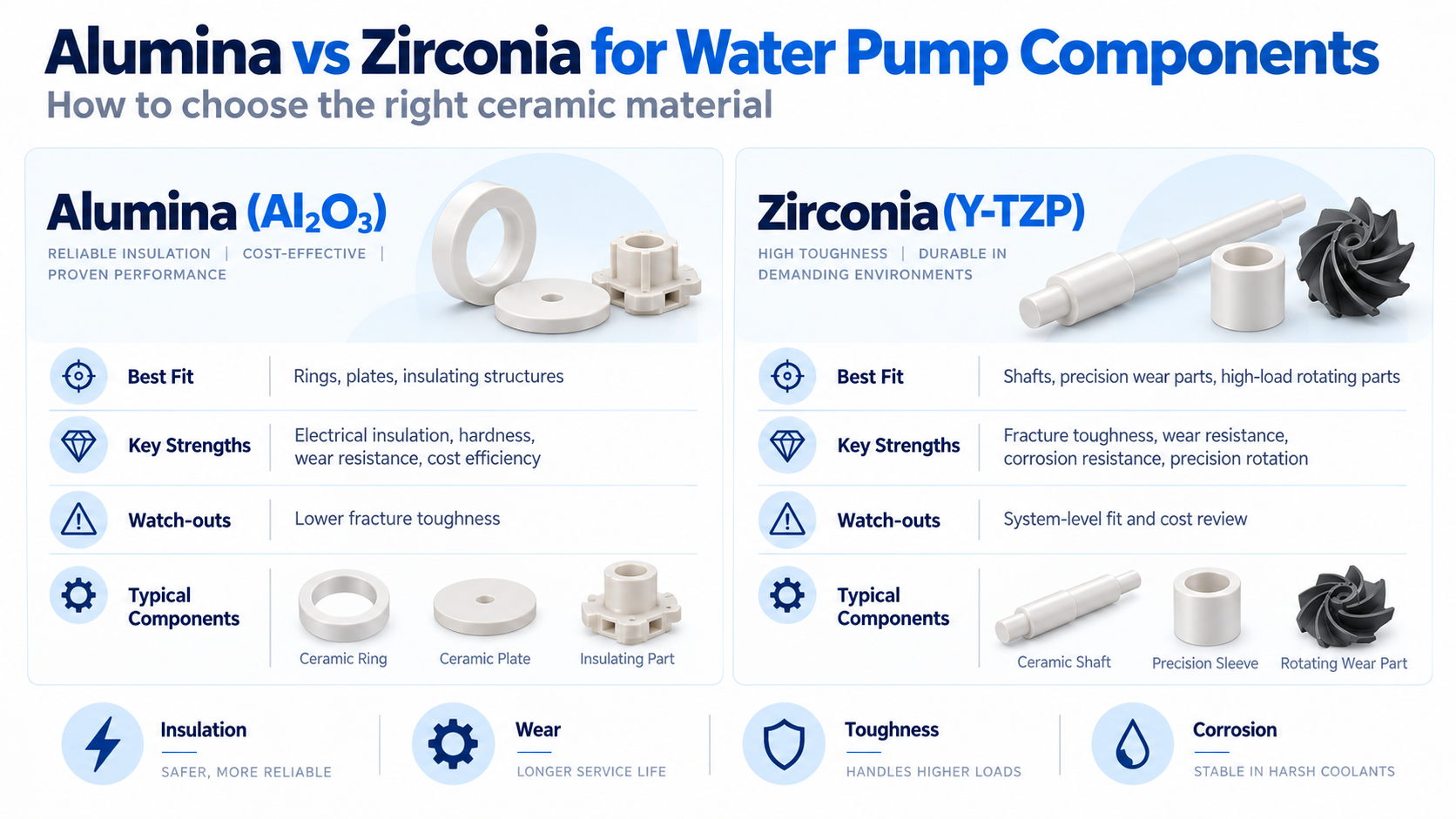
Alumina and zirconia are both advanced ceramic materials, but they should not be
treated as interchangeable.
When Alumina May Be Considered
Alumina is commonly evaluated when electrical insulation, hardness, wear resistance,
chemical stability and cost effectiveness are important.
It may be suitable for rings, plates, insulating structures and other
alumina water pump components depending on the design.
When Zirconia May Be Considered
Zirconia generally offers higher fracture toughness than alumina and can be useful
where the component experiences more demanding mechanical loading or requires a
precision wear surface.
This is one reason zirconia is frequently considered for precision shafts and
other rotating or wear-related parts.
However, the material decision should still consider:
- Wear environment
- Impact and bending risk
- Electrical insulation requirement
- Coolant or corrosive medium
- Wall thickness and geometry
- Mating material
- Manufacturability
- Cost target
When Ceramic Is Not the Right Choice
Technical ceramics have valuable engineering properties, but they are not automatically
the best material for every water pump component.
Metal or polymer may be more suitable when:
- The component experiences uncontrolled impact
- The design produces severe tensile or bending stress
- The mounting method creates excessive local stress
- The geometry is poorly suited to ceramic manufacturing
- A lower-cost metal or polymer already meets the application requirements
This is an important distinction because replacing metal with ceramic without reviewing
the system can simply move the failure from wear or corrosion to cracking or assembly damage.
Common Design and Assembly Risks
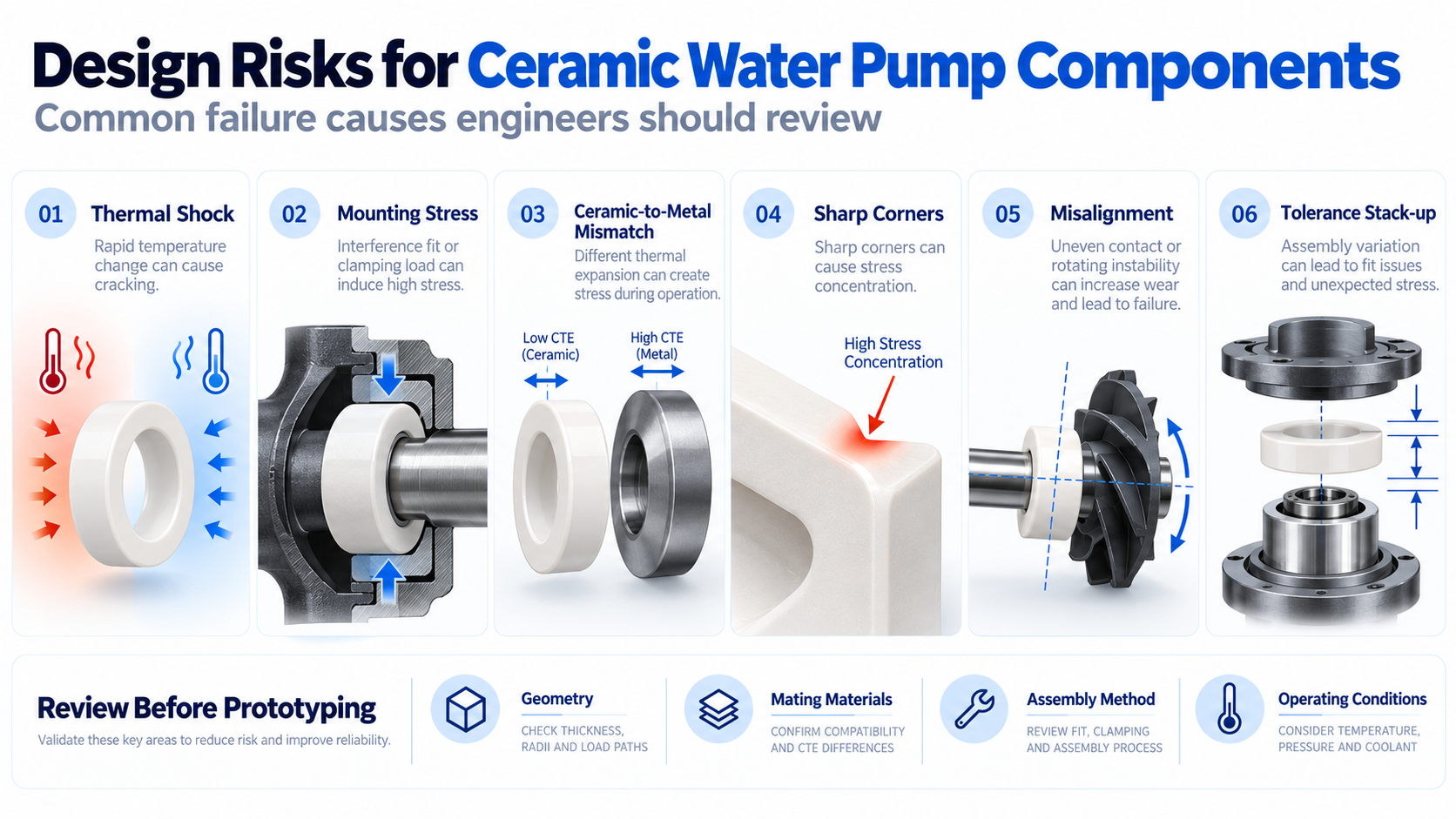
Sharp Corners and Stress Concentration
Sharp internal corners and abrupt geometry changes can concentrate stress.
Larger radii and smoother transitions may be worth evaluating during drawing review.
Interference Fit and Mounting Stress
Ceramics do not plastically deform like many metals.
An interference condition that is acceptable in a metal-to-metal assembly can create
dangerous local stress in a ceramic component.
Ceramic-to-Metal Thermal Expansion Mismatch
A ceramic component may be assembled into a metal housing or against another material
with different thermal expansion behavior.
Temperature cycling can therefore introduce stress even when the initial room-temperature
fit appears acceptable.
Surface Finish and Mating-Part Wear
A very hard ceramic surface may still create problems if the mating component,
surface finish or lubrication condition is unsuitable.
The complete tribological pair should be reviewed rather than evaluating only
the ceramic component.
Tolerance Stack-Up
Applying unnecessarily tight tolerances to every dimension can increase cost
without improving the pump.
Critical functional dimensions should be identified separately from dimensions
that can tolerate normal manufacturing variation.
What Should Be Included in an ODM Drawing Review?
For custom EV water pump components, a drawing alone may not provide
enough information to select the correct ceramic material or manufacturing route.
A useful engineering review should include:
- Component function
- Pump medium or coolant
- Operating temperature range
- Rotational or sliding contact conditions
- Load direction
- Mating materials
- Critical dimensions and tolerances
- Surface requirements
- Assembly method
- Estimated annual quantity
- Existing failure mode, if applicable
Providing this information early can help determine whether alumina, zirconia
or another material approach is appropriate before prototype production begins.
Frequently Asked Questions
Which water pump components are commonly made from technical ceramics?
Depending on the pump design, ceramic shafts, rings, plates, bushings and other
custom wear or insulating components may be evaluated. Not every pump contains
all of these components.
Is alumina or zirconia better for a water pump component?
There is no universal answer. Alumina may be attractive for insulation, hardness,
wear resistance and cost, while zirconia may be considered where greater fracture
toughness or mechanical durability is needed.
Can ceramic replace metal in every rotating component?
No. Impact, bending stress, assembly method, geometry, mating materials and cost
must all be considered before converting a metal part to ceramic.
What can cause a ceramic water pump component to crack?
Possible causes include mounting stress, interference fit, sharp geometry,
misalignment, thermal expansion mismatch, impact and excessive mechanical loading.
What information is required for an ODM ceramic component review?
The most useful information includes the drawing, component function, operating
conditions, mating materials, critical dimensions, load conditions, surface requirements
and expected quantity.
Request an ODM Drawing Review
Zhengqiang supports drawing-based ODM development of alumina and zirconia ceramic
components for EV and electronic water pump applications.
If you are developing a custom shaft, ring, plate or other ceramic component,
send your drawing together with the operating conditions and mating-material details
for an engineering and manufacturability review.