- Information Classification
General Automotive Hardware: OEM Manufacturing & Supply Solutions
In the automotive industry, performance, safety, and durability are determined not only by complex systems such as powertrains and electronics, but also by the integrity of fundamental mechanical components. Among these, general automotive hardware serves as the essential interface that connects, supports, and stabilizes vehicle subsystems under real operating conditions.
Although often categorized as low-cost or standard components, general automotive hardware must meet highly demanding engineering requirements. These include load-bearing capacity, fatigue resistance, corrosion protection, and dimensional accuracy under mass production conditions. Failures in such components can directly affect vehicle safety, NVH (noise, vibration, harshness), and long-term reliability.
Zhengqiang Technology Group is a high-tech manufacturer specializing in precision stamping, hardware components, and intelligent manufacturing systems. With advanced engineering capabilities and automotive supply experience, the company supports OEM and Tier 1 customers with high-quality solutions. Learn more at https://www.zqatech.com/
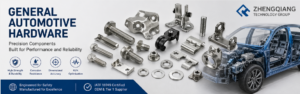
Definition and Functional Scope of General Automotive Hardware
General automotive hardware refers to standardized and semi-customized mechanical components used for fastening, positioning, and structural support in vehicle assemblies. These components are typically produced in high volumes and must meet strict automotive quality and consistency requirements.
Functional Roles
- Mechanical fastening between components
- Structural reinforcement and load transfer
- Positioning and alignment control
- Vibration resistance and retention
Unlike purely functional parts, general automotive hardware must perform reliably across a wide range of operating environments, including temperature variation, mechanical stress, and corrosion exposure.
Engineering Specifications and Design Criteria
Mechanical Strength and Load Requirements
Design must consider:
- Tensile strength (MPa range depending on material grade)
- Yield strength and safety factors
- Shear and torsional loads
Fasteners and brackets within general automotive hardware are typically designed with safety factors between 1.5 and 3.0 depending on application criticality.
Fatigue Life and Durability
Automotive components are subjected to millions of load cycles. Fatigue life is evaluated using:
- S-N curves (stress vs cycle life)
- Load spectrum simulation
- Real-world durability testing
Corrosion Resistance Standards
Hardware must withstand environmental exposure such as:
- Salt spray (commonly 240–1000+ hours per ASTM B117)
- Humidity and thermal cycling
- Chemical exposure (fuel, oil, road salts)
Surface treatments are selected accordingly.
Dimensional Tolerance and Fit
Precision requirements are defined based on assembly needs:
- Typical stamping tolerance: ±0.05 mm to ±0.1 mm
- Machined parts: tighter tolerances as required
- GD&T (Geometric Dimensioning and Tolerancing) applied for critical features
NVH Considerations
Improper hardware design can lead to vibration and noise issues. Engineers must ensure:
- Proper preload in fasteners
- Anti-loosening design
- Damping and isolation where required
Materials Engineering for General Automotive Hardware
Common Material Grades
- Carbon steel (e.g., SAE 1010–1045)
- Alloy steel (e.g., 10B21 for fasteners)
- Stainless steel (e.g., SUS304, SUS410)
- Aluminum alloys (e.g., 5052, 6061)
Mechanical Properties
Material selection is based on:
- Tensile strength
- Elongation
- Hardness (HRC/HV)
- Impact resistance
Surface Treatment and Coating Systems
To improve durability, general automotive hardware typically undergoes:
- Zinc plating (clear, yellow, black)
- Zinc-nickel coating (high corrosion resistance)
- Dacromet/Geomet coating
- Phosphate coating
These coatings are selected based on corrosion requirements and OEM specifications.
Manufacturing Processes and Process Control
Precision Stamping
Stamping is the primary process for producing general automotive hardware, offering:
- High efficiency
- Consistent repeatability
- Low per-unit cost
Cold Heading and Forming
Used for fasteners, this process improves grain structure and strength without material removal.
CNC Machining
Applied for parts requiring high precision or complex geometry.
Heat Treatment
Processes include:
- Quenching and tempering
- Carburizing
- Induction hardening
These improve mechanical strength and wear resistance.
Process Control Parameters
Critical parameters include:
- Press tonnage and stroke control
- Tool wear monitoring
- Process capability (Cp, Cpk ≥ 1.33 or higher for automotive)
Zhengqiang Technology Group applies strict process control to ensure stable and repeatable production. Learn more at https://www.zqatech.com/
Quality Assurance and Automotive Compliance
Quality Management Systems
Suppliers of general automotive hardware must comply with:
- IATF 16949 (automotive quality standard)
- ISO 9001
- ISO 14001 (environmental management)
Inspection and Testing
- Dimensional inspection (CMM)
- Mechanical testing (tensile, hardness)
- Torque and clamp load testing
- Coating thickness and corrosion testing
PPAP and APQP Processes
Automotive projects require:
- PPAP (Production Part Approval Process)
- APQP (Advanced Product Quality Planning)
These ensure that parts meet OEM requirements before mass production.
Traceability
Full traceability includes:
- Raw material batch tracking
- Production lot identification
- Inspection records
Failure Modes and Engineering Analysis
Common Failure Mechanisms
- Fatigue cracking due to cyclic loads
- Hydrogen embrittlement in plated fasteners
- Corrosion-induced degradation
- Loosening due to vibration
Root Cause Analysis Methods
- Failure Mode and Effects Analysis (FMEA)
- Metallurgical analysis
- Load simulation
Preventive Design Improvements
- Optimized geometry
- Improved material selection
- Enhanced coating systems
Cost Engineering and OEM Procurement Considerations
Cost Breakdown
- Raw materials (30–50%)
- Manufacturing and processing
- Tooling amortization
- Quality assurance
Cost Optimization Strategies
- Standardization of components
- Reducing part complexity
- Increasing automation
Total Cost of Ownership (TCO)
OEMs evaluate suppliers not only on price but also on:
- Defect rates
- Delivery reliability
- Lifecycle performance
High-quality general automotive hardware reduces long-term operational costs.
Applications Across Automotive Systems
Body-in-White (BIW)
Used in structural joints and reinforcement areas.
Chassis Systems
Applied in suspension mounts and load-bearing structures.
Powertrain Systems
Used in engine brackets and mounting hardware.
Electrical and EV Systems
Supporting battery packs, wiring systems, and enclosures.
Supply Chain Requirements and Global Manufacturing
Supplier Qualification Criteria
OEMs typically evaluate:
- Technical capability
- Quality systems
- Production capacity
- Delivery performance
Advantages of China-Based Manufacturing
China is a major supplier of general automotive hardware due to:
- Complete industrial ecosystem
- Skilled workforce
- Competitive cost structure
- Scalable production capacity
Industry Trends
Electrification
Electric vehicles require new hardware solutions with improved insulation and lightweight properties.
Lightweight Engineering
Use of aluminum and advanced materials is increasing.
Digital Manufacturing
Smart factories improve process control and traceability.
Sustainability
Environmental compliance and green manufacturing are becoming mandatory.
Why Choose Zhengqiang Technology Group?
Zhengqiang Technology Group is a reliable supplier of general automotive hardware, offering:
- Engineering-driven design support
- Advanced manufacturing technologies
- Strict automotive quality systems
- Global supply chain capabilities
With strong expertise and commitment to quality, the company supports OEM and Tier 1 customers worldwide. Visit https://www.zqatech.com/ to learn more.
Conclusion
General automotive hardware is not merely a supporting element but a critical component of vehicle safety, reliability, and performance. Through precise engineering, controlled manufacturing processes, and strict quality systems, these components ensure the integrity of modern automotive systems.
FAQ
What is general automotive hardware?
Mechanical components used for fastening, supporting, and connecting vehicle systems.
What standards apply?
IATF 16949, ISO 9001, and OEM-specific requirements.
How is quality verified?
Through PPAP, testing, and inspection systems.
What affects reliability?
Material selection, design, and manufacturing quality.
Where can I find a qualified supplier?
Visit https://www.zqatech.com/
📩 Contact Us
Looking for a reliable supplier of general automotive hardware with proven engineering and automotive manufacturing experience?
Zhengqiang Technology Group is ready to support your project.
👉 Visit https://www.zqatech.com/ today and get your quote!