- Information Classification
What Is an Die Tool: Types, Uses and Guide
Introduction to What Is an Die Tool
In precision manufacturing, tools that can deliver consistent, high-volume, and accurate results are essential. One of the most important tools in this field is the die tool. If you are asking what is an die tool, it refers to a specialized manufacturing tool used to cut, shape, or form materials—typically metal—into specific geometries using force, usually through a press system.
Understanding what is an die tool is critical for industries such as automotive, electronics, home appliances, and industrial equipment, where millions of identical parts must be produced with tight tolerances. As a high-tech enterprise focused on precision components, mold manufacturing, and intelligent equipment, Zhengqiang Technology Group provides advanced die tool solutions for global markets.
What Is an Die Tool in Manufacturing?
To clearly define what is an die tool, it is a custom-engineered tool designed to transform raw material—such as metal sheets—into finished or semi-finished parts through processes like stamping, cutting, bending, or forming.
Die tools are typically installed in mechanical or hydraulic presses. When force is applied, the die and punch interact to shape or cut the material according to the desired design. These tools are essential for mass production due to their ability to ensure consistency, speed, and cost efficiency.
In simple terms, what is an die tool can be understood as the “mold” that defines the final shape of a manufactured part in metalworking processes.
Types of Die Tools
To better understand what is an die tool, it is important to explore the different types used in industrial production.
Progressive Die
A progressive die performs multiple operations in sequence within a single press. As the material moves through different stations, it undergoes cutting, bending, and shaping processes step by step. This type is ideal for high-volume production.
Compound Die
A compound die carries out multiple cutting operations in a single stroke. It is commonly used for flat parts where precision and speed are required.
Transfer Die
A transfer die moves the workpiece between different stations during the manufacturing process. This allows for more complex geometries and deeper forming operations.
Forming Die
A forming die reshapes material without cutting it, making it suitable for bending and contouring applications.
Each type highlights a different aspect of what is an die tool and how it supports various production needs.
Key Components of a Die Tool
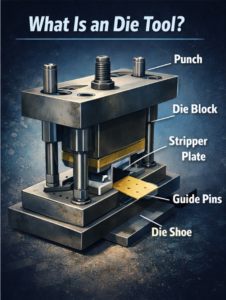
A deeper understanding of what is an die tool requires knowledge of its core components:
- Punch: Applies force to cut or shape the material
- Die Block: Contains the cavity that determines the final shape
- Stripper Plate: Removes material from the punch after operation
- Guide Pins: Ensure alignment between upper and lower sections
- Die Shoe: Provides structural support and stability
These components work together to ensure precision, repeatability, and durability in manufacturing operations.
How Does a Die Tool Work?
To fully grasp what is an die tool, it is essential to understand its working principle.
A die tool is mounted in a press machine. When the press is activated, the punch moves downward toward the die. The material placed between them is either cut or formed into a specific shape.
Depending on the design, the process may include:
- Blanking (cutting out shapes)
- Piercing (creating holes)
- Bending (changing angles)
- Drawing (forming deep shapes)
The accuracy of the die tool ensures that each part produced meets strict quality standards.
Applications of Die Tools Across Industries
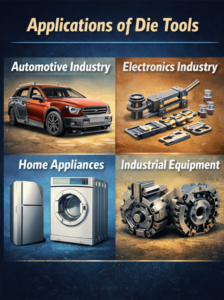
The concept of what is an die tool becomes more practical when examining its applications:
Automotive Industry
Used for manufacturing body panels, brackets, and structural components.
Electronics Industry
Essential for producing connectors, terminals, and precision metal parts.
Home Appliances
Applied in the production of casings, frames, and internal components.
Industrial Equipment
Used for creating durable and high-precision mechanical parts.
With capabilities in precision stamping, mold manufacturing, and surface treatment, Zhengqiang Technology Group supports global industries with high-quality die tool solutions. Learn more at https://www.zqatech.com/
Materials Used in Die Tool Manufacturing
When discussing what is an die tool, material selection plays a crucial role in performance and lifespan.
Common materials include:
- Tool Steel: High strength and wear resistance
- Carbide: Suitable for high-volume, high-precision applications
- Coated Materials: Improve durability and reduce friction
Advanced material technologies ensure die tools can withstand high pressure, repeated use, and harsh working conditions.
Advantages of Die Tools in Modern Manufacturing
Understanding the benefits helps clarify what is an die tool in industrial contexts.
High Precision
Die tools produce components with tight tolerances and consistent quality.
Mass Production Capability
They enable rapid production of large quantities of identical parts.
Cost Efficiency
While initial tooling costs may be high, long-term production costs are significantly reduced.
Repeatability
Ensures every product meets the same specifications, improving overall quality control.
Design and Manufacturing Considerations
The design process is a critical part of understanding what is an die tool in practice.
Key factors include:
- Product geometry and complexity
- Material thickness and properties
- Production volume requirements
- Tool durability and maintenance needs
Modern technologies such as CAD/CAM design, CNC machining, and automated production systems are used to create high-precision die tools.
Maintenance and Lifespan of Die Tools
Maintenance is an important aspect of what is an die tool in long-term use.
Regular inspection and servicing are required to maintain performance. Key maintenance practices include:
- Cleaning and lubrication
- Replacing worn components
- Checking alignment and precision
Proper maintenance extends tool life and ensures consistent production quality.
Future Trends in Die Tool Technology
The evolution of what is an die tool is closely linked to advancements in manufacturing technology.
Emerging trends include:
- Smart manufacturing and automation
- Integration with digital design systems
- Use of advanced materials and coatings
- Increased precision through AI-assisted design
These innovations are improving efficiency, reducing waste, and enhancing product quality.
Conclusion
So, what is an die tool? It is a fundamental manufacturing solution that enables precise, efficient, and large-scale production of metal components. From simple parts to complex industrial components, die tools are essential in modern manufacturing.
With extensive experience in precision stamping, mold manufacturing, intelligent equipment, and advanced materials, Zhengqiang Technology Group provides customized die tool solutions for global clients. Choosing the right die tool and manufacturing partner is key to achieving high efficiency and consistent quality.
Work With a Reliable Die Tool Manufacturer
Looking to improve your manufacturing efficiency with high-quality die tools? Visit https://www.zqatech.com/ to explore our full capabilities. Our expert team is ready to provide customized solutions tailored to your needs.
Contact us today to enhance your production performance and stay ahead in the competitive market.