Alumina Ceramic Substrate for Power Electronics: Thermal Conductivity, Insulation & Selection Guide
An alumina substrate is widely used in power electronics and electrical assemblies where
heat transfer and electrical insulation are required at the same time.
However, selecting the right ceramic substrate involves more than simply choosing an alumina grade.
Engineers also need to evaluate purity, thickness, flatness, geometry, surface requirements,
mounting stress and the actual electrical and thermal conditions of the assembly.
This guide explains the main factors to consider before specifying a custom alumina ceramic substrate.
What Is an Alumina Ceramic Substrate?
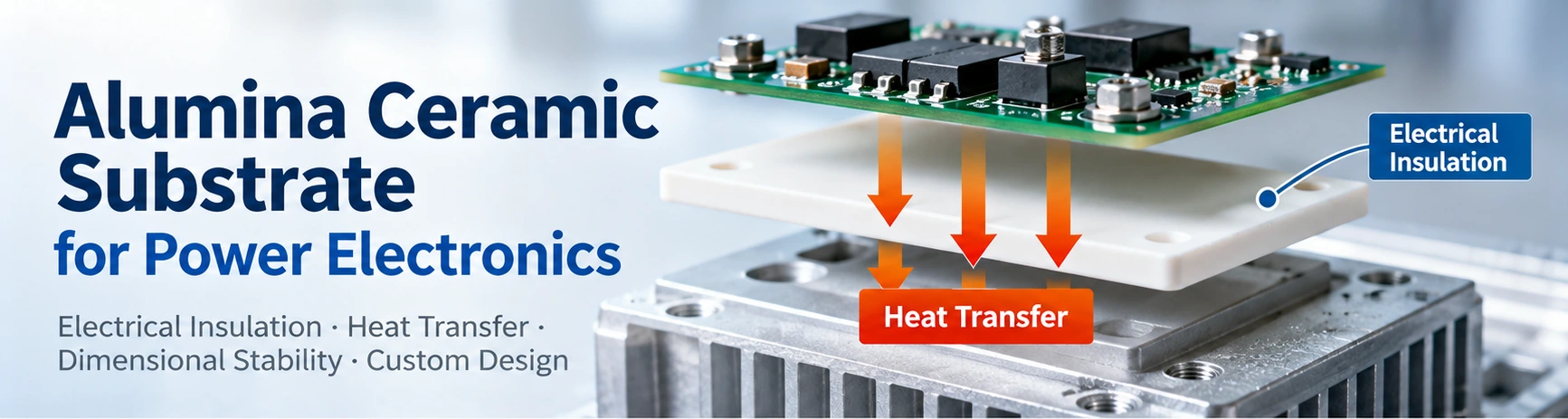
An alumina ceramic substrate is a flat or custom-shaped ceramic component made primarily from
aluminum oxide (Al2O3).
In electronic and power assemblies, it can provide an electrically insulating interface
while also helping transfer heat away from heat-generating components.
Depending on the application, an alumina substrate may be a simple ceramic plate or a customized component
with holes, slots, stepped features, locating points or irregular external profiles.
Ceramic Substrate vs. General Ceramic Plate
The terms are sometimes used interchangeably, but their design requirements may be different.
A general ceramic plate may only require basic dimensional and mechanical stability.
A ceramic substrate used in an electrical or thermal assembly often requires closer control of
thickness, flatness, surface condition and insulation performance.
Why Alumina Is Used in Power and Electronic Assemblies
Alumina is widely considered for power and electronic applications because it combines several useful
engineering characteristics in one material.
Electrical Insulation
Alumina is an electrically insulating ceramic, making it useful when conductive parts need to be isolated
from metal housings, heat-spreading structures, circuit assemblies or other components.
The same material principle is also used in high-voltage connector applications.
For example, a custom
alumina ceramic housing for high-voltage EV connectors
can provide electrical isolation while maintaining dimensional stability in demanding assemblies.
Heat Transfer
Alumina can combine electrical insulation with useful thermal conductivity.
This makes it suitable for designs where heat needs to pass through an electrically insulating component.
The final thermal performance should not be judged from material conductivity alone.
Substrate thickness, contact area, interface condition, assembly pressure and the complete thermal path
can all affect the actual result.
Mechanical and Dimensional Stability
Ceramic substrates can provide stable geometry in assemblies where dimensional control is important.
This can help maintain controlled spacing, positioning and contact between adjacent components.
At the same time, ceramics are brittle materials.
Mounting design, edge geometry and assembly stress therefore need to be considered early in the design process.
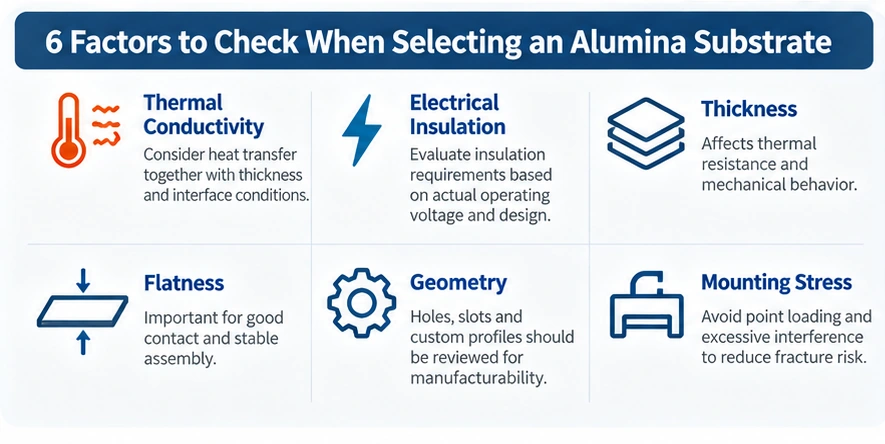
6 Factors to Check When Selecting an Alumina Substrate
The correct alumina substrate cannot be selected from a single material property.
Engineers should review the thermal, electrical, dimensional and mechanical requirements together.
1. Thermal Conductivity
Thermal conductivity indicates how efficiently heat can move through the ceramic material.
Higher conductivity may help reduce thermal resistance, but substrate thickness and interface conditions
also play an important role.
Engineers should therefore evaluate the complete thermal path rather than selecting a material only
from a thermal conductivity value.
2. Electrical Insulation
Electrical requirements may include volume resistivity, dielectric performance, insulation distance
and operating voltage.
The appropriate requirement depends on the actual circuit and assembly design.
If dielectric strength or other electrical limits are critical,
they should be specified directly in the drawing or RFQ rather than assumed from a generic alumina grade.
3. Thickness
Thickness influences both thermal resistance and mechanical behavior.
A thinner ceramic component can shorten the heat-transfer path,
while a thicker component may provide different mechanical or insulation characteristics.
There is no universal ideal thickness.
The correct value depends on the application, geometry and surrounding assembly.
4. Flatness
Flatness is especially important when the substrate contacts a PCB, metal housing or heat-spreading surface.
Poor contact can create gaps between surfaces and increase interface thermal resistance.
When flatness is critical, the drawing should clearly define the reference surface and inspection requirement.
5. Geometry
Holes, narrow slots, thin walls, sharp internal corners and sudden changes in section thickness
may affect manufacturability and local stress.
Complex features should be reviewed before production so that the ceramic geometry can be balanced
with tolerance and manufacturing requirements.
6. Mounting Stress
Ceramic components should not be treated like flexible metal shims.
Point loading, uneven clamping, excessive interference or poor surface contact can create local stress
and increase fracture risk.
How Alumina Purity Affects Substrate Selection
Alumina ceramics are available in different purity levels.
Engineering discussions commonly compare approximately 95–96% alumina with higher-purity grades
such as 99% alumina.
Purity can influence electrical, thermal, mechanical and processing characteristics,
but the exact performance depends on the ceramic formulation and manufacturing process.
Higher purity is therefore not automatically the best choice for every application.
95–96% Alumina
These grades are commonly considered when engineers require a practical balance between insulation,
thermal performance, mechanical stability, manufacturability and cost.
99% Alumina and Higher-Purity Grades
Higher-purity alumina may be selected where an application requires stricter material performance
or greater material purity.
The actual benefit should be evaluated against the electrical, thermal and mechanical requirements
of the application.
Do Not Select Purity Without an Engineering Reason
Instead of specifying the highest available purity by default,
define the actual working conditions first:
operating voltage, temperature, heat load, dimensions, mounting method and inspection requirements.
The ceramic grade can then be selected around the real application requirements.
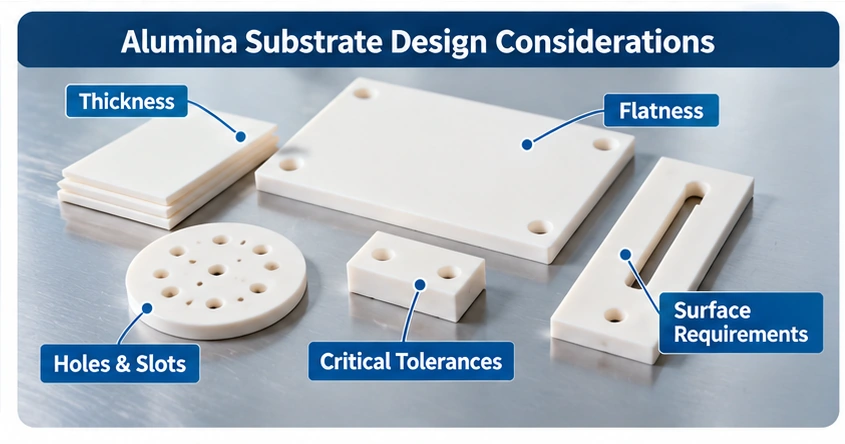
Alumina Substrate Design Considerations
Good material selection does not guarantee a reliable ceramic component.
The substrate geometry and assembly method also need to be designed around the characteristics of technical ceramics.
Thickness and Thermal Resistance
When heat must pass through the ceramic, thickness becomes part of the total thermal resistance.
Designers should evaluate the substrate together with interface materials,
adjacent metal parts and the heat-generating component.
Holes, Slots and Custom Profiles
Custom alumina substrates do not need to be simple rectangles.
Depending on manufacturability, they can include holes, slots, locating features and irregular profiles.
Very narrow features, thin sections or sharp corners should be reviewed early because they can influence
manufacturing stability and fracture risk.
Critical Tolerances
Ceramic manufacturing is different from conventional metal machining.
Dimensions that appear simple on a CAD drawing may require different manufacturing routes depending on
tolerance, thickness and geometry.
Critical dimensions should therefore be identified separately from non-critical dimensions during drawing review.
Surface Requirements
Surface requirements depend on how the ceramic interfaces with other components.
Some designs prioritize contact quality and flatness, while others may require additional finishing
or controlled surface characteristics.
Where Alumina Ceramic Substrates Are Used
Power Electronic Assemblies
Alumina substrates can be used where electrical isolation and heat transfer are both required
between electronic components and surrounding structures.
EV and Electronic Water Pumps
In electronic pump assemblies, an electrically insulating ceramic plate can form part of the thermal path
between a circuit board and the pump housing.
See an application example:
alumina ceramic heat-dissipation plate for EV water pumps
.
Electrically Insulated Heat-Spreading Components
Some assemblies require heat transfer without allowing electrical conduction between adjacent components.
A properly specified ceramic substrate can help provide this functional separation.
High-Voltage Electrical Assemblies
Alumina may also be used in components where electrical insulation,
dimensional stability and thermal performance need to be considered together.
Custom Industrial Ceramic Components
Substrate-type components can also be used in sensors, appliances,
electrical assemblies and customized industrial equipment.
Zhengqiang supports
custom alumina and zirconia ceramic components
for drawing-based applications.
Alumina vs. Other Ceramic Substrate Materials
Alumina vs. Aluminum Nitride
Aluminum nitride is often considered in applications where very high thermal conductivity is a primary requirement,
while alumina is widely used where designers require a practical balance of electrical insulation,
thermal performance, dimensional stability and cost.
The correct choice depends on heat load, insulation requirements, geometry,
production requirements and total system cost.
Material selection should therefore be based on the complete assembly rather than thermal conductivity alone.
Alumina vs. Zirconia
Alumina and zirconia are both advanced ceramic materials,
but they are usually selected for different combinations of electrical,
thermal, wear and mechanical requirements.
For example, zirconia is often considered for precision rotating and wear-related components such as a
precision zirconia ceramic shaft
,
while alumina is commonly considered for insulating plates, housings and substrate-type components.
What Should Be Included in an Alumina Substrate RFQ?
A clear RFQ helps the ceramic manufacturer evaluate manufacturability
and reduces unnecessary communication during development.
Useful information can include:
- 2D drawing and 3D model if available
- Overall dimensions
- Required thickness
- Critical dimensional tolerances
- Flatness requirements
- Hole and slot geometry
- Surface requirements
- Preferred alumina purity if already specified
- Electrical insulation requirements
- Thermal requirements
- Operating temperature and assembly conditions
- Prototype and estimated production quantities
If the substrate must meet a specific electrical or thermal target,
include that requirement explicitly rather than relying only on the ceramic material name.
For non-standard geometries, Zhengqiang supports
drawing-based custom technical ceramic parts
with engineering review and prototype evaluation.
Frequently Asked Questions
What is an alumina substrate?
An alumina substrate is a ceramic component made primarily from aluminum oxide
and used where electrical insulation, thermal transfer and dimensional stability are required.
What is an alumina ceramic substrate used for?
It can be used in power electronics, electronic pumps, high-voltage assemblies,
sensors and other electrical or thermal applications.
Is alumina electrically insulating?
Yes. Alumina is an electrical insulating ceramic.
The required electrical performance should still be confirmed for the specific grade,
thickness and operating conditions.
Can an alumina substrate transfer heat?
Yes. Alumina can conduct heat while maintaining electrical insulation.
Actual thermal performance depends on the ceramic grade, substrate thickness,
contact area and total thermal path.
Is 96% or 99% alumina better?
Neither grade is universally better.
Selection depends on electrical, thermal, dimensional, mechanical and cost requirements.
Can custom holes and slots be made in an alumina substrate?
Custom geometries are possible, but manufacturability depends on thickness,
feature size, tolerance and edge geometry.
A drawing review is recommended before production.
What thickness should an alumina substrate be?
There is no single correct thickness.
It depends on thermal resistance, electrical requirements,
mechanical support and the design of the surrounding assembly.
What information should I provide for a custom alumina substrate?
Provide the drawing, dimensions, critical tolerances, purity requirement if known,
electrical and thermal requirements, surface requirements,
operating conditions and expected production quantity.
Conclusion: Select the Substrate Around the Application
Selecting an alumina substrate requires balancing electrical insulation,
heat transfer, thickness, flatness, geometry and assembly stress.
A ceramic grade that performs well in one application may not be the best choice for another.
The most reliable approach is to start with the actual working conditions
and identify which dimensions and performance requirements are critical.
Need a custom alumina ceramic substrate?
Send your drawing and operating requirements to Zhengqiang for engineering feasibility review,
material evaluation and prototype assessment.