Ceramic Manufacturing Process: From Forming and Sintering to Quality Control
Ceramic manufacturing involves a series of controlled steps that transform ceramic raw materials
into functional technical components. For alumina and zirconia parts, the manufacturing route may include
material preparation, forming, deburring, cleaning, high-temperature sintering, dimensional inspection
and application-specific testing.
The exact process depends on the ceramic material, component geometry, thickness, production quantity
and final application. A thin alumina plate, a zirconia shaft and an electrical-insulation component
may therefore follow different manufacturing routes even though they are all technical ceramic parts.
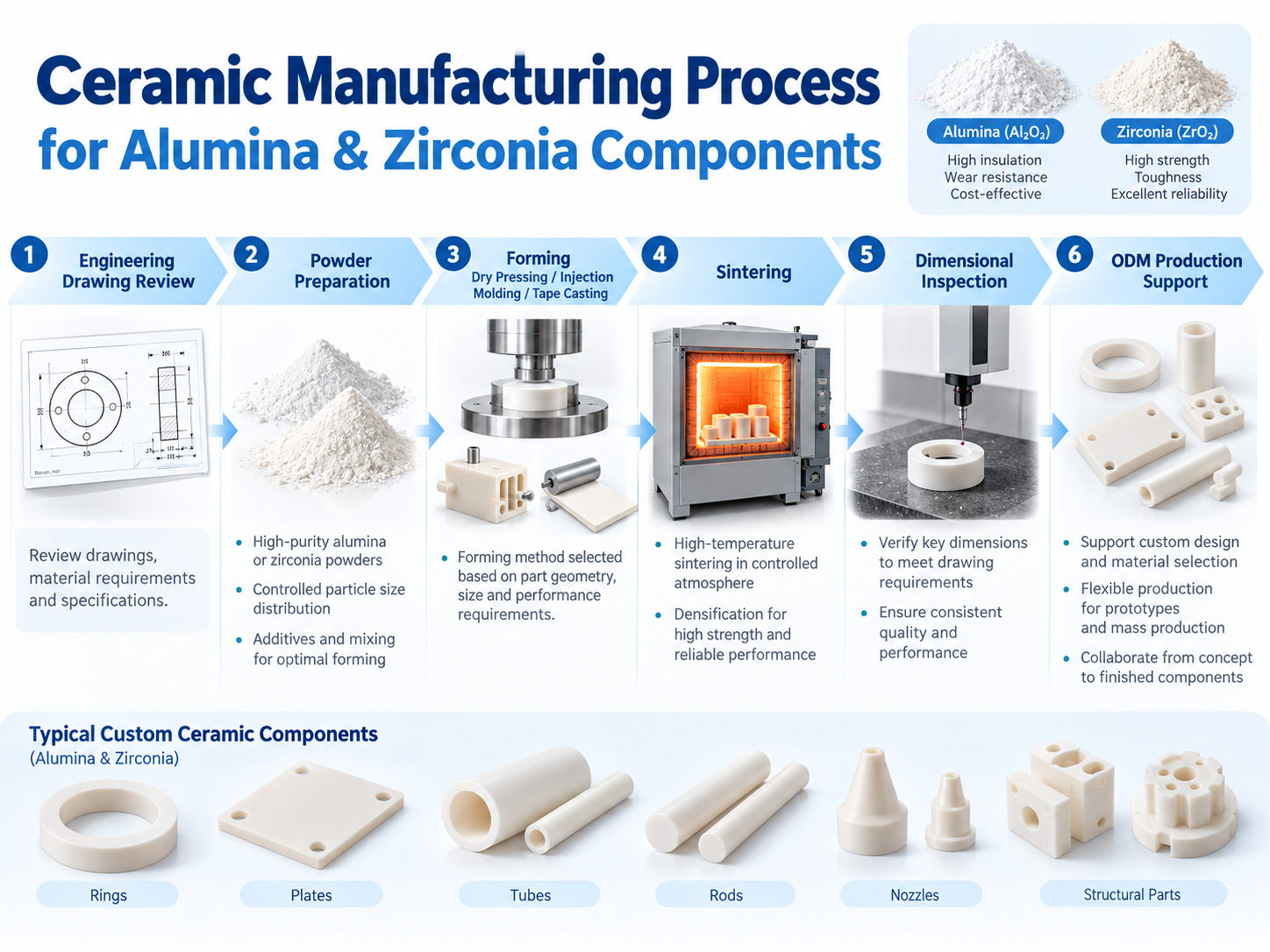
This guide explains the main stages of the ceramic manufacturing process,
how different forming methods are selected, why sintering is critical,
and what engineers should provide when developing a custom alumina or zirconia component.
What Is Technical Ceramic Manufacturing?
Technical ceramic manufacturing is the process of producing engineered ceramic components
for electrical, thermal, wear-resistant and structural applications.
Unlike decorative ceramics, technical ceramic parts are designed around functional requirements such as:
- Electrical insulation
- Thermal management
- Wear resistance
- Corrosion resistance
- Dimensional stability
- High-temperature performance
- Long-term component reliability
Common materials include alumina (Al2O3) and zirconia (ZrO2),
but the appropriate material and process should always be selected according to the application.
Main Stages of the Ceramic Manufacturing Process
Although the exact production flow varies by component,
a typical ceramic manufacturing project can be divided into several major stages.
- Application and drawing review
- Material and forming-process selection
- Ceramic forming
- Deburring and pre-sintering preparation
- Cleaning and handling
- High-temperature sintering
- Dimensional and visual inspection
- Application-specific secondary operations or functional testing
- Final inspection and production preparation
Not every product uses every step.
The manufacturing route should be selected according to the geometry and functional requirements
of the ceramic component.
Step 1: Application and Drawing Review
A custom ceramic project should begin with the application rather than the manufacturing process alone.
Before selecting a forming method, engineers need to understand how the ceramic part will function
inside the final assembly.
Useful information includes:
- 2D drawing
- 3D model, if available
- Application
- Preferred material
- Critical dimensions
- Part thickness
- Electrical requirements
- Thermal requirements
- Assembly conditions
- Expected quantity
This information helps determine whether alumina or zirconia is appropriate
and which forming process is better suited to the component.
Zhengqiang supports
drawing-based custom technical ceramic components
for alumina and zirconia applications.
Step 2: Selecting the Ceramic Material
Material selection is one of the most important decisions in technical ceramic manufacturing.
Alumina and zirconia offer different combinations of electrical, thermal,
mechanical and wear-related properties.
Alumina Ceramics
Alumina is widely used when electrical insulation,
thermal stability and dimensional performance are important.
Typical Zhengqiang applications include:
- EV charging connector ceramic housings
- Heat-dissipation and insulation plates
- Electrical ceramic components
- Custom structural ceramic parts
One example is an
alumina ceramic housing for EV charging connectors
,
where electrical insulation and dimensional stability are important to the application.
Zirconia Ceramics
Zirconia is often selected for components where wear resistance,
corrosion resistance and mechanical durability are important.
A typical example is a
zirconia ceramic shaft
used in coffee makers, water purifiers and small pump applications.
Material selection should therefore be based on the actual operating environment,
not simply on which ceramic has the highest value for one individual property.
Step 3: Ceramic Forming
The ceramic forming process creates the initial geometry of the component
before high-temperature sintering.
Different geometries require different forming methods.
Depending on the product design and production requirements,
Zhengqiang ceramic components may use processes such as dry pressing,
injection molding or tape casting.
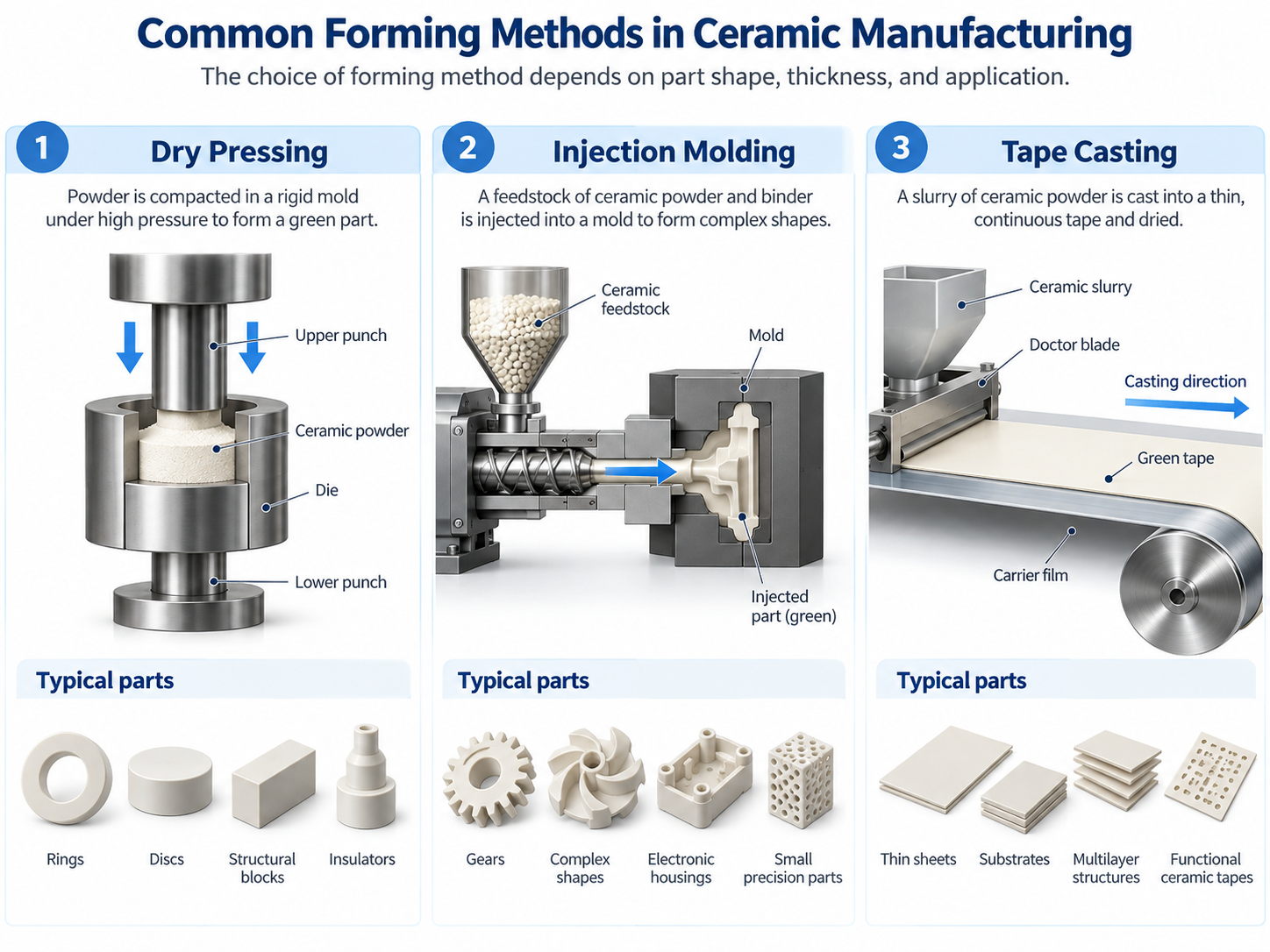
Dry Pressing
Dry pressing is suitable for many ceramic components with relatively stable,
repeatable geometries.
Ceramic powder is formed under controlled pressure to create a green body
that can later be prepared for sintering.
This method can be considered for components such as certain plates,
rings, blocks and other repeatable shapes.
Ceramic Injection Molding
Ceramic injection molding can be useful when the component geometry is more complex
or contains features that are difficult to produce through simpler pressing methods.
The suitability of injection molding depends on component shape,
size, feature design and production volume.
Tape Casting
Tape casting is associated with the production of thin ceramic sheet or plate-type components.
It can be considered when the application requires relatively thin ceramic structures
with controlled thickness.
For example, thin alumina ceramic plates may be used in electrical-insulation
and thermal-management assemblies.
Step 4: Deburring and Pre-Sintering Preparation
After forming, the ceramic component may require preparation before sintering.
At this stage, the ceramic body has not yet reached its final sintered condition
and should be handled carefully.
Depending on the product, preparation may include:
- Removing excess material
- Cleaning edges
- Checking visible forming defects
- Separating and arranging parts
- Preparing components for subsequent production steps
Consistent handling at this stage helps reduce defects before the component enters
the high-temperature sintering process.
Step 5: Cleaning and Part Handling
Cleanliness and controlled handling are important throughout the ceramic manufacturing process.
Dust, contamination or damage introduced before sintering may affect the final component.
Depending on the production line,
parts may be cleaned, organized or automatically fed between production stages.
For high-volume components, controlled feeding and consistent handling can also help improve
production efficiency and reduce unnecessary manual variation.
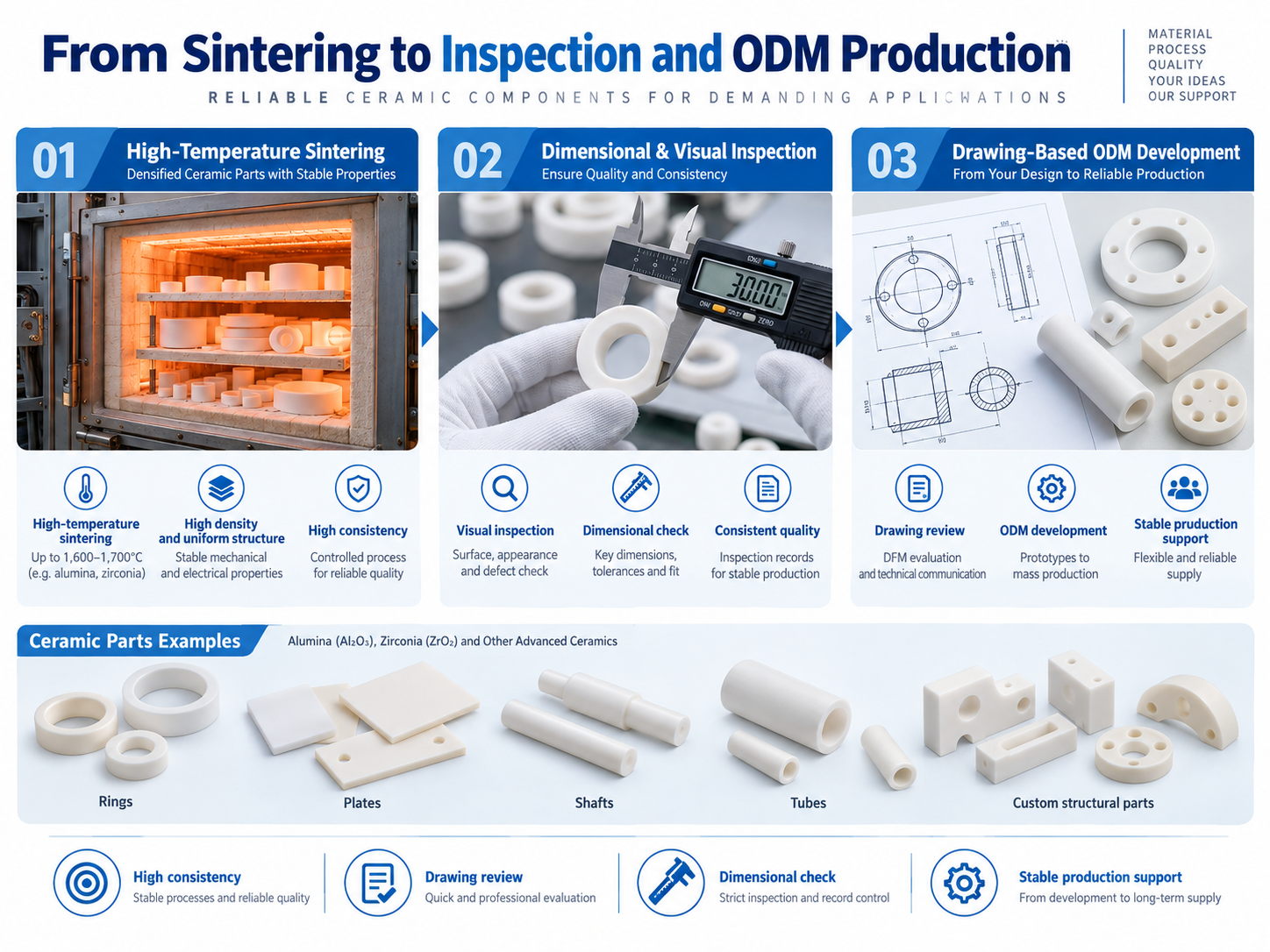
Step 6: High-Temperature Ceramic Sintering
Ceramic sintering is one of the most important stages in the entire production process.
During sintering, the formed ceramic body is exposed to a controlled high-temperature cycle
that develops the final ceramic structure and material properties.
The component changes significantly during this stage.
Its final dimensions are influenced by factors such as:
- Material formulation
- Green-body condition
- Part geometry
- Wall thickness
- Sintering conditions
- Dimensional shrinkage
This is one reason why ceramic component development should consider manufacturing feasibility
from the drawing stage.
Why Sintering Shrinkage Matters
Ceramic parts do not simply retain the exact dimensions of the green body after sintering.
Dimensional changes occur as the ceramic structure densifies.
For this reason, tool design, forming conditions and production control need to account
for the expected material behavior.
Step 7: Dimensional and Visual Inspection
Once ceramic parts have completed the required manufacturing stages,
dimensions and appearance need to be checked against the approved drawing and specification.
Inspection may include:
- Overall dimensions
- Thickness
- Diameter
- Hole or slot dimensions
- Critical assembly dimensions
- Part appearance
Not every dimension has the same functional importance.
Drawings should clearly identify which dimensions directly affect assembly,
insulation, thermal contact, rotation or other critical functions.
Step 8: Application-Specific Functional Testing
Some ceramic components require additional functional checks according to their application.
These tests should be defined according to the product rather than assumed to apply
to every technical ceramic component.
Electrical Ceramic Components
Products used in electrical applications may require electrical testing
or other application-specific checks according to the approved specification.
For example, the production flow for
microwave magnetron ceramic capacitors
can include electrical testing as part of product inspection.
Dimensional and Assembly-Critical Components
Components used in pumps, charging connectors or other precision assemblies
may place greater emphasis on dimensional consistency and interface geometry.
Step 9: Product-Specific Secondary Processes
Some ceramic products may require additional steps after the main forming and sintering stages.
These processes are product-specific and should not be assumed to apply to every ceramic component.
Depending on the product design, the manufacturing flow may include operations such as:
- Cleaning
- Selective coating where required by the product specification
- Component stacking or loading
- Electrical testing for applicable products
- Final dimensional verification
The actual production route should always be confirmed during engineering review.
How Ceramic Manufacturing Changes by Product Type
There is no single production route that applies to every technical ceramic component.
The manufacturing process should follow the geometry and function of the product.
| Component Type | Key Manufacturing Considerations | Typical Functional Focus |
|---|---|---|
| Alumina ceramic housing | Geometry, dimensional consistency, insulation structure | Electrical insulation and assembly |
| Thin alumina ceramic plate | Thickness, flatness, surface contact | Thermal transfer and electrical insulation |
| Zirconia ceramic shaft | Diameter, straightness, dimensional consistency | Rotation, wear resistance and corrosion resistance |
| Ceramic capacitor component | Material consistency, dimensions, electrical testing | Electrical performance |
| Custom structural ceramic part | Material, geometry, forming feasibility and quantity | Application-specific |
Ceramic Manufacturing for EV Water Pump Components
EV and electronic water-pump assemblies can use ceramic components where electrical insulation,
heat transfer or wear performance is required.
One example is an
alumina ceramic heat-dissipation plate for EV water pumps
.
In this application, the ceramic plate is installed between the pump housing
and the electronic circuit assembly.
The design therefore needs to consider thickness, flatness,
thermal requirements and electrical insulation together.
Ceramic Manufacturing for EV Charging Components
High-voltage and high-current charging systems can create demanding requirements
for electrical insulation and dimensional stability.
Alumina ceramic components can be considered when a connector design requires
stable insulating performance in demanding operating conditions.
Zhengqiang develops
custom alumina ceramic housings for EV charging connectors
based on customer drawings and application requirements.
Ceramic Manufacturing for Small Pump and Appliance Components
Zirconia ceramic components can also be used in small rotating assemblies
found in coffee makers, water purifiers and appliance pumps.
In these applications, the manufacturing process needs to support repeatable geometry
and stable component performance during operation.
See the
zirconia ceramic shaft for coffee makers and water purifiers
for one example.
Common Ceramic Manufacturing Design Mistakes
Choosing the Material Before Understanding the Application
Selecting alumina or zirconia based only on a material datasheet can lead to an unsuitable design.
Material choice should begin with the working environment and functional requirements.
Ignoring the Forming Process
Part geometry should be evaluated together with the intended forming method.
Thin walls, sharp corners, deep features or unusual thickness changes may affect production feasibility.
Applying Tight Requirements to Every Dimension
Not every dimension controls the function of the ceramic component.
Engineers should clearly identify critical dimensions and assembly interfaces.
Ignoring Sintering Shrinkage
Sintering changes the dimensions and structure of ceramic parts.
Ceramic components therefore require a different manufacturing approach from conventional metal parts.
Providing Only a 3D Model
A 3D model communicates geometry,
but a controlled 2D drawing is useful for defining dimensions,
critical requirements, material information and inspection criteria.
What Should Engineers Include in a Ceramic RFQ?
A complete RFQ allows the ceramic supplier to understand both the component
and the application before recommending a production route.
Useful information includes:
- 2D drawing
- 3D model if available
- Material preference: alumina or zirconia
- Purity requirement if already defined
- Application
- Overall dimensions
- Critical dimensions
- Electrical requirements
- Thermal requirements
- Operating environment
- Assembly method
- Inspection requirements
- Prototype quantity
- Estimated production quantity
If the ceramic grade has not yet been determined,
provide the operating conditions and functional requirements instead of selecting a material only by name.
Frequently Asked Questions About Ceramic Manufacturing
What is ceramic manufacturing?
Ceramic manufacturing is the controlled process of converting ceramic raw materials
into finished technical components through forming, preparation, sintering,
inspection and product-specific production steps.
How are alumina ceramic components manufactured?
The exact process depends on the component.
Alumina ceramic manufacturing may include material preparation,
dry pressing, injection molding or tape casting,
followed by preparation, high-temperature sintering and inspection.
How are zirconia ceramic components manufactured?
Zirconia components also require a controlled forming and sintering process.
The selected production route depends on part geometry,
dimensions, quantity and final application.
What is ceramic sintering?
Ceramic sintering is a high-temperature stage that develops the final ceramic structure
and properties after the component has been formed.
Dimensional changes during sintering must be considered during product development.
What ceramic forming processes are available?
Depending on the component design,
ceramic forming can include processes such as dry pressing,
ceramic injection molding and tape casting.
The most suitable method depends on geometry, thickness and production requirements.
Why is the drawing important in ceramic manufacturing?
The drawing identifies the geometry, dimensions and critical functional requirements
that influence material selection, forming method, inspection and production planning.
Can the same ceramic manufacturing process be used for every part?
No. A thin alumina plate, a zirconia shaft and an electrical ceramic component
may require different production routes.
The process should be selected according to the specific component and application.
What information is needed for a custom ceramic project?
Provide the drawing, application, preferred material if known,
critical dimensions, operating requirements and expected quantity.
This information supports manufacturability and material review.
From Drawing Review to ODM Production
Effective ceramic manufacturing begins before production starts.
Material selection, component geometry, forming method,
sintering behavior and inspection requirements should be considered together.
Zhengqiang supports drawing-based ODM development for custom alumina
and zirconia ceramic components used in EV charging,
electronic pumps, appliances and other industrial applications.
If you are evaluating a custom ceramic component,
send your drawing, material requirements,
application conditions and estimated quantity for engineering review.