a material grade. Buyers and engineers must also define operating
conditions, critical dimensions, assembly interfaces, and inspection
requirements before requesting a quotation.
An incomplete inquiry leaves important details open to interpretation.
Two suppliers may quote against different material assumptions,
tolerances, or inspection scopes, making their prices difficult to compare.
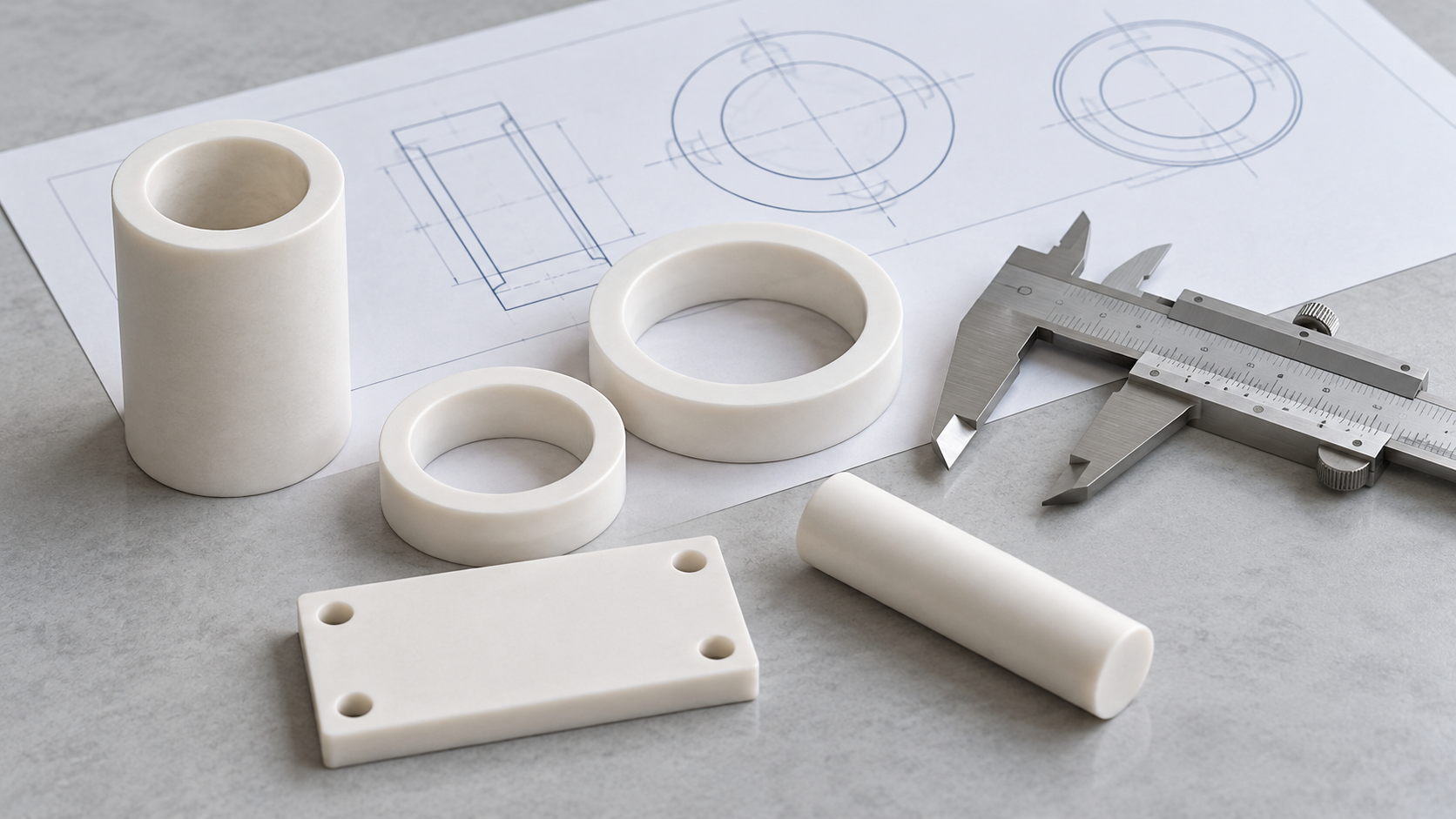
and dimensional inspection tools.
This seven-step guide explains how to prepare a clearer request for
quotation, from defining the component’s function to approving samples
and documenting production requirements.
What Is Alumina Ceramic?
Alumina ceramic is a technical ceramic based on aluminum oxide,
Al2O3. It is used in industrial applications
requiring combinations of electrical insulation, hardness, wear
resistance, and chemical resistance. The performance of a finished
component depends on its material grade, design, and operating conditions.
CeramTec’s aluminum oxide overview
explains that different compositions and microstructures produce
different material property profiles.
For procurement, “alumina ceramic” is therefore a material family,
not a complete purchasing specification. A useful inquiry identifies
the proposed grade or gives the supplier measurable requirements
against which to evaluate a material.
For background on the material, read our
introduction to alumina and aluminum oxide
.
1. Define the Function of Custom Alumina Ceramic Components
Begin with what the component must do. An insulating spacer,
locating sleeve, and wear ring can have similar shapes while
requiring different performance priorities.
Include these details in the application brief:
- Primary function:
electrical insulation, positioning, separation, wear protection,
or another defined purpose. - Operating environment:
temperature, moisture, fluids, chemicals, and abrasive particles. - Mechanical conditions:
compression, bending, vibration, impact, and repeated movement. - Expected service:
operating hours, duty cycle, maintenance interval, and replacement conditions. - Failure criteria:
cracking, leakage, electrical breakdown, excessive wear,
or loss of dimensional stability.
Separate normal operation from occasional abnormal conditions.
A steady operating temperature does not fully describe a component
exposed to rapid heating, cooling, or intermittent contact.
2. Specify Material Requirements Beyond Purity
Alumina content is an important material identifier, but purity
alone does not establish whether a grade is suitable for an application.
Request the proposed grade’s technical data sheet and identify
which properties are essential.
CoorsTek’s alumina material overview
describes a range of compositions and performance profiles,
including differences in wear and corrosion resistance.
| Requirement | Information to clarify |
|---|---|
| Material identification | Alumina content, supplier grade designation, and any applicable material standard. |
| Electrical performance | Required insulation performance, test voltage, temperature, and test method. |
| Mechanical performance | Applied loads, contact conditions, and required strength or wear testing. |
| Thermal conditions | Continuous and peak temperatures, heating and cooling rates, and cycling frequency. |
| Chemical exposure | Chemical identity, concentration, temperature, pressure, and exposure duration. |
| Documentation | Material declaration, batch identification, and agreed test reports. |
Distinguish typical data-sheet values from guaranteed acceptance
limits. If a property is critical, agree on the measurement method,
test conditions, and acceptance criteria before ordering.
3. Prepare a Controlled Drawing and Specification
A photograph or sample communicates general appearance, but it
may not define the requirements needed for repeat production.
Provide a controlled 2D drawing, supported by a 3D model where available.
The drawing package should identify:
- Drawing number, revision, units, and material requirement.
- Overall dimensions, holes, slots, and wall thicknesses.
- Critical tolerances, datums, and geometric requirements.
- Surface texture requirements on specified functional areas.
- Chamfers, radii, edge conditions, and allowable defect limits.
- Inspection methods for difficult-to-measure features.
Separate critical features from noncritical dimensions.
Explain which surfaces control fit, alignment, sealing, or electrical
clearance rather than assigning the same tight tolerance everywhere.
For custom alumina ceramic components, a clear drawing also helps
separate mandatory requirements from features that may be adjusted
following a feasibility review.
4. Describe the Assembly Interface
Review the ceramic part as part of its final assembly.
Supply the mating-part material, relevant dimensions, mounting
method, and assembly sequence.
If the part is clamped, bonded, or fitted into another component,
describe the intended retention method and service temperature range.
Request a review of contact locations, loading, and dimensional
compatibility before approving the design.
For insulation applications, specify the actual electrical and
environmental conditions. Do not assume that selecting an insulating
material alone establishes the performance of the assembled product.
See our
alumina ceramic insulator article
for related application context.
5. Request a Manufacturing Feasibility Review
Ask the supplier to explain how the proposed geometry, material,
quantity, and tolerances will be addressed.
Do not assume that every ceramic part uses the same production route.
The quotation should distinguish tooling, samples, production
parts, inspection, and any additional operations.
Capabilities and acceptance limits should be confirmed for the
actual component rather than inferred from general marketing statements.
Where a design change is proposed, request a revised drawing and
written approval. Identify whether that change affects fit,
performance, testing, or the mating assembly.
Ask suppliers to list assumptions and exclusions explicitly.
An attractive unit price is difficult to evaluate if its material
grade or inspection scope remains unclear.
6. Clarify Build-to-Print or ODM Responsibilities
A build-to-print project starts with a substantially defined customer
design. An ODM project includes agreed design-development
responsibilities in addition to component supply.
For an ODM inquiry, describe the problem to solve, installation
space, performance targets, mating interfaces, and validation plan.
A performance brief can be useful even when the final geometry
has not yet been established.
Agree on responsibility for:
- Design proposals and technical calculations.
- Drawing creation, revision, and approval.
- Tooling ownership and permitted use.
- Prototype testing and final validation.
- Intellectual property and design-change control.
Do not assume a quotation includes ODM support.
Confirm the supplier’s scope, capability, deliverables, and
approval milestones for the specific project.
7. Agree on Sample Approval and Production Inspection
Define what a successful sample must demonstrate before placing
a production order. A dimensional report confirms measured features;
it does not by itself establish performance in the final assembly.
- Dimensional approval:
identify the drawing revision and inspected features. - Visual approval:
define acceptable appearance and limits for visible defects. - Functional approval:
specify relevant assembly, electrical, wear, leakage, or other tests. - Traceability:
agree on part, material, and batch identification. - Change control:
identify changes requiring customer notification or approval. - Packaging:
define separation, protection, and identification requirements.
Record sample approval against the agreed specification.
Where practical, retain an approved reference sample together
with the applicable drawing and inspection records.
RFQ Checklist for Custom Alumina Ceramic Components
Before requesting a quotation for custom alumina ceramic components,
prepare the following information so suppliers can review the same
technical requirements and identify unresolved details.
- Component name, application, and required function.
- Controlled 2D drawing and available 3D model.
- Requested material grade or measurable material requirements.
- Critical dimensions, tolerances, and inspection criteria.
- Operating environment, loads, and assembly conditions.
- Prototype quantity, initial order quantity, and annual demand.
- Build-to-print or ODM scope and approval responsibilities.
- Testing, documentation, packaging, and delivery requirements.
Request separate identification of tooling charges, sample costs,
production pricing, lead times, assumptions, and exclusions.
Compare quotations against a common specification rather than unit price alone.
Frequently Asked Questions
Is alumina a ceramic?
Yes. Alumina, or aluminum oxide, is used to produce technical ceramic
materials. The grade and finished component specification determine
suitability for a particular application.
Is the highest-purity alumina always the best choice?
Not automatically. Evaluate the application’s electrical, mechanical,
thermal, and chemical requirements, then confirm the proposed grade
using relevant technical data and testing.
What is needed to quote custom alumina ceramic components?
Provide a drawing or application brief, material requirements,
operating conditions, critical tolerances, quantities, and acceptance
criteria. Ask the supplier to identify any assumptions in the quotation.
Can a supplier quote from a sample without a drawing?
A supplier may provide an initial estimate from a sample or sketch.
A firm production specification should define geometry, material,
tolerances, and inspection requirements.
Can alumina and zirconia components be exchanged directly?
Do not assume interchangeability. A material change requires review
of the component, assembly conditions, and validation requirements.
Our
zirconia ceramic components overview
provides related material context.
What should an ODM inquiry include?
Include the intended function, installation space, operating
environment, performance targets, and validation plan.
Agree on design ownership, development responsibilities,
deliverables, and approval milestones.
Prepare Your Ceramic Component Inquiry
Discussing a project with Zhengqiang Technology Group?
Include your drawing or application brief, operating conditions,
critical requirements, and expected quantities in the inquiry.
Ask the team to confirm material availability, manufacturing
feasibility, inspection scope, and whether build-to-print or ODM
support is available for your specific project.
Keep unresolved requirements visible until they have been reviewed
and agreed.
A well-defined RFQ gives both buyer and supplier a clearer basis
for evaluating custom alumina ceramic components, approving samples,
and controlling production requirements.