- Information Classification
Alumina Ceramic Tubes for Electrical Insulation
“`html
Alumina ceramic tubes are hollow cylindrical components made from aluminum oxide (Al₂O₃). They are used in electrical insulation and industrial applications where electrical resistance, thermal stability, hardness and dimensional reliability are important.
Compared with conventional metal tubes and some plastic insulating components, alumina ceramic tubes offer a combination of electrical and mechanical properties that makes them suitable for selected demanding environments.
However, choosing a suitable ceramic tube involves more than selecting the material. Inner diameter, outer diameter, wall thickness, length, operating conditions and manufacturing feasibility all need to be considered during the design stage.
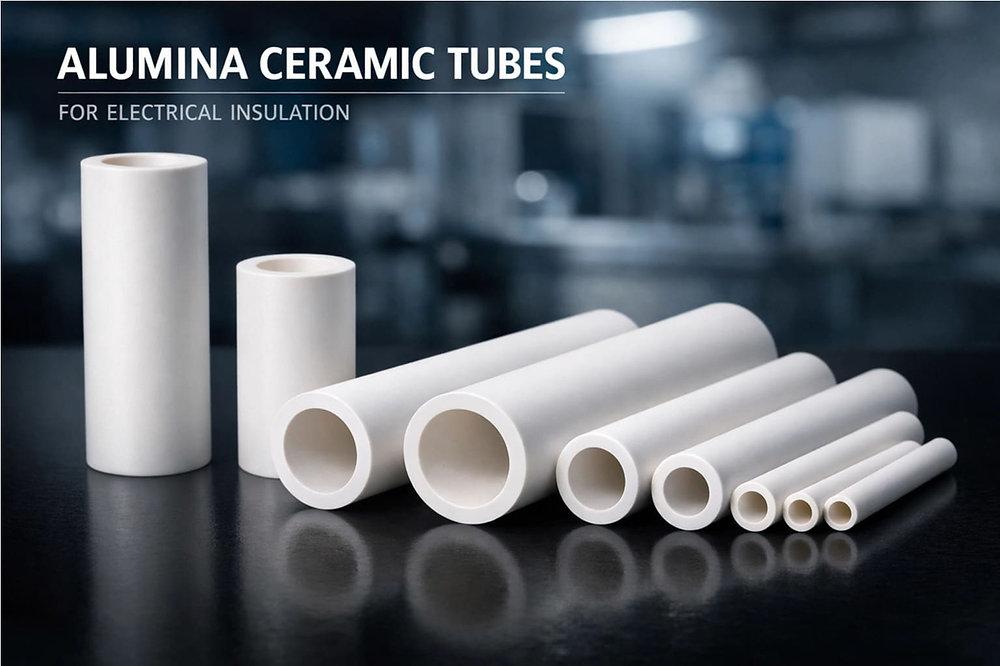
What Are Alumina Ceramic Tubes?
An alumina ceramic tube is a hollow cylindrical component manufactured from aluminum oxide ceramic (Al₂O₃).
Its hollow structure allows other components, such as conductive rods, wires or mechanical elements, to pass through or be positioned within the tube, depending on the application.
Alumina ceramic tubes can be considered for applications requiring:
- Electrical insulation between conductive components
- Thermal stability in elevated-temperature environments
- Hardness and wear resistance
- Dimensional stability
- Resistance to selected chemical environments
The final performance depends on the alumina grade, material formulation, component geometry and operating conditions.
Why Choose Alumina for Ceramic Tubes?
Alumina is one of the most widely used technical ceramic materials. Its combination of electrical, thermal and mechanical characteristics makes it suitable for various insulating and structural applications.
1. Electrical Insulation
One of the main reasons alumina is selected for ceramic tubes is its electrical insulation capability.
When a tube is positioned around a conductive element, it can help electrically isolate that element from surrounding components.
This makes alumina ceramic tubes worth considering for:
- Electrical insulating sleeves
- High-voltage electrical assemblies
- Connector insulation structures
- Industrial electrical equipment
- Insulating supports and protective components
For high-voltage applications, insulation performance must be evaluated together with tube wall thickness, creepage distance, clearance, surface condition and the complete electrical system design.
2. Thermal Stability
Industrial electrical equipment and heating assemblies may operate under elevated temperatures.
Alumina ceramic offers good thermal stability and can maintain its structural characteristics in demanding thermal environments.
When selecting a ceramic tube, engineers should consider the normal operating temperature, maximum temperature, thermal cycling and contact with surrounding materials.
3. Hardness and Wear Resistance
Alumina ceramic has high hardness and good wear resistance compared with many conventional materials.
This can be beneficial when a ceramic tube is exposed to repeated contact, friction or movement involving other components.
However, ceramic materials are brittle compared with ductile metals. Impact, uneven loading and excessive interference during assembly should therefore be avoided.
4. Chemical Stability
Alumina ceramic offers good chemical stability in many industrial environments.
It can be considered for selected applications involving moisture, water and chemical exposure. However, compatibility depends on the specific chemical, concentration, temperature and exposure conditions.
The actual operating environment should be reviewed before finalizing the material specification.
Common Applications of Alumina Ceramic Tubes
Alumina ceramic tubes serve different functions depending on their geometry, material grade and surrounding assembly.
Electrical Insulating Tubes
Electrical insulating tubes can be used to separate conductive components from surrounding metal structures or other electrical elements.
The tube dimensions and insulation requirements should be determined according to the working voltage, assembly design and applicable safety standards.
High-Temperature Industrial Equipment
In selected industrial environments, alumina ceramic tubes can be considered for applications where thermal stability and electrical insulation are important.
Examples may include insulating structures and protective components within industrial equipment.
Electrical Connector Assemblies
Custom ceramic tubes and sleeves may be incorporated into electrical connector structures to provide insulation around conductive elements.
For EV charging connectors and other high-power electrical assemblies, the design must consider the relationship between the ceramic component, conductive terminals, surrounding housing and operating temperature.
Explore our custom alumina ceramic connector components to learn more about ceramic insulating structures for electrical applications.
Key Dimensions to Consider When Designing Alumina Ceramic Tubes
Tube geometry directly affects its function, assembly compatibility and manufacturing feasibility.
When preparing a custom alumina ceramic tube drawing, engineers should clearly define the following dimensions.
1. Outer Diameter (OD)
The outer diameter determines how the ceramic tube fits within its surrounding housing or mounting structure.
It is important to consider the available assembly space, fitting requirements and any required clearance.
2. Inner Diameter (ID)
The inner diameter determines the available opening for wires, conductive rods or other internal components.
Engineers should specify the required clearance and identify whether the inner diameter is a critical functional dimension.
3. Wall Thickness
Wall thickness is an important consideration for both mechanical and electrical requirements.
A thicker wall may provide a different balance of structural support and insulation distance, while a thinner wall may reduce available mechanical strength.
The appropriate thickness depends on the application, material grade, component dimensions and operating conditions.
4. Tube Length
Overall length affects installation space, support conditions and the relationship between the tube and surrounding components.
Longer tubes may also introduce additional manufacturing and dimensional consistency challenges, depending on the forming method and geometry.
5. Concentricity and Straightness
For assemblies where internal and external surfaces must remain aligned, concentricity and straightness may be important functional requirements.
These requirements should be clearly identified in the engineering drawing and evaluated for manufacturing feasibility.
6. End Geometry and Surface Requirements
The ends of a ceramic tube may need to fit against other components or provide a defined contact surface.
Specify whether the ends need to be flat, chamfered or have another defined geometry. Also identify any areas where chips, cracks or surface defects are unacceptable.
How Does Powder Pressing Affect Ceramic Tube Design?
At Zhengqiang, powder pressing is the confirmed forming process for our custom technical ceramic components.
In this process, prepared alumina ceramic powder is placed into a forming die and compacted under pressure to create a shaped green body. The component subsequently undergoes sintering to develop its final ceramic structure.
For hollow cylindrical components such as ceramic tubes, the relationship between the geometry and tooling arrangement is particularly important.
Powder Filling and Distribution
Powder needs to fill the forming die consistently. The tube geometry, wall thickness and forming arrangement can influence powder distribution during filling.
Uneven powder distribution may contribute to variations in the density of the pressed body.
Wall Thickness and Forming Feasibility
Very thin walls, narrow internal openings and large differences in cross-sectional thickness can make a design more challenging to evaluate for powder pressing.
Uniform and practical wall thicknesses should be considered wherever the application allows.
Green Body Handling
After compaction, the formed component is known as a green body. It has its basic shape but has not yet developed the final ceramic structure.
Because the green body is more vulnerable to handling damage, the forming geometry and handling requirements should be considered together.
Sintering and Dimensional Changes
During high-temperature sintering, ceramic particles bond together and the material densifies. This process is generally accompanied by dimensional shrinkage.
Therefore, the final tube dimensions must be considered together with the forming and sintering conditions.
Important: Not every hollow tube geometry is automatically suitable for powder pressing. Long, narrow, thin-wall or complex tubular designs require an individual feasibility review based on dimensions, tooling and material characteristics.
Alumina Ceramic Tube vs. Metal Tube
Alumina ceramic and metal tubes serve different engineering purposes. The right choice depends on whether the application prioritizes electrical insulation, mechanical loading, thermal conditions or other functional requirements.
| Factor | Alumina Ceramic Tube | Metal Tube |
|---|---|---|
| Electrical Properties | Electrical insulating material | Generally electrically conductive |
| Hardness | High hardness | Depends on metal and alloy |
| Wear Resistance | Good wear resistance | Depends on alloy and surface condition |
| Thermal Stability | Good thermal stability | Depends on alloy and operating environment |
| Mechanical Behavior | Hard but brittle | Generally more ductile |
| Typical Function | Electrical insulation and selected structural applications | Structural support and fluid or mechanical transport |
For applications where electrical isolation is essential, alumina ceramic may be a suitable alternative to a conductive metal tube.
For applications involving impact, bending or substantial mechanical loading, the design must account for the brittle nature of ceramic materials.
What Information Is Needed for a Custom Alumina Ceramic Tube?
When requesting a custom ceramic tube, a detailed engineering drawing helps the manufacturer understand the application and evaluate powder-pressing feasibility.
We recommend preparing the following information:
- 2D engineering drawing: Include the overall shape and all critical dimensions.
- 3D model: Provide a 3D file if available to help communicate the component geometry.
- Material: Specify alumina (Al₂O₃) and the required grade if known.
- Outer diameter: Define the required external dimensions.
- Inner diameter: Specify the opening and required clearance.
- Wall thickness: Identify the nominal thickness and any critical variations.
- Overall length: Provide the required tube length.
- Operating conditions: Include voltage, temperature, environment and mechanical loading where applicable.
- Assembly requirements: Explain how the ceramic tube connects with other components.
- Quantity: Provide sample requirements and estimated annual demand.
If some requirements have not yet been finalized, provide the available drawing and application information for an initial engineering review.
Frequently Asked Questions About Alumina Ceramic Tubes
What are alumina ceramic tubes used for?
Alumina ceramic tubes are used in selected electrical insulation and industrial applications. They can help isolate conductive components and provide thermal stability, hardness and dimensional reliability.
Are alumina ceramic tubes electrically insulating?
Yes. Alumina is an electrically insulating ceramic material. The actual insulation performance of a tube depends on the material grade, wall thickness, dimensions, surface condition and operating environment.
Can alumina ceramic tubes withstand high temperatures?
Alumina has good thermal stability and is used in elevated-temperature applications. The suitable operating temperature depends on the material grade, thermal cycling and surrounding assembly conditions.
How do I select the correct alumina ceramic tube dimensions?
Start with the required outer diameter, inner diameter, wall thickness and overall length. Also consider the fitting conditions, insulation requirements and mechanical loading of the complete assembly.
Can alumina ceramic tubes be manufactured by powder pressing?
Powder pressing can be considered for suitable ceramic component geometries. However, the feasibility of a hollow tube depends on its length, diameter, wall thickness, tooling arrangement and material characteristics. A drawing review is necessary before confirming production feasibility.
Are alumina ceramic tubes suitable for high-voltage electrical applications?
They may be considered for high-voltage insulation applications. The final design must be evaluated against the required voltage, creepage distance, clearance, wall thickness and applicable safety standards.
What is the difference between an alumina ceramic tube and a ceramic sleeve?
The terms may overlap in industrial applications. A ceramic tube generally describes a hollow cylindrical component, while a sleeve often refers to a component designed to surround or protect another part. The exact function depends on the component geometry and assembly.
Custom Alumina Ceramic Components for ODM Projects
Zhengqiang focuses on drawing-based ODM development of custom alumina (Al₂O₃) and zirconia (ZrO₂) ceramic components.
Our confirmed ceramic forming process is powder pressing. Each proposed component should be evaluated according to its geometry, material requirements, dimensions and intended application.
For alumina ceramic tubes and other electrical insulating components, customers can provide drawings, samples and application specifications for an initial engineering feasibility review.
Whether you are developing an electrical insulating tube, a ceramic sleeve or another custom structural component, the design should be evaluated around its actual functional requirements.
Explore Our Custom Technical Ceramic Solutions
Learn more about custom alumina ceramic connector components.
Send Your Drawing for an ODM Feasibility Review →