- Information Classification
Ceramic Part Drawing Checklist: 7 Details for an RFQ
A clear ceramic part drawing checklist helps engineers and purchasing teams communicate technical requirements before requesting a quotation for custom ceramic components. For alumina (Al₂O₃) and zirconia (ZrO₂) parts, drawings should clearly identify critical dimensions, tolerances, material requirements and application conditions.
Incomplete drawings can lead to unnecessary clarification, quotation delays or mismatched expectations. Whether you are developing an insulating component, a ceramic ring, a shaft or a precision plate, preparing the right information helps your supplier evaluate the project more efficiently.
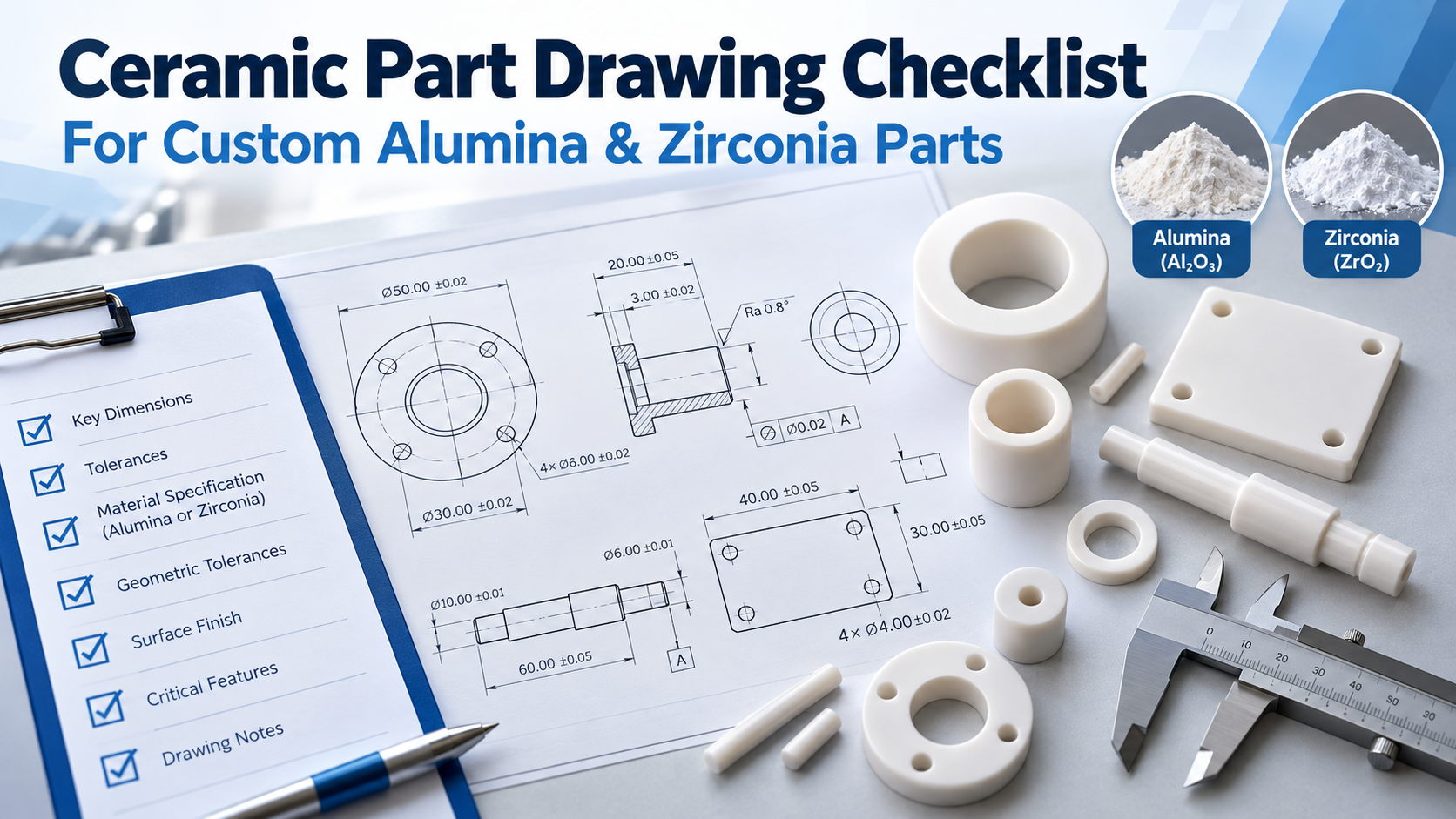
Why Use a Ceramic Part Drawing Checklist?
Technical ceramic components are often designed for specific assembly conditions and operating environments. A drawing needs to communicate not only the overall shape, but also the features that affect fit, function and inspection.
For alumina and zirconia components, the information required depends on the part geometry, intended application and performance requirements. A well-prepared drawing gives the supplier a clearer basis for reviewing material suitability, manufacturing feasibility and quotation requirements.
The following seven items can help you prepare a more complete request for quotation (RFQ).
1. Provide a Complete 2D Drawing or 3D Model
Start with a clear, current engineering drawing. If available, provide a 3D model together with the 2D drawing so that the component geometry and critical dimensions can be reviewed more effectively.
Your drawing should identify:
- Overall length, width and height
- Hole diameters, internal diameters and external diameters
- Wall thickness and other important structural dimensions
- Grooves, slots, steps, chamfers and radii
- Reference datums and important assembly features
- Drawing number, revision and unit of measurement
Check that the dimensions are consistent across different views. If a dimension is essential to assembly or performance, identify it clearly rather than leaving the supplier to infer it from the drawing.
2. Specify the Ceramic Material
Material selection is an important part of custom ceramic component development. Zhengqiang focuses on two ceramic material families: alumina (Al₂O₃) and zirconia (ZrO₂).
Alumina Ceramic (Al₂O₃)
Alumina is commonly selected for applications requiring electrical insulation, hardness, wear resistance and thermal stability. The appropriate grade depends on the required properties and the component’s working environment.
Zirconia Ceramic (ZrO₂)
Zirconia is often considered for precision components requiring a combination of strength, fracture toughness and wear resistance. Its properties vary with composition, stabilizing system and material grade.
When preparing an RFQ, state the required material and any specified grade or property requirements. If you are unsure which material is suitable, provide the application conditions and ask for an engineering review before finalizing the specification.
Explore our custom ceramic components for examples of alumina and zirconia applications.
3. Identify Critical Dimensions and Tolerances
Dimensions describe the intended geometry of a component, while tolerances define the permitted variation. Not every dimension needs the same tolerance, so focus on the features that affect fit, assembly, movement or performance.
Review the following points:
- Nominal dimensions and their permitted deviations
- Hole sizes, shaft diameters and mating dimensions
- Wall thickness and other functionally important dimensions
- Clearance or interference requirements for assembly
- Dimensions that must be inspected during quality verification
Avoid specifying unnecessarily tight tolerances for every feature. Tighter tolerances may increase manufacturing difficulty, inspection requirements and cost. Discuss critical tolerances with the supplier to confirm their feasibility for the selected material and component geometry.
For reference, ISO 129-1 describes general principles for presenting dimensions and associated tolerances in technical product documentation.
4. Define Geometric Requirements and Reference Datums
Some components require more than dimensional tolerances. Depending on the application, geometric requirements may include flatness, parallelism, perpendicularity, concentricity-related requirements or run-out.
These requirements should be specified only when they serve a functional purpose. Reference datums should be clear enough for the supplier and inspection team to understand how the component will be measured.
For example, a ceramic ring that must fit around a mating component may require careful control of its inner diameter, outer diameter and relevant geometric relationships. A plate used in an assembly may require specific flatness or hole-position requirements.
For additional background, consult the official ISO 1101 standard for geometrical tolerancing.
5. Specify Surface Finish and Edge Requirements
Surface finish and edge conditions can affect assembly, friction, sealing, wear and handling. If a particular surface is functionally important, identify it on the drawing and explain its purpose where necessary.
Consider specifying:
- Surface finish requirements for functional contact areas
- Edges that require a defined chamfer or radius
- Areas where sharp edges or chips are unacceptable
- Surfaces that contact seals, shafts or mating components
- Any special appearance or inspection requirements
Do not apply the same finish requirement to every surface unless the application requires it. Clearly distinguishing critical surfaces from non-critical surfaces helps avoid ambiguity during quotation and inspection.
6. Explain the Operating Environment and Functional Requirements
A drawing describes the component, but application information helps the supplier understand why particular material properties and dimensions matter.
Include relevant details such as:
- Operating temperature and temperature changes
- Mechanical loads, contact conditions and rotational speed, where applicable
- Exposure to water, moisture, chemicals or other fluids
- Electrical insulation or dielectric requirements, where applicable
- Assembly method and the materials of mating components
- Expected service conditions and critical performance requirements
For example, an alumina insulating component used in an electrical assembly may have different priorities from a zirconia ring used in a rotating component. Explaining the application helps the supplier evaluate which requirements need particular attention.
7. Confirm Quantity and Quality Requirements
Production quantity and inspection expectations should be included in the RFQ. These details help the supplier understand the scope of the project and prepare a more relevant quotation.
Where applicable, specify:
- Prototype or sample quantity
- Estimated annual demand and expected order volume
- Required delivery schedule
- Critical dimensions that require inspection
- Requested inspection reports or material documentation
- Packaging, identification and traceability requirements
If the project is still at the development stage, indicate which details are confirmed and which remain open for engineering review. This helps avoid treating preliminary requirements as final production specifications.
Ceramic Part Drawing Checklist for RFQ Preparation
Before sending your drawing, use this summary to check whether the essential information is ready.
| Item | Information to Check |
|---|---|
| Drawing | Current 2D drawing or 3D model, drawing number and revision |
| Material | Alumina (Al₂O₃), zirconia (ZrO₂), and required grade if specified |
| Dimensions | Overall dimensions, critical features and measurement units |
| Tolerances | Dimensional tolerances and functional geometric requirements |
| Surface | Important surface finish, edges and contact areas |
| Application | Operating environment, loads, temperature and functional requirements |
| Quantity and quality | Sample quantity, annual demand and inspection documentation |
Request a Custom Alumina or Zirconia Ceramic Evaluation
Preparing a complete ceramic part drawing checklist can make communication more efficient when sourcing custom ceramic components. Clear drawings and application requirements also help identify questions that should be resolved before production begins.
Zhengqiang supports the evaluation of custom alumina and zirconia ceramic components according to customer drawings, material requirements and application conditions. Each project should be reviewed against its specific geometry, tolerances and performance expectations.
You can explore our ceramic component range or review our alumina ceramic housing for EV charging connectors for an example of an application-specific ceramic component.
To request an initial ODM evaluation, prepare your drawing or 3D model, material preference, critical dimensions, operating conditions and estimated quantity. If some specifications have not yet been determined, explain the intended application so the requirements can be reviewed with your supplier.
Frequently Asked Questions
What should be included in a ceramic part drawing?
A ceramic part drawing should normally include the component geometry, dimensions, tolerances, material requirements, relevant surface and edge specifications, drawing revision and any critical functional features.
Should I specify alumina or zirconia in the drawing?
Yes, if the material has already been selected. Specify alumina (Al₂O₃) or zirconia (ZrO₂) and the required grade when known. If you need help selecting a material, provide the application and operating conditions for evaluation.
Do all dimensions need tight tolerances?
No. Tolerances should reflect functional and assembly requirements. Applying unnecessarily tight tolerances to non-critical dimensions may increase manufacturing and inspection costs without improving the component’s intended performance.
Can I request a quotation before the drawing is finalized?
You can provide a preliminary drawing or model for an initial discussion. Clearly identify any unconfirmed dimensions, material requirements or operating conditions so that the quotation and feasibility review can account for the outstanding information.
What information should I send with an RFQ?
Provide the latest drawing or 3D model, material requirements, critical tolerances, application conditions, estimated quantity and any required inspection documentation. More complete information helps the supplier evaluate the project and identify questions early.