Dry Pressing Ceramics: Process, Design Considerations & Drawing Guide
Dry pressing ceramics is a powder-forming process used to create
technical ceramic components by compacting prepared ceramic powder inside a mold.
The pressed part, known as a green body, is then sintered to develop the final
ceramic structure and material properties.
But not every ceramic drawing is equally suitable for dry pressing.
Part geometry, wall-section changes, holes, edges, critical dimensions,
tooling direction and sintering behavior can all affect the production route.
For engineers developing a custom ceramic component, the key question is therefore not only
“Can this part be dry pressed?”
but also
“Is the geometry suitable for stable forming and sintering?”
What Is Dry Pressing in Ceramic Manufacturing?
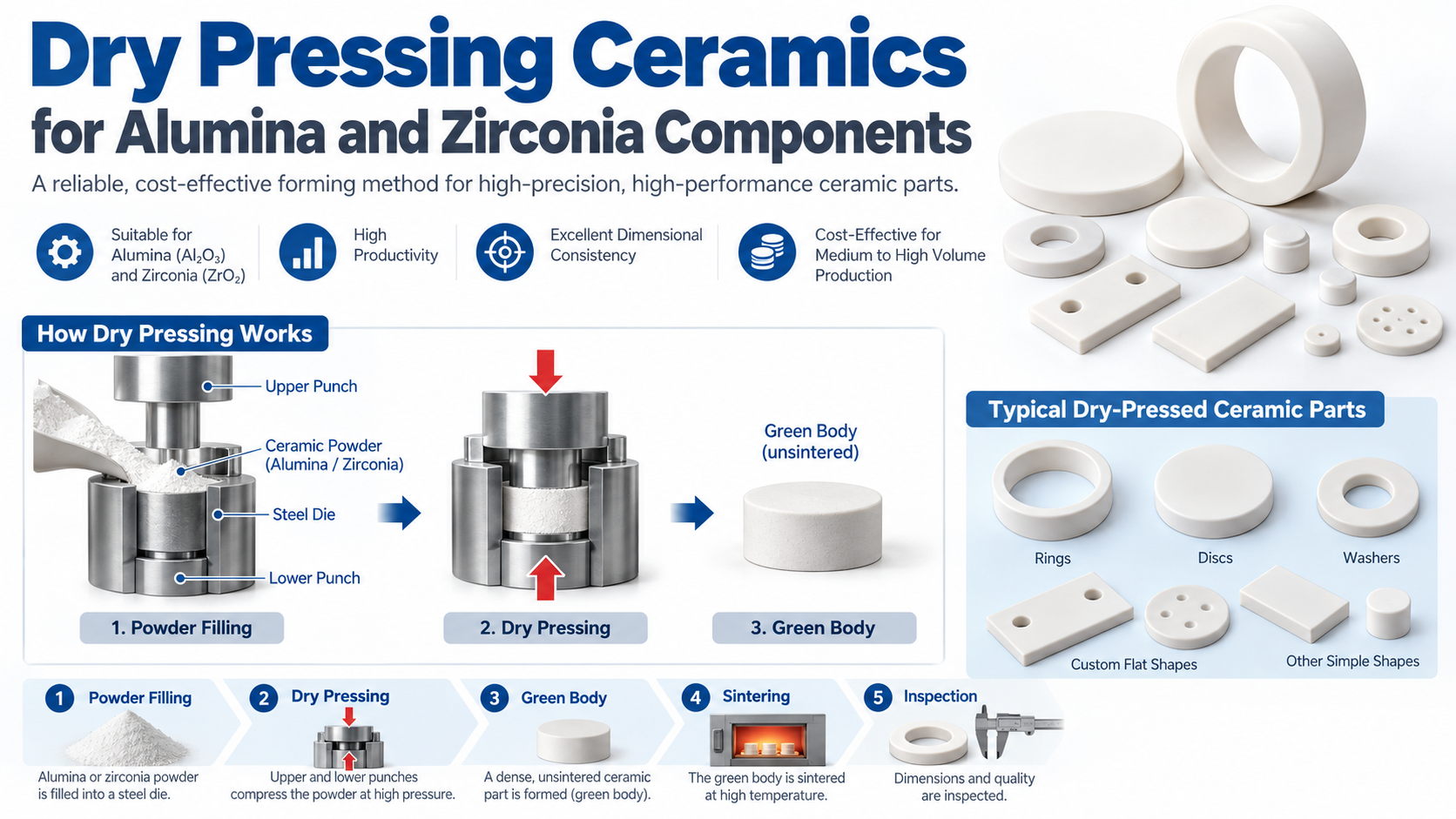
Ceramic dry pressing is a mold-based forming method.
Prepared ceramic powder is placed into a defined cavity and compacted under pressure
until it forms a stable green body.
At this stage, the component already has the basic shape required by the product drawing,
but it has not yet reached its final ceramic condition.
The pressed component must still undergo sintering.
During this high-temperature stage, the ceramic structure develops and the dimensions
of the component change from those of the original green body.
This means dry pressing and sintering should not be treated as two unrelated operations.
Tooling, green-body geometry and final dimensional requirements need to be considered
together from the beginning of the project.
Dry Pressing Ceramics: From Powder to Finished Component
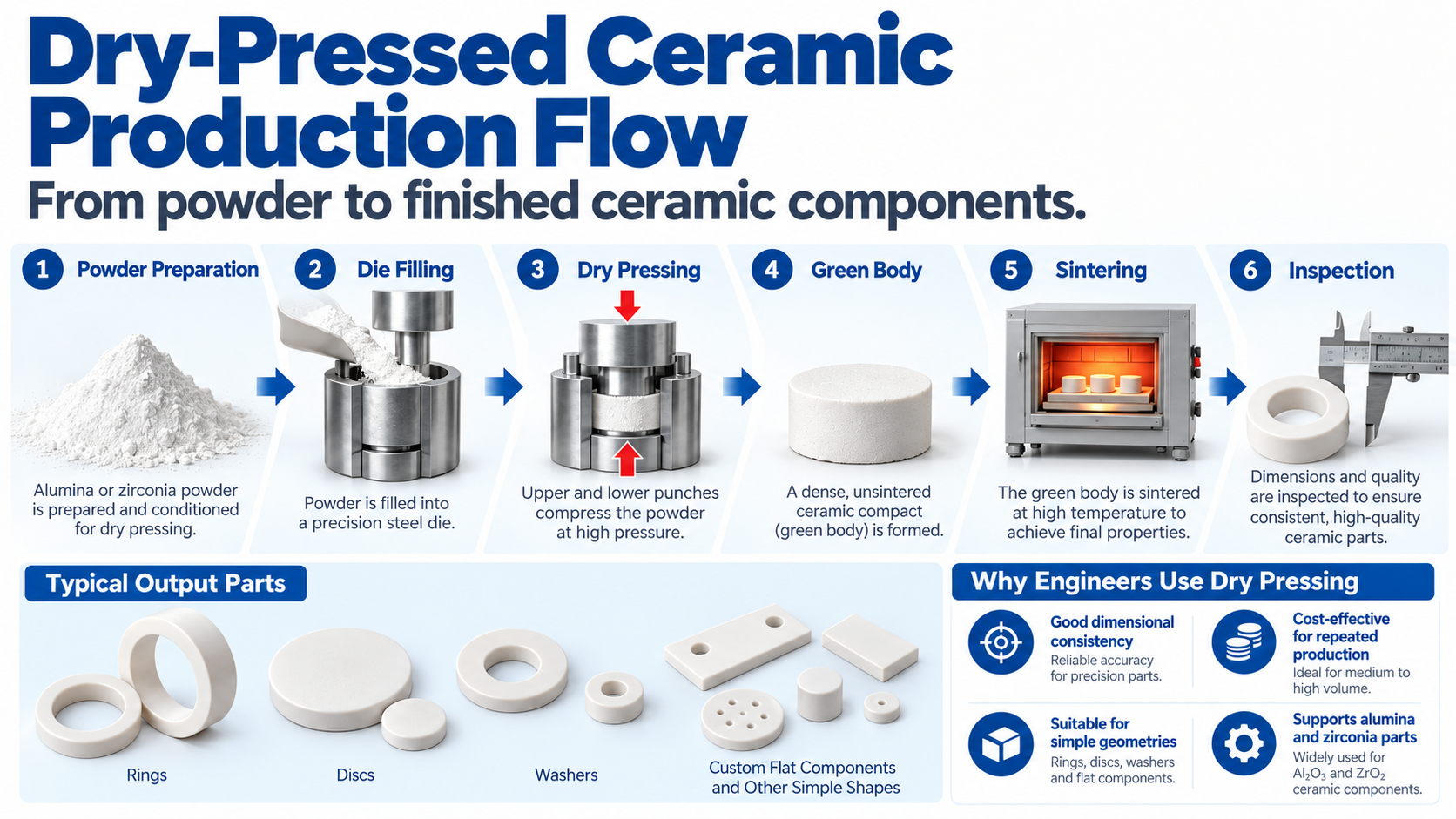
The dry pressing route can be understood as a sequence from ceramic powder preparation
through forming, sintering and final inspection.
| Stage | What Happens | What Engineers Should Consider |
|---|---|---|
| 1. Powder Preparation | Ceramic powder is prepared for stable forming. | Material selection and powder condition must suit the component and application. |
| 2. Powder Dry Pressing | Powder is compacted inside tooling to form the green body. | Geometry, section changes and tooling direction influence forming. |
| 3. Green Body | The pressed part has its basic geometry but is not yet fully sintered. | Green dimensions are not the same as final fired dimensions. |
| 4. Sintering | The ceramic develops its final structure and material characteristics. | Dimensional change during firing must be considered in advance. |
| 5. Inspection | The finished component is checked against agreed requirements. | Critical dimensions and functional features should be clearly identified on the drawing. |
Step 1: Ceramic Powder Preparation
The process begins with ceramic powder appropriate for the selected material
and final application.
Powder condition matters because the material must fill the mold and compact
consistently enough to create a stable green body.
Material selection should therefore be made according to the actual functional
requirements of the ceramic component rather than the forming process alone.
Alumina, for example, is widely used where combinations of electrical insulation,
wear resistance, structural stability and temperature resistance are important.
Zirconia offers a different combination of mechanical properties and is used
for other engineering applications.
The appropriate material and forming route should be confirmed according to
the customer drawing and operating requirements.
Step 2: Ceramic Powder Dry Pressing
During ceramic dry pressing, prepared powder is loaded into
a mold cavity and compacted to create the basic shape of the component.
Because this is a tooling-based process, product geometry has a direct effect
on how the part can be formed.
A simple-looking CAD model may still contain features that need additional review,
such as large changes in wall thickness, deep internal geometry,
difficult release directions or highly localized critical features.
For this reason, tooling should not be considered only after the product design
has been completely frozen.
An earlier drawing review can help identify features that may affect stable pressing.
What Is a Ceramic Green Body?
A green body is the shaped ceramic component after pressing but before final sintering.
It already resembles the intended finished part,
but its physical condition and dimensions are not yet the same as those
of the fully sintered ceramic.
This distinction is important for designers.
A dimension shown on the final product drawing cannot simply be transferred
directly to the green-body tooling without considering what happens during firing.
The entire route from powder compaction through sintering must therefore be considered
when evaluating a custom ceramic component.
Step 3: Sintering After Dry Pressing
After the green body has been formed, the component enters the sintering stage.
During sintering, the compacted ceramic structure develops into the final
technical ceramic material.
The component also undergoes dimensional change.
This is one of the most important differences between ceramic manufacturing
and conventional metal-component production.
Engineers should therefore think about the final part rather than evaluating
only the pressed shape.
Dimensional relationships that are critical to assembly or function should be
identified clearly before tooling and production planning begin.
What Types of Ceramic Parts Are Better Suited to Dry Pressing?
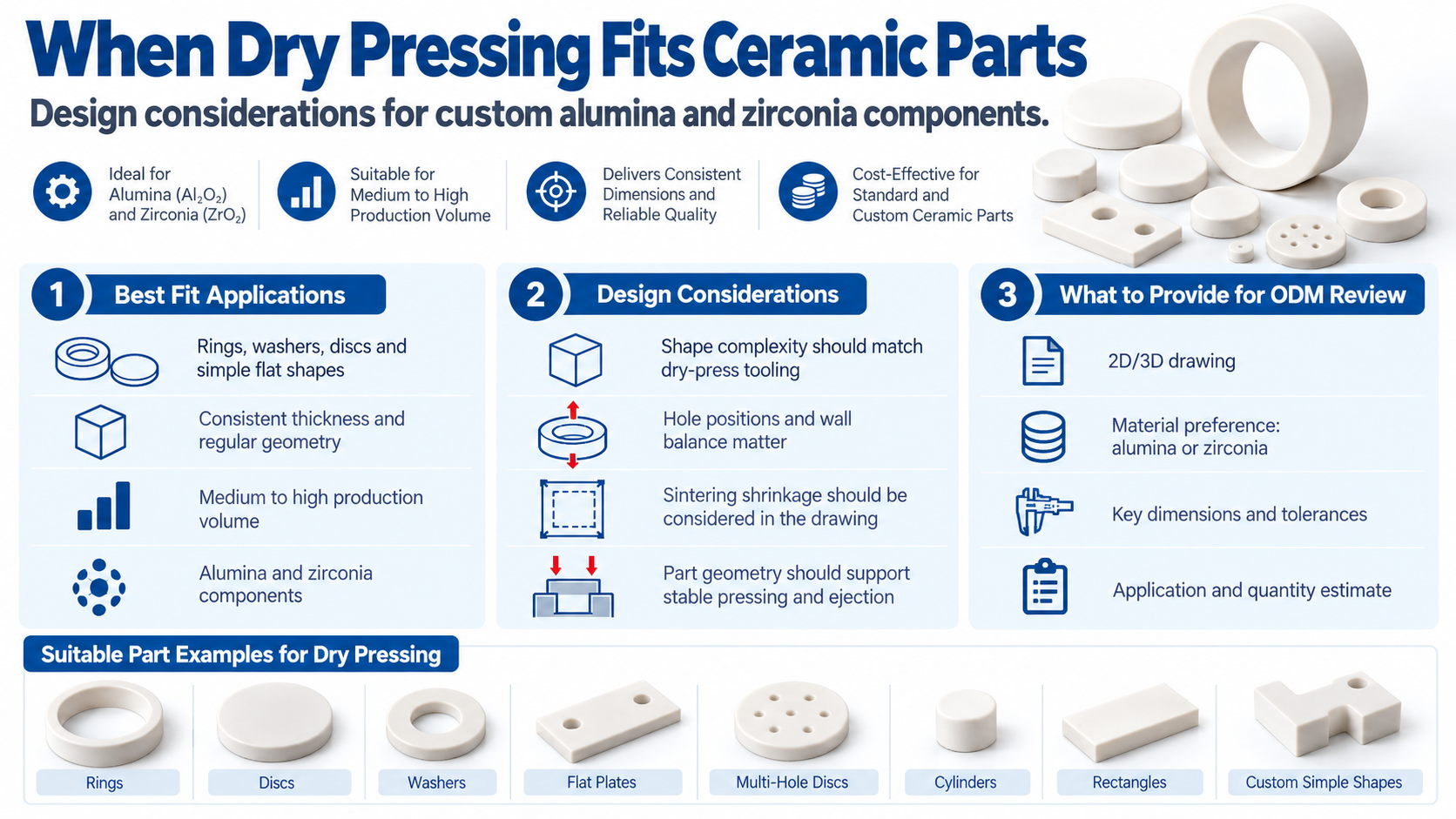
Dry pressing can be an efficient forming method for suitable component geometries,
particularly when a repeatable mold-based production route is appropriate.
However, no single forming method is ideal for every ceramic component.
The following factors should be reviewed before confirming dry pressing:
- Overall component shape
- Wall and section thickness relationships
- Holes and internal features
- Pressing and release direction
- Critical functional dimensions
- Edge and corner geometry
- Material requirement
- Expected production quantity
- Final application and assembly conditions
The decision should therefore be based on the complete drawing rather than
simply the outside dimensions of the part.
Design Features That Matter in Dry Pressing Ceramics
1. Uneven Wall Sections
Large differences between thick and thin sections deserve careful review
because the ceramic powder must fill and compact throughout the complete geometry.
Sudden section changes should therefore be included in the manufacturing review
before tooling is finalized.
2. Holes and Internal Geometry
Holes, cavities and internal features can affect tooling structure,
pressing direction and part release.
If a hole performs an important assembly or functional role,
its relationship to other features should be clearly defined on the drawing.
3. Edges and Corners
Ceramic components should not automatically copy the geometry rules used
for machined metal parts.
Sharp transitions and undefined edge conditions can make production
and handling more difficult.
Critical edge requirements should therefore be identified according to function.
4. Critical Dimensions
One of the most useful things an engineer can do is clearly distinguish
critical dimensions from general dimensions.
Dimensions affecting assembly, alignment, electrical insulation,
sealing or another functional interface deserve particular attention.
Applying unnecessarily strict requirements to every feature can make
a component more difficult to manufacture without improving its function.
Dry Pressing Alumina Ceramic Components
Alumina is one of the most widely used technical ceramic materials
for electrical, structural and wear-related applications.
For component geometries suitable for mold-based forming,
alumina dry pressing can provide a repeatable route
from ceramic powder to a sintered part.
Zhengqiang supplies custom alumina ceramic components for several applications.
Related examples include
alumina ceramic components for EV charging connectors
and
99% alumina ceramic rings for EV water pumps
.
The manufacturing route for an individual component should still be confirmed
according to its drawing and actual application requirements.
Why Tooling Review Matters Before Production
Dry pressing relies on tooling.
That makes early design review particularly important.
If a major geometry change is identified only after tooling preparation,
it can create unnecessary development time and cost.
Before tooling is confirmed, the engineering review should answer questions such as:
- Which dimensions directly affect product function?
- Which surfaces mate with another component?
- Are any holes or internal features difficult to form?
- Are there major changes between thick and thin sections?
- What edge conditions are required?
- What material is specified?
- What operating environment will the part experience?
- What quantity is required for prototype and production?
Drawing Checklist for a Dry-Pressed Ceramic Component
A clear technical drawing makes it easier to evaluate the material,
geometry, tooling and production route.
Information to Include in Your RFQ
- 2D technical drawing
- 3D model, if available
- Required ceramic material or grade, if known
- Overall dimensions
- Clearly marked critical dimensions
- Hole and internal-feature requirements
- Edge, radius or chamfer requirements
- Mating-component information
- Assembly method
- Operating environment
- Electrical, thermal, wear or chemical requirements where relevant
- Prototype quantity
- Expected production quantity
This information allows the ceramic manufacturer to review the component
as an engineering application rather than only as a drawing with dimensions.
Dry Pressing vs the Complete Ceramic Manufacturing Process
Dry pressing is one part of the complete technical ceramic manufacturing route.
Powder preparation, forming, sintering and inspection all contribute
to the finished component.
If you want a broader overview of the entire process,
see our
ceramic manufacturing process guide
.
This article focuses specifically on powder dry pressing,
green-body formation, tooling-related design considerations
and the relationship between pressing and sintering.
Inspection After Sintering
After sintering, the finished ceramic component should be checked
against the approved drawing and agreed project requirements.
Inspection requirements vary according to the product,
but dimensional verification and visual condition are important parts
of evaluating whether the finished component meets the intended design.
Product-specific requirements should be defined during drawing review,
rather than adding unconfirmed acceptance criteria after production begins.
Common Mistakes When Designing Dry-Pressed Ceramic Parts
- Treating ceramic pressing like metal machining:
mold-based ceramic forming has different design and tooling considerations. - Ignoring sintering dimensional change:
the green body is not the final finished component. - Leaving critical dimensions unidentified:
important functional relationships should be clear on the drawing. - Adding complex geometry without a functional reason:
every feature should support a real product requirement. - Changing major geometry after tooling review:
important design decisions should be resolved as early as possible. - Providing dimensions without application information:
operating and assembly conditions help explain why a feature is important.
Frequently Asked Questions About Dry Pressing Ceramics
What is dry pressing in ceramics?
Dry pressing is a ceramic forming process in which prepared ceramic powder
is compacted inside a mold to create an unfired green body.
The pressed component is then sintered to develop its final ceramic structure.
What is ceramic powder compaction?
Ceramic powder compaction means applying pressure to ceramic powder
so that it forms a stable shape before sintering.
Dry pressing is one powder-compaction method used in technical ceramic manufacturing.
Is a dry-pressed ceramic part finished immediately after pressing?
No. The pressed component is still a green body.
It must undergo sintering before reaching its final ceramic condition.
Does a ceramic part change size during sintering?
Yes. Dimensional change occurs during the sintering process,
which is why tooling and final dimensions must be evaluated together.
Is dry pressing suitable for every ceramic component?
No. Suitability depends on material, component geometry,
tooling requirements, functional features and production quantity.
The drawing should be reviewed before the forming route is confirmed.
What materials can be dry pressed?
Technical ceramic materials can be formed through powder compaction
when the material formulation and part geometry are suitable.
The specific material and process route should be confirmed for each project.
What information should I send for a custom ceramic project?
Send the 2D drawing, 3D model if available,
material requirement, critical dimensions,
application conditions, assembly information
and expected prototype and production quantities.
Send Your Drawing for Engineering Review
Zhengqiang supports drawing-based ODM development
for custom technical ceramic components using
powder dry pressing and sintering.
If you are evaluating a custom ceramic component,
send your drawing together with the material requirement,
critical dimensions, application conditions
and expected production quantity.
The component geometry and project requirements can then be reviewed
before tooling and production planning.