Heat Transfer
Verified thermal conductivity of ≥25 W/m·K supports heat transfer through
the ceramic plate toward the pump housing.



A custom ceramic heat dissipation plate designed for installation
between the EV water pump PCB and aluminum pump housing, combining heat transfer,
electrical insulation and thin-profile ceramic construction.
Electronic and EV water pumps integrate compact electrical and mechanical systems
in a limited space. Heat generated by the circuit board must be transferred away
while the PCB remains electrically isolated from the aluminum housing.
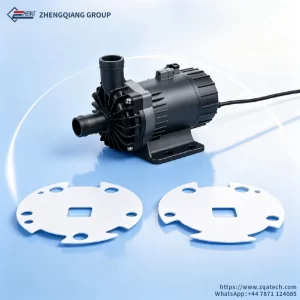
In this application, the alumina ceramic plate sits between the PCB and aluminum
pump housing. Its role is to support heat transfer toward the housing while providing
electrical insulation and a dimensionally controlled mounting interface.
Verified thermal conductivity of ≥25 W/m·K supports heat transfer through
the ceramic plate toward the pump housing.
Volume resistivity of 1014 Ω·cm supports electrical separation
between the circuit board and conductive housing.
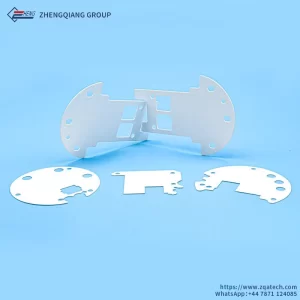
Thin alumina plates can be produced with custom holes, slots and irregular
geometries to match the pump assembly.
| Material | Alumina Ceramic |
|---|---|
| Alumina Content | >96% |
| Bulk Density | ≥3.65 g/cm³ |
| Thermal Conductivity | ≥25 W/m·K |
| Volume Resistivity | 1014 Ω·cm |
| Dimensional Control Accuracy | ±0.5% |
| Flatness Control Accuracy | ±0.3% |
| Processable Thickness | 0.1–1.0 mm |
| Geometry | Custom irregular shapes, holes and complex slots |
| Main Application | EV / NEV electronic water pump PCB and housing interface |
Final geometry, thickness and dimensional requirements should be reviewed against
the customer’s drawing and assembly conditions.

This product is a rigid alumina ceramic plate, not a soft thermal
interface pad. The material combines thermal conductivity with very high electrical
resistivity in a thin structural component.
The ceramic heat dissipation plate is designed as a thin, rigid
alumina component for applications where heat transfer and electrical insulation
are required at the same interface.
The same ceramic component can participate in the thermal path while maintaining
electrical isolation between the PCB and aluminum housing.
The verified processable thickness range is 0.1–1.0 mm, supporting compact
electronic water pump assemblies.
Circular, semi-circular, rectangular and irregular shapes with holes and slots
can be reviewed according to the customer drawing.
Flatness and dimensional control are especially relevant where the plate forms
an interface between the PCB and housing.
Actual thermal performance depends on more than the ceramic material alone.
Contact surfaces, flatness, thickness, mounting pressure and surrounding materials
can all influence the final heat-transfer path.
For this reason, Zhengqiang recommends reviewing the ceramic plate together with
the pump housing and PCB interface instead of selecting the part only from a generic
material specification.
Zhengqiang supports drawing-based ODM development of thin alumina ceramic plates
for EV and electronic water pump applications.
Circular, rectangular and irregular plate geometries can be evaluated
according to the pump layout.
Complex openings, mounting holes and slots can be reviewed based on functional
and manufacturing requirements.
Critical dimensions, thickness, flatness and interface conditions should
be identified before prototype evaluation.
Providing these details helps determine whether the geometry and dimensional
requirements are suitable for prototype development and stable production.
For each custom ceramic heat dissipation plate, thickness,
flatness, hole geometry and mating surfaces should be reviewed against the
actual EV water pump design.
A ceramic heat dissipation plate addresses the electronic and thermal interface
of the pump. Other ceramic components may serve different functions such as
rotating wear interfaces or structural parts.
The current product is designed for installation between the aluminum pump
housing and the PCB or circuit board.
The verified product specification identifies the material as alumina ceramic
with an alumina content above 96%.
The current verified product specification lists thermal conductivity of
≥25 W/m·K.
The verified processable thickness range shown for this product is 0.1–1.0 mm.
Final geometry should still be reviewed against the customer drawing.
Custom irregular geometries and complex holes or slots are supported subject
to engineering and manufacturability review.
Send the drawing or 3D model, target thickness, critical dimensions, flatness
requirement, PCB and housing interface information, operating conditions
and expected quantity.
Send your plate drawing, target thickness, installation interface and operating
requirements for an ODM manufacturability review.